
Dhruvsoft Implementation Methodology
A Phased, Client-Approved Approach to Project Delivery — Across Salesforce, Zoho, and Oracle NetSuite
At Dhruvsoft, we believe that a successful platform implementation is not just about technology — it is about process discipline, transparent communication, and ensuring that every stage of delivery is validated by the people who understand your business best: you. Whether we are implementing Salesforce, Zoho, or Oracle NetSuite, our project management approach can be delivered as a structured, phase-gated methodology or as an Agile, sprint-based engagement — the model is matched to your project’s complexity, timeline, and how your team prefers to work. What doesn’t change, on either model, is the underlying principle: the project does not move forward without your explicit review and approval.
Talk to a Project Manager — Get a Free Consultation
One Methodology, Three Platforms
Dhruvsoft works across three ecosystems: Salesforce, where we are a certified CREST Partner; Zoho, where we hold Advanced Partner status; and Oracle NetSuite, where we deliver implementations through our NSSuccess team as a NetSuite Solution Provider. Regardless of which platform is right for your business, every engagement is delivered through the same disciplined delivery framework described below. The platform changes the tools, technical architecture, and specific configuration work involved — it does not change the process discipline your project receives.
Choosing the Right Delivery Model: Phased or Agile
Not every project calls for the same delivery rhythm. Depending on your requirements, we run engagements through one of two models:
Phased (stage-gated) delivery — the six-phase model detailed below, where each stage produces a defined deliverable and the project only advances once you’ve formally reviewed and approved it. This model suits projects with well-defined, stable requirements, compliance or audit needs that call for a documented sign-off trail at each milestone, or clients who prefer full visibility into the plan before work begins on the next stage.
Agile (sprint-based) delivery — the same underlying requirements-to-support lifecycle, but executed in short iterations with working functionality demoed and reviewed at the end of each sprint rather than only at the end of a phase. This model suits projects where requirements are expected to evolve, where early and frequent hands-on feedback is valuable, or where getting a working version in front of users quickly matters more than a fully locked-down upfront design.
In both models, client review and approval remain built into the process — the difference is the cadence at which that review happens: at defined phase gates, or at the end of every sprint. Which model fits your project is one of the first things we’ll discuss during your discovery conversation.
Our Approach: Phased Delivery with Client Approval at Every Stage
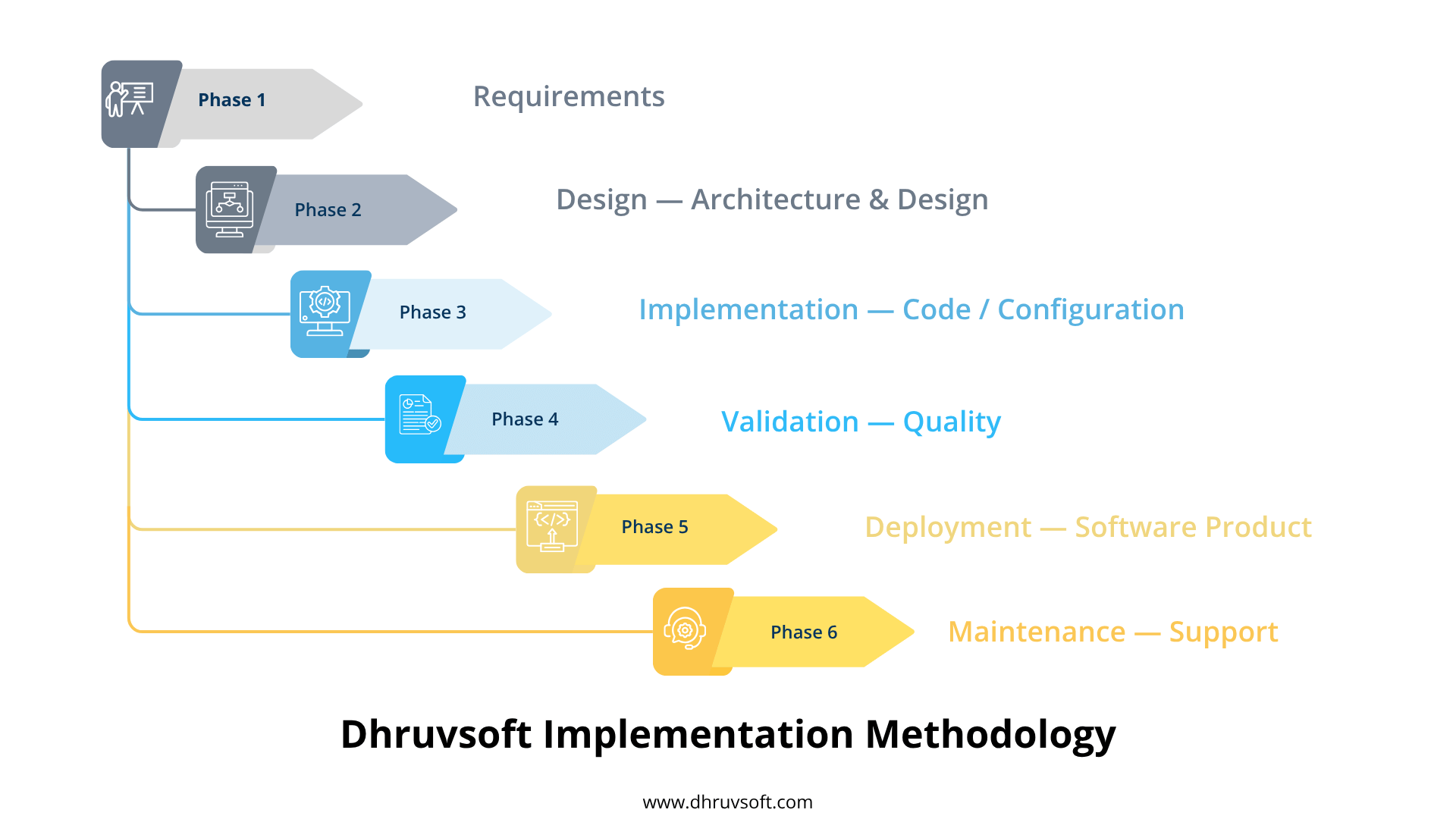
Dhruvsoft’s phased implementation methodology follows a six-phase model, applied consistently whether the engagement is a Salesforce implementation, a Zoho deployment, or a NetSuite rollout. At the end of each phase, we present a defined deliverable to the client. Only after the client reviews, provides feedback, and formally approves that deliverable does the project advance to the next stage.
This approach exists for three important reasons:
- It ensures the project always moves in the right direction — aligned to your actual requirements, not assumptions made weeks or months earlier.
- It eliminates the risk of discovering misalignments late in the project, when rework is costly and timelines are under pressure.
- It creates transparent, documented communication between our project team and your stakeholders — so there are no surprises at go-live, on any platform.
The result is an implementation — Salesforce, Zoho, or NetSuite — where you remain in control at every milestone, and where our team and your team are always operating from the same shared understanding of the project.
The Six Phases of Dhruvsoft’s Implementation Methodology
| Phase | Stage | Client Deliverable | What Happens |
|---|---|---|---|
| Phase 1 | Requirements | Requirements Document | We gather and document your business needs, process flows, user stories, and integration requirements across your chosen platform(s). Client sign-off on the Requirements Document is mandatory before the project moves forward. |
| Phase 2 | Design | Architecture & Design | Our architects design the solution — data model, system architecture, integration design, and UI/UX wireframes. No development begins until the design is approved by the client. |
| Phase 3 | Implementation | Code / Configuration | The development and configuration team builds the solution to the approved design. Code reviews, configuration standards, and version control discipline are enforced throughout this phase. |
| Phase 4 | Validation | Quality | Comprehensive testing is performed — functional testing, integration testing, security validation, and user acceptance testing. The client reviews and approves the tested solution before deployment. |
| Phase 5 | Deployment | Software Product | The approved solution is deployed to the production environment. Dhruvsoft manages the deployment process, environment configuration, data migration, and go-live support. |
| Phase 6 | Maintenance | Support | Post-launch, our support team provides ongoing maintenance, platform update compatibility, performance monitoring, and continuous enhancements as your business evolves. |
Note: Each phase concludes with a formal client review and approval checkpoint. The project does not proceed to the next phase until the deliverable for that phase is signed off — a standard we apply identically across Salesforce, Zoho, and NetSuite engagements. When a project runs on our Agile model instead, this same review discipline applies at the end of each sprint rather than at the end of each phase.
Phase-by-Phase Breakdown
Phase 1: Requirements
Every successful implementation begins with a thorough understanding of what the business actually needs. In this phase, our business analysts and project managers work directly with your stakeholders to capture process flows, user stories, integration requirements, reporting needs, and success criteria — whether the target platform is Salesforce, Zoho, or NetSuite.
The output is a formal Requirements Document — a clear, structured record of what is being built and why. This document forms the foundation for every subsequent decision in the project. Nothing proceeds until this document is reviewed and approved by your team.
What you can expect:
- Structured discovery workshops with your key stakeholders
- Process mapping and gap analysis against standard platform capabilities (Salesforce, Zoho, or NetSuite)
- Documented user stories and functional requirements
- Formal Requirements Document for client review and sign-off
Phase 2: Design — Architecture & Design
With requirements approved, our solution architects translate your business needs into a technical design. On Salesforce, this covers the data model, object relationships, automation design, and Lightning UI approach. On Zoho, it covers module configuration, workflow automation, and cross-application data flow across the Zoho suite. On NetSuite, it covers the ERP data model, subsidiary and role structure, SuiteScript customizations, and financial workflows.
The Architecture and Design document produced in this phase is a detailed blueprint of the solution to be built. It eliminates ambiguity for the delivery team and gives you visibility into exactly how your environment will be structured before configuration or development begins. Client approval at this stage prevents costly redesigns during implementation.
What you can expect:
- Solution architecture and platform-specific data model design
- Integration design for third-party systems and APIs
- Security model, role hierarchy, and sharing or permission architecture
- UI/UX wireframes and page layout planning
- Architecture and Design Document for client review and sign-off
Phase 3: Implementation — Code / Configuration
Development and configuration begin only after the design has been formally approved. Our team builds the solution to the exact specifications defined in the approved architecture. On Salesforce, this means custom objects, Apex logic, Lightning components, automation flows, and integrations. On Zoho, this means module configuration, Deluge scripting, workflow rules, and cross-app integrations across Zoho CRM, Books, Creator, and related products. On NetSuite, this means SuiteScript development, workflow configuration, saved searches, and financial report builds.
On projects delivered through our Agile model, this phase is broken into sprints, with a working increment of the solution demoed to your team at the end of each sprint rather than only at the end of the full build.
Throughout this phase, our team follows structured development standards, conducts peer reviews, and maintains version control discipline. Regular progress updates keep your project stakeholders informed without requiring you to manage the technical details directly.
What you can expect:
- Platform-native development: Apex and Lightning Web Components (Salesforce), Deluge and workflow builder (Zoho), or SuiteScript and SuiteFlow (NetSuite)
- Integration builds using REST/SOAP APIs, MuleSoft, or platform-native connectors
- Peer code review and development standards enforcement
- Version control and build management
- Regular progress reporting to client stakeholders
Phase 4: Validation — Quality
Before any solution reaches your users, it goes through comprehensive testing. Our quality assurance team conducts functional testing against the approved requirements, integration testing across connected systems, security and permission testing, and performance validation under realistic load conditions — regardless of platform.
User Acceptance Testing (UAT) is conducted with your business stakeholders — not just our technical team. This is your opportunity to validate that the solution behaves exactly as specified in the requirements and design phases. Only after UAT sign-off does the project move to deployment.
What you can expect:
- Functional testing against the approved requirements document
- Integration and end-to-end testing across connected systems
- Security and role-based access testing
- Performance and load testing, if required
- Structured User Acceptance Testing (UAT) with client stakeholders
- Formal UAT sign-off before deployment
Phase 5: Deployment — Software Product
With validation complete and client approval confirmed, the solution is deployed to the production environment — a Salesforce org, a Zoho account, or a NetSuite instance. Dhruvsoft manages the full deployment process — environment preparation, data migration, cut-over planning, and go-live support — to ensure a smooth transition with minimal disruption to your business.
Deployment is treated as a structured project event, not a casual push. Every deployment follows a defined cut-over plan with rollback provisions in place, ensuring that your business is protected even in edge-case scenarios.
What you can expect:
- Deployment planning and cut-over schedule
- Production environment configuration and data migration
- Go-live support and hyper-care period
- User training and adoption support or hyper support
- Post-deployment verification and sign-off
Phase 6: Maintenance — Support
An implementation does not end at go-live. Salesforce ships three major releases a year, Zoho continuously rolls out product updates, and NetSuite pushes two major releases annually — while your business processes change and your user base grows. Dhruvsoft’s post-deployment maintenance and support service ensures that your environment remains stable, current, and aligned to your business needs long after launch, on whichever platform you run.
Our support team provides ongoing monitoring, platform update compatibility management, bug resolution, and continuous enhancement services — so your investment keeps delivering value as your business evolves.
What you can expect:
- Release management and platform update compatibility (Salesforce, Zoho, or NetSuite)
- Bug resolution and performance monitoring
- Continuous enhancement and feature development
- User support and training for new team members
- Regular review sessions to align the platform to evolving business needs
Why Dhruvsoft’s Methodology Delivers Better Outcomes
Many platform implementations fail not because of technical problems, but because of process failures — misaligned requirements, undocumented design decisions, insufficient testing, or stakeholders who are surprised by the final product. Dhruvsoft’s methodology, whether run as a phased or Agile engagement, is specifically designed to eliminate these failure modes, on Salesforce, Zoho, or NetSuite alike.
No hidden assumptions: Every requirement is documented and approved before design begins. Every design decision is documented and approved before development begins. At no point does the project rely on undocumented verbal agreements or informal understandings.
Full client visibility: You review and approve every major deliverable — at each phase gate, or at the end of every sprint. You are never presented with a completed system and asked whether it meets requirements you specified months earlier. Problems are caught early — when they are cheap to fix.
Transparent communication: Our project team and your stakeholders operate from the same documented understanding of the project at every stage. Status updates, milestone reviews, and approval checkpoints are built into the process — not treated as optional extras.
Predictable delivery: On phased engagements, requirements and design are locked down before development begins, so scope creep is managed proactively through formal change management. On Agile engagements, scope is expected to evolve, and that evolution happens transparently, sprint by sprint, rather than silently.
Who Benefits from Dhruvsoft’s Implementation Approach
- Businesses implementing Salesforce, Zoho, or NetSuite for the first time who want structured guidance through a complex process
- Organizations that have experienced failed or misaligned implementations in the past and need a more disciplined approach
- Companies with multiple stakeholder groups who need transparent documentation and formal sign-off processes
- Enterprises with compliance, audit, or governance requirements that demand a documented implementation trail
- ISVs and technology companies building Salesforce AppExchange products who need rigorous quality validation before marketplace submission
- Growing businesses evaluating which platform — Salesforce, Zoho, or NetSuite — best fits their operational and budget requirements, and wanting a partner who can implement any of the three with equal rigor
- Teams with evolving or not-yet-fully-defined requirements who want an Agile, iterative path to a working solution rather than a fully locked-down upfront design
About Dhruvsoft
Dhruvsoft is a certified Salesforce CREST Partner, a Zoho Advanced Partner, and an Oracle NetSuite implementation partner, with a track record of successful implementations across the USA, UK, Europe, Australia, India, and Asia. Our team combines deep platform expertise — across Salesforce, Zoho, and NetSuite — with structured project management discipline, delivering implementations that stay on scope, on schedule, and aligned to your business goals, whether run as a phased or Agile engagement.
Our app development team has built and supported numerous Salesforce AppExchange applications and Zoho Creator applications, with products in active use at leading companies across North America, Europe, Australia, and Asia. Whether you are starting a new implementation, extending an existing environment, or building a product for a platform marketplace, Dhruvsoft brings the credentials and the process to deliver it right — on whichever platform, and whichever delivery model, fits your business.
Frequently Asked Questions
Do you follow Agile or Waterfall methodology?
Both — we choose based on your project. For engagements with stable, well-defined requirements or compliance needs that call for a documented sign-off trail, we run our phased, stage-gated six-phase methodology. For projects where requirements are likely to evolve or where you want working functionality in front of users quickly, we run an Agile, sprint-based delivery instead. In both cases, client review and formal approval are built into the process — the difference is whether that happens at phase gates or at the end of each sprint. We’ll recommend the right model for your project during the initial discovery conversation.
What happens if I want to make changes after a phase has been approved?
Changes requested after a phase has been signed off are handled through a formal change management process. The impact on scope, timeline, and cost is assessed and documented, and a change request is raised for client approval before any additional work begins. This applies identically across Salesforce, Zoho, and NetSuite engagements. On Agile engagements, new or changed requirements are simply added to the backlog and prioritized into an upcoming sprint.
How long does each phase typically take?
Phase (or sprint) duration varies depending on the complexity and scope of your implementation and the platform involved. During the initial project scoping conversation, our project manager will provide a timeline estimate based on your specific requirements and the delivery model we recommend.
What does client approval involve at each phase?
At the end of each phase (or, on Agile engagements, each sprint), we present the deliverables — Requirements Document, Architecture Design, tested system, working increment, and so on — in a structured review session. Your stakeholders review the deliverable, provide feedback, and formally confirm approval. This is documented and retained as part of the project record.
Do you provide project management throughout the engagement?
Yes. A dedicated Project Manager from Dhruvsoft is assigned to every implementation engagement, regardless of platform or delivery model. Your Project Manager oversees the delivery process, manages communication between teams, tracks milestones or sprints, and is your primary point of contact throughout the project.
Which platform is right for my business — Salesforce, Zoho, or NetSuite?
It depends on your business size, budget, and functional requirements. Salesforce is typically the strongest fit for complex CRM and sales-process needs at scale. Zoho offers a cost-effective, integrated suite well suited to growing SMBs. NetSuite is purpose-built for businesses that need integrated financial and ERP capability. Our Project Managers can walk you through the trade-offs relevant to your specific situation during a discovery conversation.
Can I speak to a Project Manager before committing to an engagement?
Absolutely. We encourage a discovery conversation with one of our Project Managers before any formal engagement begins. This gives you visibility into our approach, our team’s experience, and how we would handle your specific implementation context — including which delivery model fits best — whatever platform you are considering.
Ready to Talk to a Project Manager?
If you want to understand more about our project management methodology, discuss your Salesforce, Zoho, or NetSuite implementation requirements, or have a Project Manager walk you through whether a phased or Agile approach would work best for your specific situation, get in touch today.
Connect with our team today. A Dhruvsoft Project Manager will reach out to schedule a no-obligation discovery conversation at your convenience. Contact Us — Talk to a Project Manager


