Selling active pharmaceutical ingredients (APIs) is nothing like selling standard B2B products. A single enquiry can involve procurement managers, R&D scientists, quality assurance teams, and regulatory specialists on the customer side, and just as many internal teams on yours. Sales cycles run for months, sometimes years, and every stage demands technical documents, samples, and approvals.
Yet many API manufacturers still run this process on spreadsheets, shared inboxes, and an ERP that was never designed for customer-facing work. The result is missed follow-ups, scattered customer history, and forecasts that rely on guesswork.
Salesforce offers a practical way out. As a Salesforce Crest Partner with 200+ Salesforce projects delivered, Dhruvsoft has seen how a well-designed CRM brings enquiries, samples, technical evaluations, quotations, and contracts into one connected platform. This guide explains how Salesforce supports API manufacturers, which processes to digitize first, how to integrate with your ERP, and which mistakes to avoid.
Why Pharma API Manufacturers Need a Specialized CRM Strategy
An active pharmaceutical ingredient is the component of a medicine that produces its therapeutic effect. API manufacturers supply these ingredients to pharmaceutical companies, CDMOs, distributors, and contract manufacturers across many regulated markets. Each customer segment buys differently, and each country adds its own documentation and compliance expectations.
A generic CRM setup does not fit this reality. API sales are technical, relationship-driven, and slow. Several stakeholders on the buyer’s side, from procurement and R&D to quality, regulatory, and supply chain, must sign off. Customers work to strict specifications, request extensive quality and regulatory documentation, and run evaluations that take weeks or months. Pricing then depends on volume, contract terms, and delivery commitments.
A CRM built only around leads, deals, and quotes cannot capture that depth. A specialized strategy treats the API customer journey as its foundation, capturing product details, customer requirements, sample status, and approvals alongside normal sales activity. It also respects the fact that the ERP remains the system of record for finance and operations, while Salesforce becomes the commercial and customer engagement layer.
Understanding the API Customer Lifecycle
Before configuring a CRM, it is important to understand how an API customer moves from the first enquiry to repeat business. A typical lifecycle includes:
- Lead generation: Leads arrive from industry events, website enquiries, distributor referrals, digital campaigns, and outbound sales.
- Product enquiry: Customers ask about a specific API, grade, quantity, specification, and target market.
- Technical qualification: Sales and technical teams assess the customer’s product and technical requirements.
- Sample request: Samples are prepared, documented, and dispatched for customer testing.
- Customer evaluation: Customers test the API and share feedback or request more information.
- Regulatory and quality review: Quality and regulatory teams review documentation, specifications, certifications, and compliance requirements.
- Commercial negotiation: Teams agree on pricing, volumes, payment terms, and delivery schedules.
- Contracting: Commercial, supply, quality, and legal agreements are finalized.
- Ongoing supply: The relationship continues through orders, deliveries, repeat purchases, support, and account expansion.
Why the API Sales Process Is Complex
- Multiple stakeholders are involved, including procurement, R&D, quality, regulatory, and supply chain teams.
- Customers often have strict technical and product specifications.
- Extensive quality and regulatory documentation may be required.
- Requirements can vary by country and regulatory market.
- Pricing depends on volume, contract terms, and delivery requirements.
- Customer approvals and evaluations can take weeks or months.
- Without a connected CRM, important information can become scattered across emails, spreadsheets, and personal notes.
Common CRM Challenges for Pharma API Manufacturers
Most API manufacturers face a similar set of problems:
- Fragmented customer information: Customer details sit across the ERP, spreadsheets, email, and individual sales records, so no one has a complete picture.
- Limited visibility into product opportunities: It is hard to see enquiries by API, customer, application, or geography.
- Unmanaged technical evaluations: Sample requests, trial status, and customer feedback live in email chains.
- Quality and regulatory coordination gaps: Several internal teams support customer qualification, but documentation requests and approvals are difficult to track.
- Weak forecasting: Long sales cycles, uncertain timelines, and complex pricing make pipeline forecasts unreliable.
These are exactly the areas where Salesforce can deliver measurable value.
How Salesforce CRM Supports Pharma API Manufacturers
Salesforce gives API manufacturers a 360-degree customer view by bringing accounts, contacts, opportunities, product requirements, communication history, and commercial activity into a single record. When a procurement manager calls, your team can see which APIs the company buys, which samples are under evaluation, and what was discussed last month.
It also becomes a shared workspace. API sales rarely depend on the sales team alone, so business development, technical, quality, regulatory, customer service, and finance teams can all work from the same customer record. That cuts email hand-offs and speeds up responses to customers.
Managing the API Sales Lifecycle in Salesforce
- Lead and enquiry management: Capture enquiries from website forms, conferences, distributor referrals, existing customers, and campaigns, then route each one by territory, API category, or customer segment.
- Structured product enquiries: Record the API name, grade, required quantity, target market, application, and expected timeline for every enquiry, so reporting stays reliable.
- Sample management: Track sample requests, dispatch, evaluation status, feedback, and follow-ups. Samples are often the turning point in a deal and the easiest step to lose in email.
- Technical qualification: Log customer requirements, technical documentation, evaluation milestones, and internal approvals so every team knows where a customer stands.
- Commercial negotiation: Manage pricing, minimum order quantities, volumes, contract terms, and delivery requirements within the opportunity, with approval workflows for discounts and exceptions.
- Opportunity closure: Capture won and lost outcomes, loss reasons, and competitor information. Over time, this data shows why you win and lose business.
Managing API Products and Customer Requirements
Portfolio Management
An API manufacturer may manage many molecules, grades, and product categories. Salesforce organizes this portfolio so sales teams can quickly match APIs to customer requirements. Product records can hold specifications, manufacturing capabilities, capacity, and target markets, which also helps management see where demand is growing.
Customer-Specific Requirements
API customers often have specific quality, packaging, regulatory, documentation, and testing requirements. Salesforce captures these and makes them visible to sales, technical, quality, and regulatory teams, creating one clear record from the first enquiry through sampling, approval, and supply.
Market and Geography Tracking
API manufacturers serve customers across many countries and regulatory markets. Tracking opportunities by country, market, segment, and territory helps sales managers spot high-potential regions and build targeted strategies.
Choosing the Right Salesforce Capabilities
Sales Cloud covers the core of enquiry, opportunity, and account management. Two other Salesforce products are worth evaluating for API manufacturers. Manufacturing Cloud’s sales agreements and account-based forecasting suit long-term, volume-based supply contracts, giving teams a view of committed versus actual volumes. Revenue Cloud (including CPQ) handles complex, volume-tiered pricing and quote approvals. The right mix depends on your sales model, so it should be decided during discovery rather than assumed upfront.
Connecting Salesforce With ERP and Pharma Business Systems
Salesforce manages customer-facing work such as leads, enquiries, opportunities, and interactions, while the ERP manages financial and operational transactions. Integrating the two gives sales, finance, supply chain, and operations teams one consistent view of each customer, without switching between systems.
Typical data exchanged includes customer records, product information, pricing, and inventory availability, plus visibility into orders, shipments, invoices, and payment status. This can be done through integration platforms such as MuleSoft or Celigo, middleware, or custom integration APIs.
The benefits are practical. Duplicate data entry disappears, sales teams answer customer questions about orders and availability faster, and commercial and operations teams plan from the same pipeline. Because Dhruvsoft also runs an established Oracle NetSuite practice, we can design and deliver both sides of a Salesforce–NetSuite integration under one team, which removes a common source of hand-off delays and data-ownership disputes.
Salesforce Automation for API Sales Teams
- Lead Assignment: Salesforce automatically assigns leads based on territory, geography, API/product category, or customer segment. This ensures enquiries reach the right salesperson quickly and reduces missed opportunities.
- Follow-Up Automation: Salesforce can automate reminders for enquiries, sample requests, technical evaluations, and proposals. This helps sales teams maintain consistent follow-ups throughout long API sales cycles.
- Approval Workflows: Salesforce can route discount, special pricing, contract, and commercial exception requests to the appropriate approvers. This speeds up decision-making and improves approval visibility.
- Task and Activity Automation: Salesforce can automatically create tasks for calls, meetings, emails, and follow-ups based on opportunity stages. Teams can easily track pending activities and avoid missed customer interactions.
Salesforce Analytics for Pharma API Manufacturers
Dashboards and reports turn CRM data into clear business decisions:
- Pipeline visibility: View opportunities by API, customer, region, and salesperson to spot high-value deals and those that need attention.
- Sales forecasting: Track expected revenue and opportunity probability by product and geography.
- Customer analytics: Analyze revenue, purchases, and engagement to identify key accounts and growth potential.
- Commercial performance: Measure lead-to-opportunity conversion, sample-to-order conversion, win rate, and sales cycle duration. Sample-to-order conversion is especially useful, because it shows whether technical evaluations are turning customer interest into revenue.
Key Account Management for Pharma Customers
- Managing Multiple Stakeholders: Pharma customers often have multiple stakeholders involved in the buying process, including procurement, R&D, quality, regulatory, supply chain, and senior management. Salesforce helps sales teams track each stakeholder and their role in the account.
- Strategic Account Planning: Sales teams can create account plans based on customer objectives, revenue targets, current products, and future expansion opportunities. This helps manufacturers focus on long-term customer growth rather than individual orders.
- Customer Relationship History: Salesforce can maintain a complete history of customer meetings, emails, enquiries, proposals, samples, and commercial discussions. Sales teams can quickly understand previous interactions and continue conversations with better context.
- Account Expansion: Manufacturers can identify opportunities to introduce new APIs, enter new markets, and expand relationships across different customer locations or divisions. This helps increase product penetration and grow the overall value of strategic accounts.
AI and Agentforce for Pharma API Sales
AI is becoming a practical part of Salesforce for life sciences. For API sales teams, useful applications include:
- AI-generated summaries of accounts, opportunities, and interactions, with recommended next actions
- Predictive insights that flag stalled opportunities, pipeline risks, and high-value deals
- Personalized customer communications and follow-up recommendations
- Agentforce, Salesforce’s AI agent platform, for handling routine customer enquiries and supporting internal workflows within defined permissions and governance
The key is to introduce AI gradually. Start with summaries and insights, measure the value, and expand once data quality and governance are in place. AI is only as reliable as the data behind it.
Data Security, Compliance, and Governance
Pharma customers expect strong control over their information. A well-designed Salesforce implementation includes:
- Role-based access for sales, business development, management, quality, regulatory, and executive users
- Data governance through standardized records, clear product data ownership, and data quality rules
- Auditability through field history tracking, activity records, and approval history. Where longer retention or broader field coverage is needed, Salesforce Shield adds Field Audit Trail, platform encryption, and event monitoring.
- Integration security with secure integration APIs, authentication, controlled data exchange, and least-privilege access
It is also important to position Salesforce correctly. It is a CRM and commercial engagement platform. Regulated quality, manufacturing, laboratory, and regulatory systems should remain the authoritative source for specialized records where required.
Salesforce CRM Architecture for API Manufacturers
Most of the solution can be built on standard Salesforce objects such as accounts, contacts, leads, opportunities, products, and activities. Where the business needs more detail, custom objects can represent API enquiries, sample requests, technical evaluations, customer requirements, regulatory documentation requests, and product qualifications.
Enterprise integrations typically connect the ERP, quality management systems, regulatory systems, marketing automation, email and calendar, and analytics platforms. Keep customization focused: use standard features first and add custom objects only where the process truly requires them.
Salesforce Use Cases for API Manufacturers
| Business Area | Salesforce Use Case | Potential Business Benefit |
|---|---|---|
| Lead Management | Capture and route API enquiries | Faster response |
| Opportunity Management | Track technical and commercial stages | Better pipeline visibility |
| Sample Management | Track requests and evaluation status | Fewer missed follow-ups |
| Product Management | Map APIs to customer requirements | Better product discovery |
| Account Management | Centralize customer relationships | Stronger engagement |
| ERP Integration | Connect commercial and operational information | Better decision-making |
| Sales Forecasting | Pipeline and revenue dashboards | Improved predictability |
| Key Account Management | Track stakeholders and growth plans | Stronger retention |
| Automation | Automate repetitive activities | Higher productivity |
| AI | Provide summaries and recommendations | Faster decision-making |
Illustrative Scenario: Salesforce for a Mid-Sized API Manufacturer
Consider a mid-sized API manufacturer whose sales team tracks enquiries in spreadsheets. Samples and technical evaluations are managed through email, customer data sits across several systems, and leadership cannot see the pipeline by API or geography. Forecasting orders is difficult.
A Salesforce approach would centralize accounts and contacts, standardize API enquiries and opportunity stages, track samples and technical evaluations, automate follow-up tasks, integrate with the ERP, and give executives sales dashboards.
The outcomes such an implementation targets include better visibility into API opportunities, faster follow-up on samples, improved forecasting, less manual administration, and stronger strategic account management. Results vary by organization.
Salesforce Implementation Roadmap
A structured roadmap reduces risk:
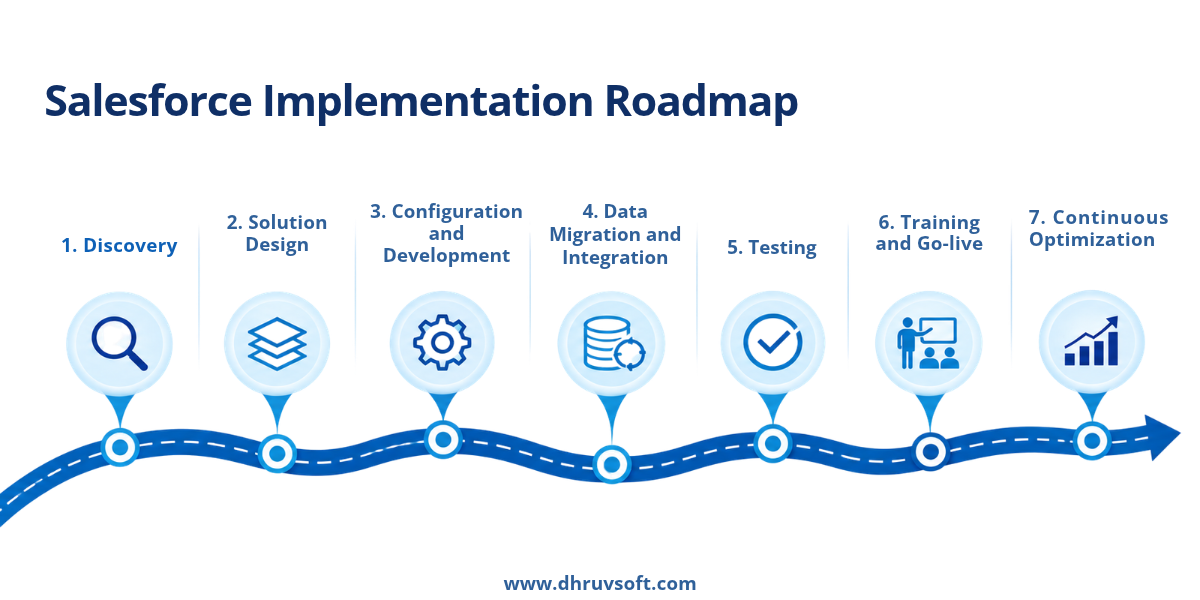
- Discovery: Map the API sales lifecycle, identify stakeholders, document existing systems, and define KPIs.
- Solution design: Define the data model, opportunity stages, security model, and integration architecture.
- Configuration and development: Build CRM configuration, automation, custom objects where needed, and dashboards.
- Data migration and integration: Clean legacy data, migrate accounts, contacts, leads, and opportunities, and connect the ERP and other systems.
- Testing: Run functional, integration, data validation, and user acceptance testing.
- Training and go-live: Deliver role-based training, documentation, deployment, and hypercare support.
- Continuous optimization: Improve processes, automation, analytics, and AI adoption through managed Salesforce services.
Common Salesforce CRM Mistakes to Avoid
- Treating API sales like simple transactional sales
- Failing to capture technical and customer requirements
- Managing samples outside the CRM
- Ignoring regulatory and quality stakeholders
- Duplicating ERP functionality inside Salesforce
- Over-customizing the CRM
- Building integrations without defining data ownership
- Introducing AI without controls and governance
Best Practices for Salesforce in Pharma API Manufacturing
- Design around the complete API customer lifecycle
- Standardize enquiry and opportunity stages
- Track samples and evaluations systematically
- Maintain a structured API product catalog
- Integrate with ERP and specialized systems strategically, with clear data ownership
- Build dashboards for sales and executive teams
- Automate repetitive follow-ups
- Adopt AI gradually, based on measurable value
Final Thoughts
Pharma API sales demand visibility across customers, products, enquiries, samples, technical evaluations, and commercial negotiations. Salesforce can centralize these customer-facing processes while integrating with the ERP and specialized pharmaceutical systems. Automation and analytics reduce manual work and sharpen pipeline visibility, and AI adds further value when deployed with proper governance. Done well, the result is stronger customer relationships, more reliable forecasts, and clearer sight of new growth opportunities.
Frequently Asked Questions
How can Salesforce help pharma API manufacturers?
Salesforce centralizes enquiries, samples, technical evaluations, quotations, and customer history in one platform, giving teams better pipeline visibility, faster follow-ups, and more reliable forecasts.
Can Salesforce track API samples and technical evaluations?
Yes. Custom objects and workflows can record sample requests, dispatch, evaluation status, and customer feedback, with automated reminders so follow-ups are not missed.
Can Salesforce integrate with SAP or Oracle NetSuite?
Yes. Salesforce connects to SAP, Oracle NetSuite, and other ERPs through integration platforms such as MuleSoft or Celigo, or through custom integration APIs. Dhruvsoft has an established NetSuite practice alongside its Salesforce practice, so both sides of a Salesforce–NetSuite integration can be delivered by one team.
How can Salesforce improve pharma sales forecasting?
Pipeline stages, opportunity probability, and dashboards by API, region, and customer give leaders a clearer, data-backed view of expected revenue. For volume-based supply contracts, Manufacturing Cloud adds account-based forecasting.
Can Salesforce support key account management?
Yes. Teams can map stakeholders across procurement, R&D, quality, and regulatory, record every interaction, and plan account expansion in one place.
Can Salesforce connect with quality or regulatory systems?
Yes, where needed. Those regulated systems should typically remain the authoritative source for specialized quality and regulatory records.
How can AI improve API sales and customer service?
AI can summarize accounts and interactions, flag stalled opportunities, recommend next actions, and support routine enquiries, provided it runs under clear governance.
Is Salesforce suitable for mid-sized API manufacturers?
Yes. A phased implementation lets mid-sized manufacturers start with core enquiry, sample, and opportunity tracking, then add integrations and AI as they grow.
Ready to Modernize CRM for Your API Business?
Dhruvsoft helps pharmaceutical and life sciences organizations design, implement, integrate, migrate, and optimize Salesforce to improve customer visibility, streamline complex sales processes, and support commercial growth. Connect with our Salesforce experts to discuss your CRM strategy.
About Dhruvsoft
Dhruvsoft is a Salesforce Crest Partner and AppExchange Partner with more than 15 years in business, 200+ Salesforce projects delivered, 50+ certified consultants, and 100+ clients across seven industries. Our ISO 9001 and ISO 27001 certifications reflect the quality and information security standards that regulated industries such as pharma expect.
For API manufacturers, we bring an industry-aware CRM strategy built around complex pharmaceutical B2B sales, backed by end-to-end delivery. That covers Salesforce implementation, configuration, and automation; ERP integration, including Oracle NetSuite through our in-house NetSuite practice; data migration with cleansing, mapping, and validation; AI and Agentforce adoption; and managed services for ongoing administration, enhancements, and optimization.
 About Ramu Chiluka


