
Revenue growth isn’t just about generating leads — it’s about converting them consistently and at scale. Yet most sales organizations lose significant revenue not due to poor products or wrong markets but from invisible pipeline leakage: deals that quietly die from lack of follow-up, get stuck in the wrong stage, or are forecasted inaccurately because reps are tracking opportunities outside the CRM.
Structured opportunity management in Salesforce closes this gap. It replaces gut-feel selling with a repeatable system — where every deal has a clear owner, a stage-appropriate action plan, and enough visibility for leadership to coach and intervene before it’s too late.
Why Opportunity Management Matters
Sales teams that lack structured opportunity management face a common set of problems: stalled deals with no clear next step, pipeline reviews that feel like guesswork, and forecast calls where managers spend more time challenging numbers than coaching reps.
Salesforce addresses these challenges by giving teams a shared, real-time view of every deal — from initial lead qualification to final close. When configured and adopted properly, it transforms the CRM from a reporting tool into an active revenue management system.
Understanding Revenue Leakage in Sales Pipelines
What Is Pipeline Leakage?
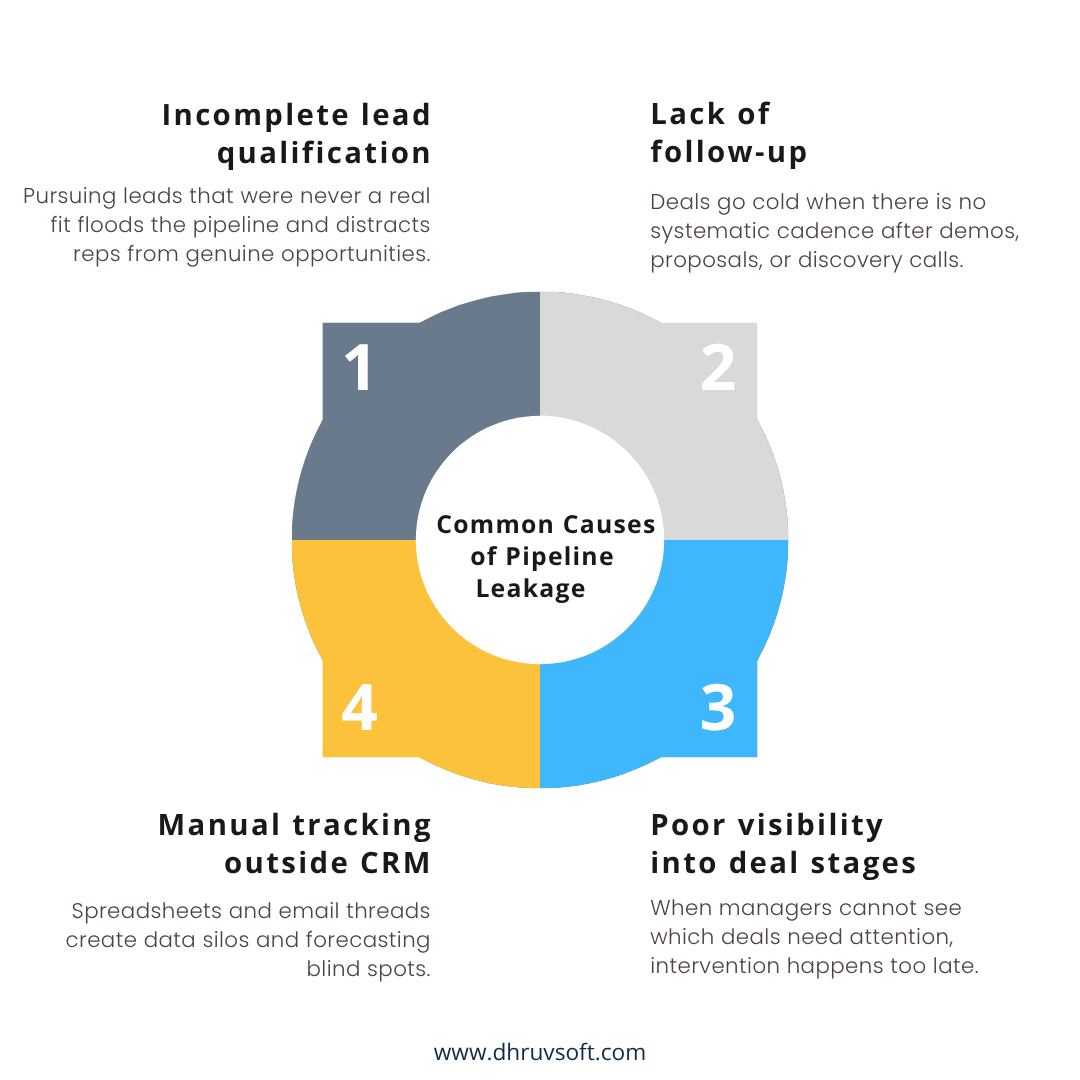
Pipeline leakage refers to opportunities that enter your sales funnel but never convert — not because the deal was unwinnable, but because your process failed to carry it forward. It is a silent tax on your revenue that compounds over time.
Common Causes of Leakage
- Incomplete lead qualification — Pursuing leads that were never a real fit floods the pipeline and distracts reps from genuine opportunities.
- Lack of follow-up — Deals go cold when there is no systematic cadence after demos, proposals, or discovery calls.
- Poor visibility into deal stages — When managers cannot see which deals need attention, intervention happens too late.
- Manual tracking outside CRM — Spreadsheets and email threads create data silos and forecasting blind spots.
The business impact is concrete: missed revenue targets, forecast inaccuracies that mislead leadership, and longer sales cycles that erode competitive positioning. All of these are rooted in fixable process failures.
Building a Strong Lead-to-Opportunity Process
Standardizing Lead Qualification
Define explicit MQL (Marketing Qualified Lead) and SQL (Sales Qualified Lead) criteria so every rep qualifies consistently, not instinctively. Adopt proven frameworks such as BANT (Budget, Authority, Need, Timeline) or MEDDIC (Metrics, Economic Buyer, Decision Criteria, Decision Process, Identify Pain, Champion) to bring rigor to early-stage qualification.
Automating Lead Assignment
Territory- and product-based routing reduces response time from hours to minutes. First-response speed is one of the strongest predictors of win rate — automated assignment ensures no lead sits uncontacted because of ambiguous ownership.
Ensuring Seamless Lead Conversion
Capture complete customer context at the moment of conversion. Validation rules and required fields prevent the two most common conversion failures: duplicate records and data gaps that stall early-stage deals before they ever get a fair look.
Structuring Opportunity Stages Effectively
Define Clear Sales Stages
A well-structured pipeline typically includes: Qualification, Discovery, Proposal, Negotiation, and Closed-Won or Closed-Lost. Avoid more than seven or eight stages — excess stages create friction and inconsistent adoption across the team.
Establish Exit Criteria for Each Stage
Exit criteria matter more than stage names. Each stage should have documented, objective conditions that must be met before a deal advances. “Customer confirmed budget and timeline” is an exit criterion. “Feels ready” is not. Without this discipline, reps move deals forward based on optimism rather than evidence — producing forecasts that consistently disappoint.
Standardize Opportunity Data
Require the same set of fields at each stage: deal value, close date, named decision-makers, and competitor intelligence. This data feeds your forecasts and your coaching conversations. Incomplete records are not just an administrative inconvenience — they are a revenue risk.
Improving Pipeline Visibility with Salesforce
Real-Time Opportunity Dashboards
A deal your manager cannot see is a deal at risk. Real-time dashboards transform the pipeline from a rep-level list into an organizational asset. Build views for pipeline by stage, forecast visibility, and stalled opportunities. These become the foundation of your weekly pipeline review.
Sales Forecasting Best Practices
Separate commit from upside. Commit deals are high-confidence and expected to close within the period. Upside deals are speculative. Showing both — and holding reps accountable to their commit numbers — shifts forecasting from a political exercise to a useful planning tool.
Identifying Risk Early
Flag deals with no activity in the past N days. Low engagement, aging close dates, and missing next steps are early warning signs of lost deals. The sooner a manager can engage, the more likely a rescue is possible.
Automating Opportunity Management
Workflow Automation
The best sales process is one reps actually follow — and reps follow processes that do not slow them down. Automate follow-up reminders when deals go dark, route discount approvals and contract reviews to the right stakeholders automatically, and escalate stalled deals above a revenue threshold to management before the close date passes.
AI and Predictive Insights
Einstein Opportunity Scoring and similar AI tools rank deals by win probability, surfacing which opportunities deserve more attention and which are unlikely to close regardless of effort. This allows reps and managers to prioritize the right deals at the right time.
Activity Tracking Automation
Emails, calls, and meetings should log automatically against the relevant opportunity record. When activity capture is manual, it becomes selective — and selective data produces unreliable forecasts and coaching blind spots.
Strengthening Sales Discipline and Accountability
Mandatory fields and validation rules enforce data completeness at the point of entry, not after the fact. Sales cadence standards define the expected follow-up process at each stage, reducing the variability between top performers and everyone else. And pipeline dashboards give managers the visibility they need to coach based on data — not anecdotes.
Accountability is not about surveillance. It is about giving every rep the information and support they need to execute consistently — and giving leadership the visibility to identify where the process is working and where it is not.
Aligning Sales, Marketing, and Customer Success
Marketing Contribution Visibility
Campaign influence attribution shows which marketing programs are generating revenue — not just leads. This closes the loop between marketing spend and closed-won deals, allowing teams to align budget to what actually converts.
Hand off to Customer Success
Revenue leakage does not stop at Closed-Won. A poor onboarding experience turns a hard-won customer into churn within the first year. Structured hand-offs — with complete deal context transferred to the Customer Success team — reduce time-to-value and improve retention.
Shared Revenue Accountability
When Sales, Marketing, and Customer Success share a single view of the customer journey — from first campaign touch to renewal — the organization stops optimizing for hand-off metrics and starts optimizing for revenue outcomes.
Reducing Opportunity Leakage
- Monitor stalled deals — Set automated alerts for opportunities with no activity beyond a defined threshold. Inactivity is the most reliable leading indicator of a lost deal.
- Improve follow-up consistency — Automated reminders and sequences reduce the dependence on individual rep discipline. The process should catch what people miss.
- Track lost opportunity reasons — Every Closed-Lost record should capture why the deal was lost: price, timing, competitor, or no decision. This data drives competitive analysis and process improvement over time.
Measuring Opportunity Management Performance
Track these five metrics consistently to measure the health of your opportunity management process:
- Win rate —The proportion of qualified opportunities that result in closures, measured by representative, team, segment, and product line.
- Sales cycle length — Calculate the typical number of days between opportunity inception and closure. Pinpoint stages where deals frequently get stuck.
- Pipeline velocity — (Number of deals × average deal size × win rate) ÷ sales cycle length. A single number for pipeline health.
- Forecast accuracy — How close were committed deals to actual closed-won? Target ±10% variance from commit to close.
- Stage conversion rates — Where in the funnel are you losing the most opportunities? That is where process investment pays off fastest.
Common Mistakes to Avoid
- Over-complicated stages — More than seven or eight stages create friction and inconsistent adoption. Keep it simple enough that every rep knows the flow by memory.
- Poor CRM adoption — The most sophisticated Salesforce configuration is worthless if reps log deals in spreadsheets. Adoption is a leadership problem, not a training problem.
- Lack of data quality controls — Without validation rules and mandatory fields, data quality degrades over time, and forecasts become unreliable.
- Forecasting based on intuition — When managers override CRM data with gut feel consistently, the CRM loses credibility, and reps stop using it. Trust the data, then invest in improving the data.
Seven Best Practices
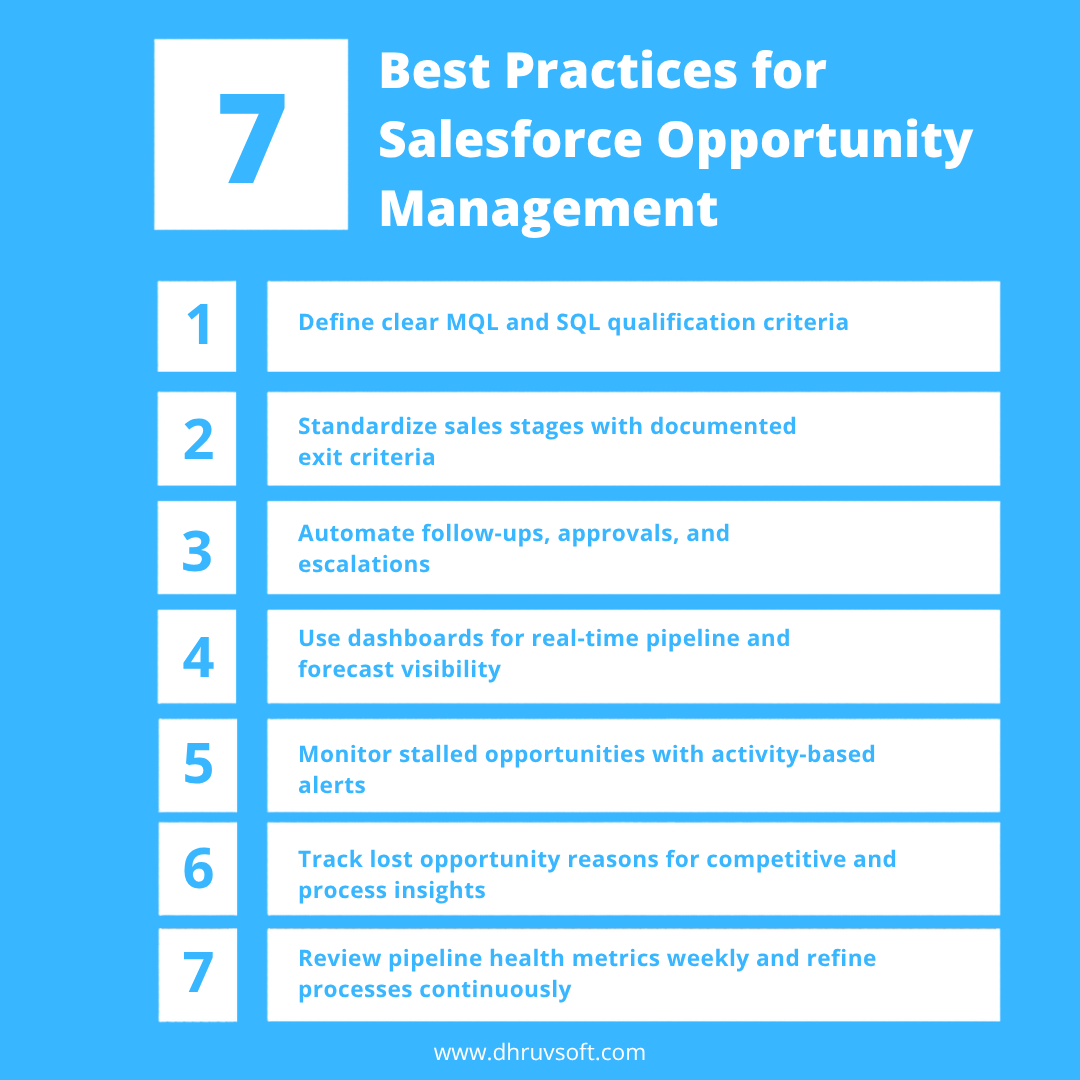
- Define clear MQL and SQL qualification criteria: Clearly define Marketing Qualified Leads (MQLs) and Sales Qualified Leads (SQLs) to ensure alignment between marketing and sales teams. Standardized qualification criteria improve lead quality and conversion rates. This creates a more efficient pipeline management process.
- Standardize sales stages with documented exit criteria: Every sales stage should have clearly documented entry and exit conditions. Standardization improves forecasting accuracy and pipeline visibility. It also ensures consistency across sales teams and processes.
- Automate follow-ups, approvals, and escalations: Automation reduces manual effort and ensures timely actions throughout the sales cycle. Follow-ups, approval workflows, and escalations can be triggered automatically based on predefined rules. This improves efficiency and reduces delays.
- Use dashboards for real-time pipeline and forecast visibility: Real-time dashboards provide visibility into pipeline performance, deal progress, and forecast accuracy. Leadership teams can quickly identify risks and opportunities. This enables faster and more informed decision-making.
- Monitor stalled opportunities with activity-based alerts: Activity-based alerts help identify opportunities that lack engagement or progress. Sales managers can take corrective action before deals are lost. This improves pipeline health and sales productivity.
- Track lost opportunity reasons for competitive and process insights: Analyzing lost deals helps organizations identify competitive gaps and process weaknesses. Understanding why opportunities are lost improves future sales strategies. This supports continuous improvement in pipeline management.
- Review pipeline health metrics weekly and refine processes continuously: Regular pipeline reviews help teams identify bottlenecks, risks, and improvement opportunities early. Weekly analysis ensures processes remain aligned with business goals. Continuous refinement drives stronger sales performance and forecasting accuracy.
Conclusion
Effective opportunity management is not a Salesforce configuration project — it is a revenue strategy. The tools, automation, and dashboards Salesforce provides are only as powerful as the processes and discipline behind them. Organizations that invest in structured opportunity management see higher win rates, faster sales cycles, and forecasts they can actually trust.
The path from lead to closed-won without leakage is built on consistent qualification, disciplined stage management, automated follow-up, and a culture of CRM accountability. Start with the fundamentals, measure what matters, and refine continuously.
Ready to Improve Your Pipeline?
Dhruvsoft helps organizations optimize Salesforce opportunity management — from stage design and qualification frameworks to AI-driven forecasting and automation. Our experts work alongside your sales and operations teams to build a pipeline that accurately predicts and performs consistently.
 About Imtiaz Ansari


