Customer service is no longer just about resolving tickets—it is about preventing them, predicting them, and increasingly, handling them without human intervention. The modern customer journey is dynamic, complex, and demanding. Customers interact across multiple channels, expect real-time responses, and have little patience for repetitive, slow, or disconnected experiences. The organizations that thrive in this environment are those that move beyond traditional service models and embrace intelligent, AI-driven approaches.
For years, organizations operated in a reactive model. A customer faced an issue, raised a ticket, and waited. Even with improvements in response time and agent productivity tools, the underlying model itself remained fundamentally unchanged—humans at the centre, AI at the periphery. Today, that model is being disrupted from the ground up. Customers expect:
- Instant responses, regardless of time zone or channel
- Context-aware interactions that remember previous touchpoints
- Proactive communication before issues escalate into crises
- Zero repetition—no re-explaining the same problem to multiple agents
- And ideally, no issues at all, thanks to preventive intelligence
This fundamental shift in customer expectations has given rise to predictive customer service. But with the latest innovations in Salesforce—most notably Agentforce—we are now entering the next, more transformative phase – Autonomous (Agentic) Customer Service.
Why Predictive Service Is No Longer Enough
Predictive service was a significant leap forward. By leveraging machine learning and historical data analytics, businesses were able to move from a reactive posture to a proactive one. This shift delivered measurable improvements across service operations. Organizations deploying predictive models could:
- Anticipate churn before customers disengaged or cancelled
- Identify recurring product or service issues before they become widespread
- Forecast service demand and align staffing and resources accordingly
These capabilities yielded real value. But prediction alone still depends on human execution. A model may flag a high-risk customer, but an agent must follow up. A forecast may highlight a staffing gap, but a manager must act on it. The insight and the action remain separate, connected only by human judgment—and human bandwidth is finite.
The real transformation happens when AI not only predicts but also acts. When the gap between insight and execution collapses. When workflows are triggered automatically, responses are generated instantly, and resolutions happen without waiting for human intervention. This is precisely where modern Salesforce AI capabilities change the game entirely.
The New Foundation: Data Cloud + Unified Customer Intelligence
No AI capability—however sophisticated—can deliver value without high-quality, unified data at its core. This is a lesson many organizations have learned the hard way. Siloed data creates siloed intelligence. Fragmented systems produce fragmented customer experiences. Stale data leads to inaccurate predictions and misguided actions.
At the core of modern service transformation is unified, real-time data. With Salesforce’s Data Cloud, organizations can finally achieve the data foundation that makes AI transformational rather than merely incremental:
- Customer data is unified across CRM, ERP, support platforms, and external systems—creating a single, authoritative source of truth
- Every interaction—email, call, purchase, service case, social engagement—is connected and contextualised
- AI models operate on live, contextual data rather than static snapshots frozen at the time of last data import
This infrastructure creates a true 360° customer view—one that evolves in real time as new data flows in. The result is a foundation that enables:
- More accurate predictions, grounded in complete and current data
- Real-time decision-making that reflects the customer’s current state and context
- Hyper-personalized service experiences that feel relevant, timely, and genuinely helpful
Without this foundation, even the most advanced AI models remain limited in scope and reliability. With it, AI becomes genuinely transformational—capable of delivering consistent, intelligent outcomes at scale.
From Einstein AI to Agentforce: The Rise of Autonomous Service
Salesforce’s AI journey has evolved significantly and deliberately—from predictive models that surface insights, to generative AI that drafts content and responses, and now to Agentforce, which represents the era of agentic AI. Each stage has built upon the last, and together they form a comprehensive AI architecture for modern customer service.
1. Einstein AI (Predictive + Generative Intelligence)
Salesforce Einstein remains a foundational pillar of AI-powered service. By embedding machine learning and generative capabilities directly into the Salesforce platform, Einstein enables organizations to operate with greater speed, intelligence, and consistency. With Einstein AI, organizations can:
- Predict case escalation risks before they materialise, enabling early intervention
- Recommend next best actions to agents based on case history, customer sentiment, and resolution patterns
- Generate high-quality email responses, case summaries, and knowledge articles automatically—reducing manual drafting time
- Analyse customer sentiment and interaction patterns to identify dissatisfaction signals before they escalate
Together, these capabilities improve resolution speed, response consistency, and overall agent productivity—while also enhancing the quality of the customer experience.
2. Agentforce (Autonomous AI Agents)
The most significant and consequential shift in the Salesforce AI ecosystem is the introduction of Agentforce—a platform for deploying AI agents that can independently perform multi-step tasks, make contextual decisions, and take action across systems. Unlike traditional bots or simple automation rules, Agentforce agents are designed to:
- Understand customer intent with nuance—interpreting not just what a customer says, but what they need
- Take actions across systems—updating records, triggering workflows, querying data sources, and communicating across channels
- Resolve cases end-to-end, from initial query to confirmed resolution, without requiring human intervention at every step
- Learn and improve over time, refining their behaviour based on outcomes and feedback
In practice, this means AI agents can independently respond to customer queries across chat, email, and digital channels, trigger backend workflows in real time, automatically update CRM records with relevant case details, and escalate to human agents only when complexity, sensitivity, or policy thresholds require it. The result is a service model where AI is not just a support tool—service is executed by AI, with humans providing oversight, handling exceptions, and managing the most complex or high-value interactions.
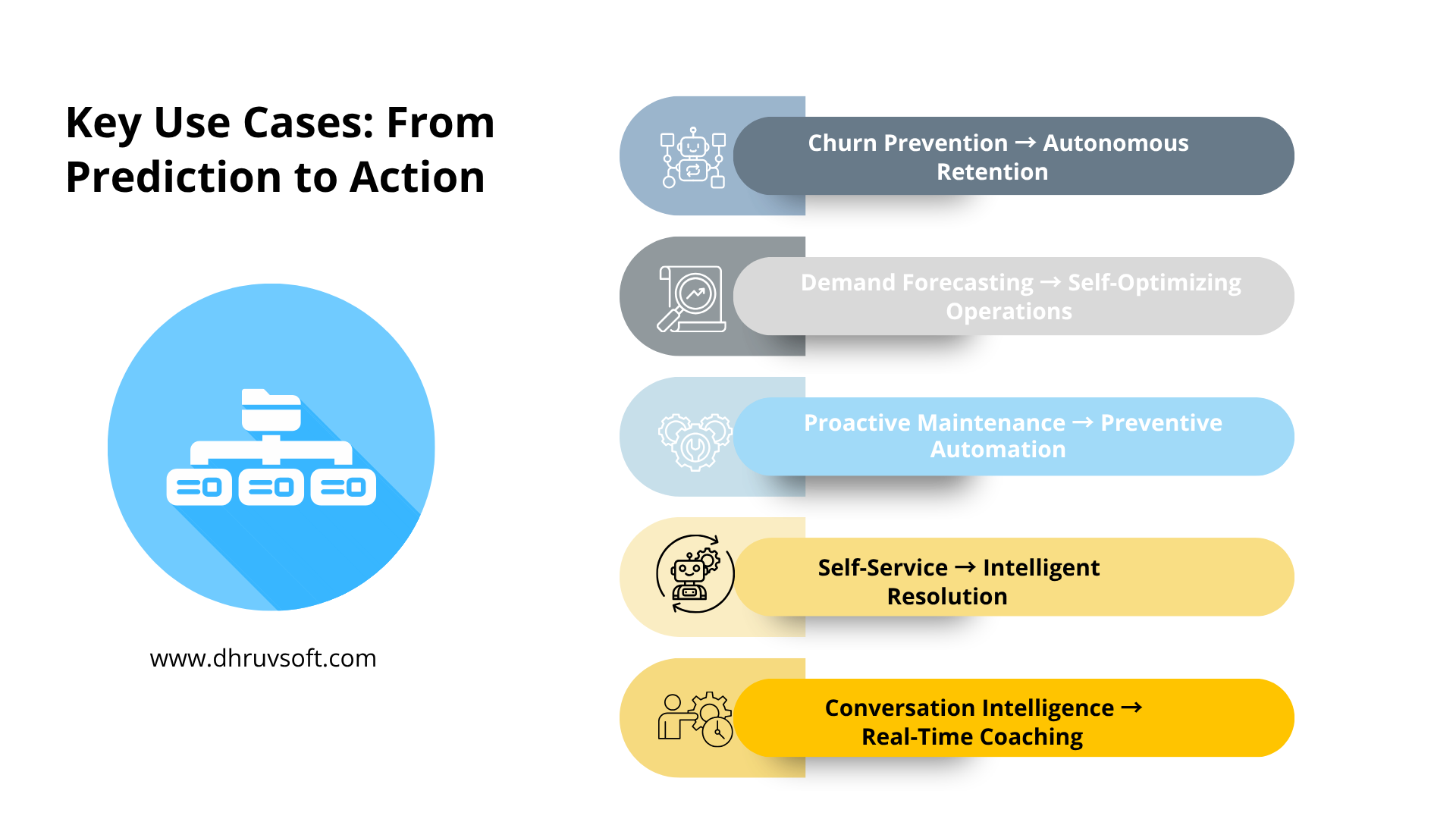
Key Use Cases: From Prediction to Action
The real measure of any AI investment is not the technology itself—it is the business outcomes it produces. Below are five high-impact use cases that illustrate how modern Salesforce AI is transforming service operations from insight to execution.
1. Churn Prevention → Autonomous Retention
Earlier:
- Identify high-risk customers through predictive scoring models
- Assign flagged customers to an account manager for follow-up
- Wait for the account manager to reach out—often days later
Now:
- AI detects churn signals in real time as behavioural and transactional data flows in
- Automatically triggers personalized engagement workflows—tailored to the customer’s history, preferences, and risk profile
- Sends proactive, contextually relevant communication through the customer’s preferred channel
- Alerts account teams only when direct human intervention is determined to be necessary—freeing agents to focus where they matter most
The outcome: faster response to at-risk customers, higher retention rates, and significantly reduced manual workload for account teams.
2. Demand Forecasting → Self-Optimizing Operations
Earlier:
- Analyse historical case volumes on a weekly or monthly basis
- Produce staffing plans manually based on historical trends
- React to unexpected spikes after they have already impacted service levels
Now:
- AI predicts demand spikes dynamically, incorporating real-time signals from product launches, marketing campaigns, and external events
- Automatically reallocates resources—routing capacity to the right queues, channels, and skill sets
- Adjusts routing logic based on real-time load balancing
- Continuously optimises workforce planning, reducing both over-staffing and under-staffing
The outcome: fewer service bottlenecks, improved SLA adherence, and optimised operational costs without constant manual intervention.
3. Proactive Maintenance → Preventive Automation
Earlier:
- Identify product or service issues by analysing clusters of similar cases
- Raise internal flags for engineering or operations teams
- Wait for a resolution before communicating proactively with affected customers
Now:
- AI monitors patterns across customers continuously, in real time
- Detects anomalies early—before they cascade into a widespread service incident
- Automatically triggers alerts, remediation workflows, or preventive customer communications
- Reduces case volume by addressing issues before customers even realize a problem exists
The outcome: fewer escalations, higher customer trust, and a measurable reduction in reactive case volume.
4. Self-Service → Intelligent Resolution
Earlier:
- Static knowledge bases requiring customers to search and navigate independently
- Basic rule-based chatbots that could only handle scripted scenarios
- High deflection failure rates pushing customers back to human agents
Now:
- AI understands full conversational context and customer intent—even when queries are vague or complex
- Generates dynamic, personalized answers rather than returning static article links
- Resolves issues instantly by connecting to back-end systems and executing transactions on behalf of the customer
- Escalates only genuinely complex or sensitive cases to human agents—with full context already captured
The outcome: dramatically improved self-service resolution rates, reduced agent load, and better customer satisfaction.
5. Conversation Intelligence → Real-Time Coaching
- Calls, chats, and emails are analysed continuously and in real time—not after the fact
- AI identifies sentiment, risk signals, and intent as conversations unfold, enabling timely intervention
- Provides live, contextual recommendations to agents—suggesting responses, next steps, or escalation actions
- Automatically updates CRM records with relevant interaction details, eliminating manual post-call data entry
The outcome: better agent performance, more consistent customer experiences, and a richer data trail for continuous improvement.
The Shift That Matters: Assisted → Autonomous → Augmented
Customer service is evolving across three distinct but interconnected stages. Understanding where your organization sits—and where you need to go—is essential to building the right AI strategy:
| Stage | Description | What It Looks Like |
|---|---|---|
| Assisted AI | AI supports agents | Suggestions, summaries, and recommended next actions surfaced during agent interactions |
| Autonomous AI | AI resolves cases independently | End-to-end resolution without human involvement for defined case types |
| Augmented Workforce | Humans + AI collaborate seamlessly | AI handles volume and routine work; humans manage complexity, exceptions, and high-value relationships |
Salesforce now enables organizations to operate across all three stages simultaneously. The entry point varies by maturity, but the real competitive opportunity lies in advancing toward autonomous service layers—where AI handles the volume, agents handle the complexity, and the organization scales without proportional cost growth.
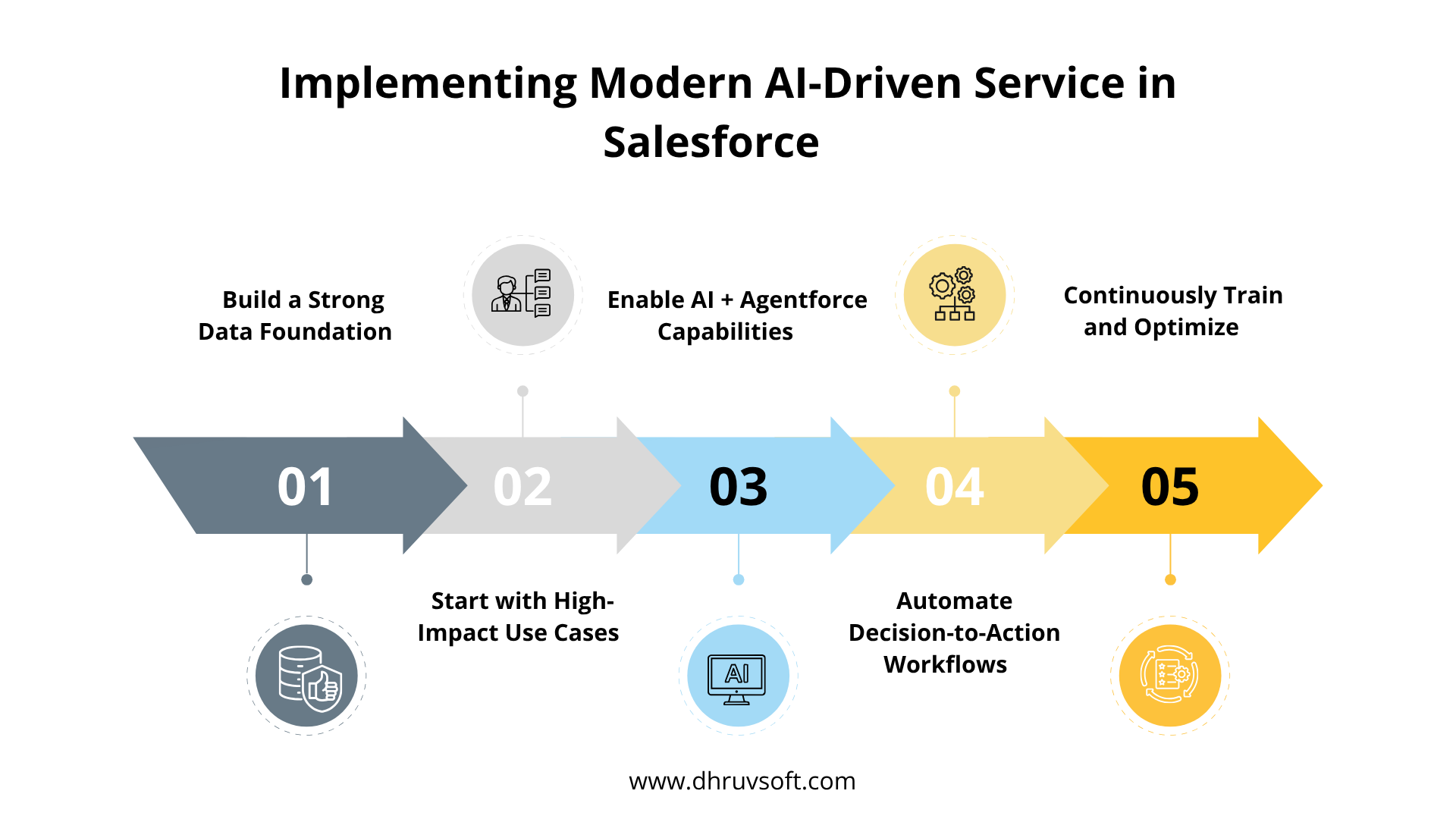
How to Implement Modern AI-Driven Service in Salesforce
A successful AI transformation in customer service requires more than enabling features or deploying tools. It requires a structured, deliberate approach that aligns technology capabilities with business goals, data readiness, and organizational change management.
1. Build a Strong Data Foundation
Before any AI capability can deliver reliable value, the underlying data must be trustworthy, accessible, and unified. This means:
- Cleaning and standardising customer data across all relevant systems
- Integrating CRM, ERP, and support platforms into a unified data model via Salesforce Data Cloud
- Ensuring real-time data availability so AI models operate on current, not stale, information
- Establishing data governance practices to maintain quality over time
2. Start with High-Impact Use Cases
Rather than attempting to boil the ocean, focus initial efforts on use cases with clear ROI, measurable outcomes, and a relatively contained scope. The most impactful starting points are typically:
- Case prioritisation—ensuring the right cases reach the right agents at the right time
- Churn prediction—identifying and acting on at-risk customer signals before they disengage
- Intelligent routing—matching cases to agents based on skill, availability, and case complexity
- Self-service automation—deflecting routine queries with AI-powered resolution
3. Enable AI + Agentforce Capabilities
- Deploy Einstein AI to surface insights, recommendations, and generated content within agent workflows
- Introduce Agentforce AI agents to handle repetitive, well-defined workflows end-to-end
- Use natural language configuration tools to build and refine agents without extensive technical development
4. Automate Decision-to-Action Workflows
Insights alone are not enough. The real value of AI emerges when insights automatically translate into action. This requires:
- Trigger workflows automatically based on AI-detected signals and decisions
- Enable proactive outbound communication without manual intervention
- Reduce the number of steps—and people—between an AI recommendation and a customer outcome
5. Continuously Train and Optimize
AI transformation is not a one-time deployment—it is an ongoing discipline. Organizations must:
- Monitor AI performance continuously against defined KPIs
- Refine and retrain models as customer behaviour, products, and processes evolve
- Improve adoption through targeted agent training, change management, and leadership alignment
Business Impact: Beyond Efficiency
Organizations that have adopted modern Salesforce AI are experiencing measurable impact far beyond simple operational efficiency gains. The value extends across the entire customer relationship lifecycle:
- Faster Resolution Times: AI-driven routing and real-time recommendations significantly reduce average handling time. Agents receive the right context, the right suggested actions, and the right supporting knowledge articles immediately—eliminating the research time that historically consumed a large portion of every interaction.
- Lower Operational Costs: Automation reduces ticket volumes by resolving routine cases without human involvement, and reduces manual effort within complex cases by handling administrative tasks like documentation, routing, and follow-up automatically. The result is a leaner, more scalable service operation that can handle volume growth without proportional headcount growth.
- Higher Customer Satisfaction: Proactive, personalized service builds the trust that drives loyalty. When customers feel that a company anticipates their needs, communicates before problems escalate, and resolves issues quickly and accurately, satisfaction scores improve markedly—and churn rates decline.
- Better Agent Experience: Perhaps counter-intuitively, AI-driven automation significantly improves the experience of human agents. When repetitive, low-value tasks are handled by AI, agents can focus on the complex, nuanced, and emotionally demanding work where human judgment, empathy, and expertise genuinely matter. This leads to higher engagement, lower burnout, and better retention.
- Increased Retention & Lifetime Value: Predictive and proactive engagement doesn’t just prevent churn—it actively strengthens customer relationships over time. Customers who experience consistently excellent, effortless service are more likely to renew, expand, refer, and advocate. The cumulative effect on customer lifetime value is substantial.
Common Pitfalls to Avoid
Even with access to advanced AI capabilities and a well-resourced Salesforce environment, success is not guaranteed. The following pitfalls are consistently the most common reasons AI service initiatives underperform or fail:
- Poor data quality: Inaccurate, incomplete, or siloed data undermines every AI model built on top of it. Predictions are only as reliable as the data that trains them. Investing in data governance before AI deployment is not optional—it is essential.
- Over-engineering AI models: Attempting to build the perfect model before deploying anything delays adoption and reduces momentum. Start with simpler, higher-confidence models and iterate based on real-world performance.
- Lack of integration: AI that cannot access and act across the systems it needs to influence produces fragmented, low-value insights. Integration between Salesforce, ERP, communication platforms, and other systems is a prerequisite for autonomous service.
- Resistance to change: Technology is rarely the limiting factor in AI transformations—people are. Without active change management, training, and leadership alignment, adoption suffers and ROI evaporates.
The solution is consistent across all of these: start small, scale fast, and focus relentlessly on business outcomes—not just technology deployment.
The Future: AI as Your First Line of Service
The trajectory is clear. Within the coming years, AI will become the default first line of customer service—handling the majority of interactions autonomously, resolving issues before they become cases, and personalising every touchpoint without requiring human effort. The role of human agents will evolve from transaction handlers to relationship managers, exception resolvers, and experience architects.
We are moving toward a future where:
- AI handles the majority of service interactions—routine, transactional, and even moderately complex
- Humans manage exceptions, high-value relationships, and situations requiring empathy and nuanced judgment
- Service becomes truly proactive, predictive, and autonomous—a source of competitive differentiation rather than just operational overhead
With platforms like Salesforce Service Cloud and Agentforce, organizations are no longer simply improving service—they are redefining what service means, what it costs, and what it delivers.
Final Thought
Predictive customer service was the first step—a meaningful advance that helped organizations move from reactive to proactive. But the landscape has shifted again, and prediction alone is no longer a differentiator. The real competitive advantage today lies in autonomous, AI-driven service execution: the ability to not just anticipate what customers need, but to act on that knowledge instantly, intelligently, and at scale.
Organizations that embrace this shift—that invest in the right data foundation, deploy AI with purpose, and build the organizational capabilities to sustain continuous improvement—will not only reduce costs and improve efficiency. They will deliver exceptional, effortless customer experiences at a scale and consistency that was simply not possible before.
Ready to Move Beyond Predictive Service?
If you’re looking to design AI-driven service workflows, implement Agentforce-based autonomous solutions, or integrate CRM, ERP, and AI into a unified, future-ready ecosystem, Dhruvsoft has the expertise and experience to help you build it right.
Our team works with organizations at every stage of the AI journey—from data readiness assessments and use case prioritisation to full-scale Agentforce deployment and optimization. Whether you are just beginning to explore AI-driven services or ready to scale an existing initiative, we provide the strategic guidance and technical execution to accelerate your transformation.
Dhruvsoft can help you build a future-ready, AI-powered service organization. Let’s start the conversation.
 About Surender Patel


