How Service teams can build stronger relationships and improve Customer loyalty with Salesforce Service Cloud
Why Customer Loyalty is a Business Priority
In an era of rapidly shifting consumer expectations, customer loyalty has become one of the most strategically important assets a business can possess. It is well established in business research that acquiring a new customer costs five to seven times more than retaining an existing one. Yet despite this well-known reality, many organizations continue to under-invest in the service experiences that determine whether a customer stays or leaves.
Loyalty is not simply about repeat purchases. It is about the emotional connection a customer develops with a brand over time—a connection that drives advocacy, referrals, and a willingness to pay premium prices. Long-term loyal customers generate significantly higher lifetime value than transactional ones, and they serve as organic brand ambassadors in a world where peer recommendations carry more weight than any advertising campaign.
Customer service sits at the heart of this loyalty equation. Every interaction a customer has with your service team—whether it is a billing query, a product issue, or a request for help—shapes how they perceive your brand. A single poor experience can undo years of goodwill. Conversely, a genuinely helpful, empathetic, and efficient service interaction can deepen loyalty far more effectively than any loyalty points programme.
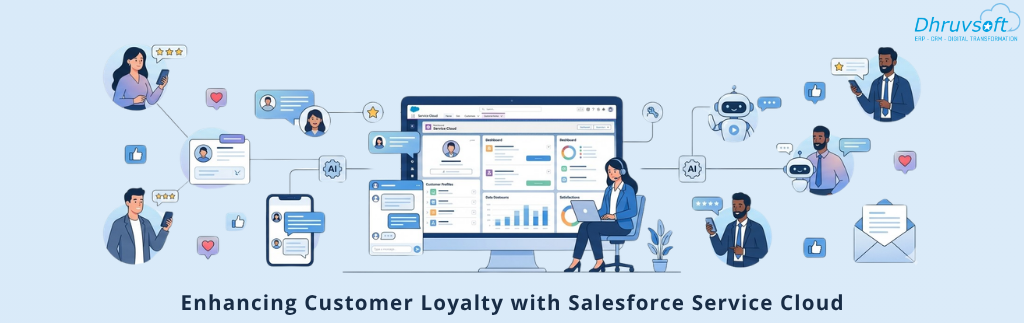
This is where Salesforce Service Cloud plays a transformative role, by unifying customer data, enabling omnichannel service, and embedding intelligent automation into every workflow. Service Cloud gives organizations the infrastructure they need to deliver the kind of service that builds lasting loyalty—consistently, at scale, and without sacrificing personalization.
Understanding Customer Loyalty in the Digital Era
What Drives Customer Loyalty Today
The drivers of customer loyalty have evolved significantly in the digital age. Price and product quality, once the dominant factors, are now table stakes in most markets. Today, the experience a customer has when interacting with your brand—particularly when something goes wrong—is what determines whether they stay or defect. Three factors consistently emerge as the primary drivers of loyalty in modern service environments:
- Fast and consistent service: Customers expect prompt responses across every channel, every time. Inconsistency—great service on one channel, poor service on another—erodes trust faster than a consistently mediocre experience.
- Personalized experiences: Customers no longer accept generic interactions. They expect brands to know who they are, understand their history, and tailor communications and solutions accordingly.
- Proactive support: The highest form of service is anticipating customer needs before they arise. Proactive communication—informing a customer of a potential issue before they notice it—signals that you genuinely care about their experience.
The Link Between Service Quality and Retention
The relationship between service quality and customer retention is direct and well-documented. Research shows that customers who receive poor service are four times more likely to switch to a competitor than those who are only dissatisfied with price or the product. The service interaction is the moment of truth.
Conversely, exceptional service creates advocacy. Customers who feel genuinely well served do not just stay—they actively recommend the brand to their networks. In a world where online reviews and social media amplify both positive and negative experiences, this advocacy effect has enormous commercial value. Service excellence, in this sense, is not a cost centre—it is a revenue driver.
Challenges in Building Customer Loyalty
Despite the clear strategic importance of service-driven loyalty, most organizations face significant operational challenges in delivering the consistent, personalized, and proactive service that loyalty requires. The most common barriers include:
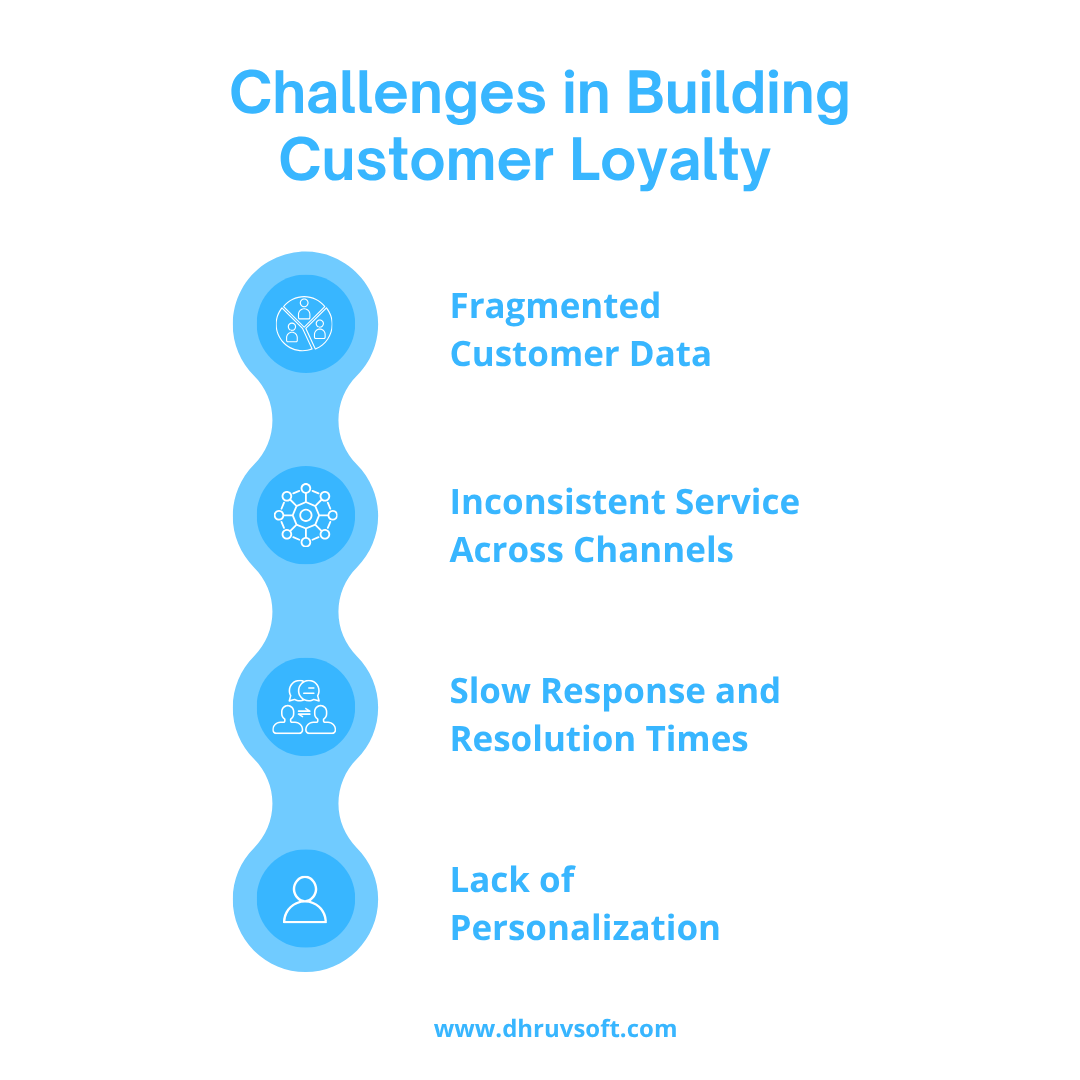
- Fragmented customer data: When customer information is scattered across CRM, billing, support, and ERP systems, agents lack the context they need to deliver informed, personalized service. Every conversation starts from scratch, and customers are forced to repeat themselves.
- Inconsistent service across channels: Many organizations deliver acceptable service through one or two channels but struggle to maintain consistency when customers move between phone, email, chat, and social. The seams between channels create frustration and erode trust.
- Slow response and resolution times: Customers have little tolerance for delays. When resolution requires multiple hand-offs, manual processes, or waiting for information trapped in another system, satisfaction plummets—and so does loyalty.
- Lack of personalization: Generic, scripted responses signal to customers that they are not known or valued. Without access to customer history and context, agents default to one-size-fits-all interactions that feel impersonal and transactional.
How to Build Customer Loyalty with Salesforce Service Cloud?
Salesforce Service Cloud Features
Unified Customer View
At the foundation of every exceptional service interaction is a complete, accurate, and accessible picture of the customer. Salesforce Service Cloud delivers this through its 360-degree customer view—a unified profile that consolidates data from every interaction, transaction, and touchpoint across the customer lifecycle.
When an agent opens a case, they immediately see the customer’s purchase history, previous service interactions, open issues, and communication preferences. This eliminates the frustration of customers having to repeat themselves and enables agents to engage with genuine context and relevance. The result is a service experience that feels personal, informed, and respectful of the customer’s time.
Omnichannel Support
Modern customers move fluidly between channels. They might start a conversation via chat, follow up by email, and escalate to a phone call—and they expect the experience to be seamless throughout. Salesforce Service Cloud’s omnichannel capabilities ensure that every channel—email, phone, live chat, social media, WhatsApp, and more—is integrated into a single service console.
Agents see the full conversation history regardless of which channel a customer uses. Cases are routed intelligently based on channel, agent skill set, and workload. Customers never have to start over because they switched channels. This consistency across touchpoints is one of the most powerful drivers of loyalty that Service Cloud enables.
Case Management Optimization
Efficient case management is the operational backbone of service excellence. Service Cloud provides a comprehensive case management framework that tracks every case from creation to resolution, automates escalation rules, and ensures that no case falls through the cracks. SLA management tools ensure that service commitments are met, and real-time dashboards give managers visibility into team performance and potential bottlenecks.
Faster, more consistent case resolution directly correlates with higher customer satisfaction and stronger loyalty. When customers know their issues will be resolved quickly and reliably, their confidence in the brand grows.
Delivering Personalized Customer Experiences
Customer Data and Insights
Personalization at scale requires data—and the ability to act on it in real time. Service Cloud, particularly when integrated with Salesforce Data Cloud, gives service teams access to rich, unified customer profiles that capture behavioural data, purchase history, service preferences, and sentiment signals. This data transforms generic service interactions into genuinely personalized conversations.
Rather than treating every customer as anonymous, agents can greet customers by name, reference recent purchases, acknowledge previous issues, and tailor their approach accordingly. This level of contextual awareness communicates to customers that they are known and valued, which is one of the most powerful loyalty-building signals a brand can send.
Tailored Communication
Service Cloud enables agents to craft tailored responses informed by customer context. Agentforce further accelerates this by suggesting personalized responses based on the customer’s history and the nature of their query. Communication templates can be dynamically populated with customer-specific data, ensuring that even high-volume interactions retain a personal feel.
Personalized communication reduces resolution friction—customers receive answers that are relevant to their specific situation rather than generic guidance they must interpret and apply themselves.
Context-Aware Support
Context-aware service means that agents understand not just what a customer is asking, but where they are in their journey with the brand. A customer who has used a product for three days has different needs compared to a loyal customer who has been using it for five years.
Service Cloud’s unified timeline and case history tools give agents the contextual intelligence they need to tailor their support approach accordingly—adjusting tone, depth of explanation, and solution recommendations to match the customer’s situation.
Improving Response and Resolution Times
Intelligent Case Routing
One of the most significant contributors to slow resolution times is misrouting—cases that are assigned to the wrong agent, team, or queue, resulting in unnecessary transfers and delays. Service Cloud’s intelligent routing capabilities eliminate this problem by automatically directing cases to the most appropriate agent based on a combination of factors: case type, agent skill set, language, priority level, and current workload.
When cases reach the right agent immediately, resolution times drop dramatically—and customers experience fewer frustrating hand-offs. This efficiency signals competence and respect for the customer’s time, both of which reinforce loyalty.
Automation and Workflows
Many of the delays in service resolution are caused not by complex problems, but by repetitive administrative tasks—sending acknowledgment emails, updating case statuses, escalating overdue cases, notifying customers of progress. Service Cloud’s workflow automation capabilities handle all of these tasks automatically, freeing agents to focus on the substantive work of actually solving customer problems.
Automated escalation rules ensure that cases approaching SLA breach thresholds are flagged and prioritised in real time. Automated customer notifications keep customers informed throughout the resolution process, reducing anxiety and the volume of inbound follow-up queries.
Knowledge Base Integration
Service Cloud’s integrated knowledge base gives agents instant access to standardised, up-to-date answers for common issues. Rather than researching solutions from scratch for every query, agents can find and apply approved resolutions quickly and consistently. Einstein Article Recommendations takes this further by automatically suggesting the most relevant knowledge articles based on the content of the case—reducing research time and improving answer quality.
A well-maintained knowledge base also powers self-service portals, enabling customers to resolve common issues independently—further reducing case volume and improving the overall service experience.
Enabling Proactive Customer Service
Predictive Service Capabilities
The highest expression of customer-centric service is anticipating needs before they become problems. Salesforce’s Einstein AI and Data Cloud enable predictive service capabilities that identify signals of potential issues—product anomalies, usage patterns that suggest confusion or dissatisfaction, and billing irregularities—before customers notice them.
By acting on these signals proactively, organizations can resolve issues before they generate cases, eliminate the frustration of unexpected problems, and demonstrate a level of attentiveness that customers rarely experience from brands. This proactive posture is one of the most powerful loyalty-building behaviours a service organization can develop.
Proactive Notifications
Service Cloud enables organizations to trigger proactive outreach through customers’ preferred channels—email, SMS, in-app notifications, or direct calls—when relevant events occur. This might include informing a customer of a known issue before they are affected, providing an update on an open case before they have to chase it, or notifying them of a renewal approaching.
Proactive notifications demonstrate that the organization is paying attention and that the customer’s wellbeing matters beyond the transactional moment. This is a significant differentiator in markets where reactive, ticket-driven service remains the norm.
Preventing Customer Frustration
Much of the frustration that drives customer churn is preventable. Long wait times, repeated transfers, having to re-explain the same problem, and discovering an issue through a service outage rather than proactive communication are all experiences that erode loyalty—and all of them are addressable through well-implemented service technology.
Service Cloud gives organizations the tools to eliminate these friction points systematically, creating a service experience that feels effortless rather than adversarial.
Empowering Service Teams for Better Engagement
Unified Service Console
- Service Cloud’s unified console brings together every piece of customer and case information into a single, streamlined interface.
- Agents no longer need to switch between multiple systems to access billing records, case history, product information, and communication logs. Everything is available in context, within a single workspace designed for efficiency.
- This consolidation dramatically reduces the cognitive load on agents—allowing them to focus their energy on the customer interaction rather than on navigating systems. The result is faster, more confident service delivery and a measurably better experience for the customer.
AI and Agent Assistance
- Einstein AI embeds intelligent assistance directly into the agent’s workflow. As a case unfolds, Einstein surfaces suggested responses, recommends relevant knowledge articles, highlights similar past cases and their resolutions, and flags sentiment signals that might indicate a customer is at risk of escalating or churning.
- These real-time recommendations help agents respond faster, more accurately, and with greater empathy.For newer agents, AI assistance accelerates the learning curve significantly—effectively giving junior team members access to the collective knowledge of the entire service organization.
- For experienced agents, it reduces the manual effort of research and documentation, freeing bandwidth for the high-value elements of the interaction.
Collaboration Tools
- Complex cases often require input from multiple people—product specialists, technical teams, account managers, or senior agents.
- Service Cloud’s built-in collaboration features, integrated with Slack, enable agents to quickly loop in the right colleagues without leaving the service console. Case collaboration is tracked and visible, ensuring continuity even when multiple people contribute to a resolution.
- Faster, more collaborative resolution directly benefits customers—who experience fewer delays and a more coordinated, knowledgeable service response.
Measuring and Improving Customer Loyalty
Customer Satisfaction Metrics
- You cannot improve what you do not measure. Service Cloud provides native tools for capturing and tracking the key metrics of service quality and customer loyalty—CSAT (Customer Satisfaction Score), NPS (Net Promoter Score), and first contact resolution rates.
- Automated post-interaction surveys can be triggered through any channel, and results flow directly into Salesforce dashboards for immediate visibility.
- These metrics provide both a real-time pulse on service performance and a longitudinal view of how loyalty trends are evolving over time—enabling data-driven decisions about where to invest in improvement.
Service Performance Analytics
- Service Cloud’s analytics capabilities give managers and leadership teams real-time visibility into every dimension of service performance: average handle time, case volume by category, SLA compliance, first response time, escalation rates, and agent performance benchmarks.
- These insights enable proactive management of service quality rather than reactive intervention after problems surface.
- When performance data is visible, accountable, and acted upon, service quality improves systematically—and so does customer loyalty.
Continuous Improvement
- The organizations that build the most durable loyalty are those that treat service improvement as an ongoing discipline rather than a one-time implementation project.
- Service Cloud’s analytics and reporting tools provide the continuous feedback loop that makes iterative improvement possible—identifying recurring issues, flagging process inefficiencies, and surfacing the patterns that indicate where the greatest gains are available.
- Combined with regular agent training, knowledge base maintenance, and periodic process reviews, this continuous improvement culture is what separates service organizations that sustain high loyalty from those that achieve it briefly and then plateau.
Case Study: Building Customer Loyalty with Salesforce Service Cloud
Challenge
- Consider a mid-sized B2B technology company struggling with declining customer satisfaction scores and increasing churn among its support contract customers.
- The root causes were familiar: customer data was scattered across a legacy CRM, a separate billing system, and a standalone ticketing tool. Agents had to switch between all three to handle a single case—introducing delays, errors, and the frustrating experience of customers having to repeat their information.
- Response times were inconsistent. High-priority customers were not always recognized as such during initial routing. And there was no proactive communication mechanism—customers discovered issues themselves, often through social media, rather than being informed by the company.
Solution
- The company partnered with Dhruvsoft to implement Salesforce Service Cloud as the unified foundation for their service operations. The implementation included full integration of their CRM, billing, and product data into a single customer profile accessible within the Service Cloud console.
- Omnichannel routing was configured to direct cases based on customer tier, case type, and agent skill set. Automated workflows were introduced to handle acknowledgment emails, escalation triggers, and SLA monitoring.
- A knowledge base was built and integrated with Einstein Article Recommendations. And a proactive notification framework was established to communicate with customers about known issues before they filed cases.
Results
- Within six months of go-live, the company reported measurable improvements across every key metric: average resolution time decreased by 38%, CSAT scores increased by 24 points, and annual churn among support contract customers dropped by 18%.
- Agents reported significantly higher confidence and job satisfaction, and the volume of escalations to senior team members fell by nearly a third. Customer loyalty—measured through NPS and contract renewal rates—improved materially, and several major accounts cited improved service as a key reason for renewing and expanding their contracts.
Best Practices in Enhancing Customer Loyalty with Service Cloud
Organizations seeking to maximize the loyalty impact of their Salesforce Service Cloud investment should observe the following best practices:
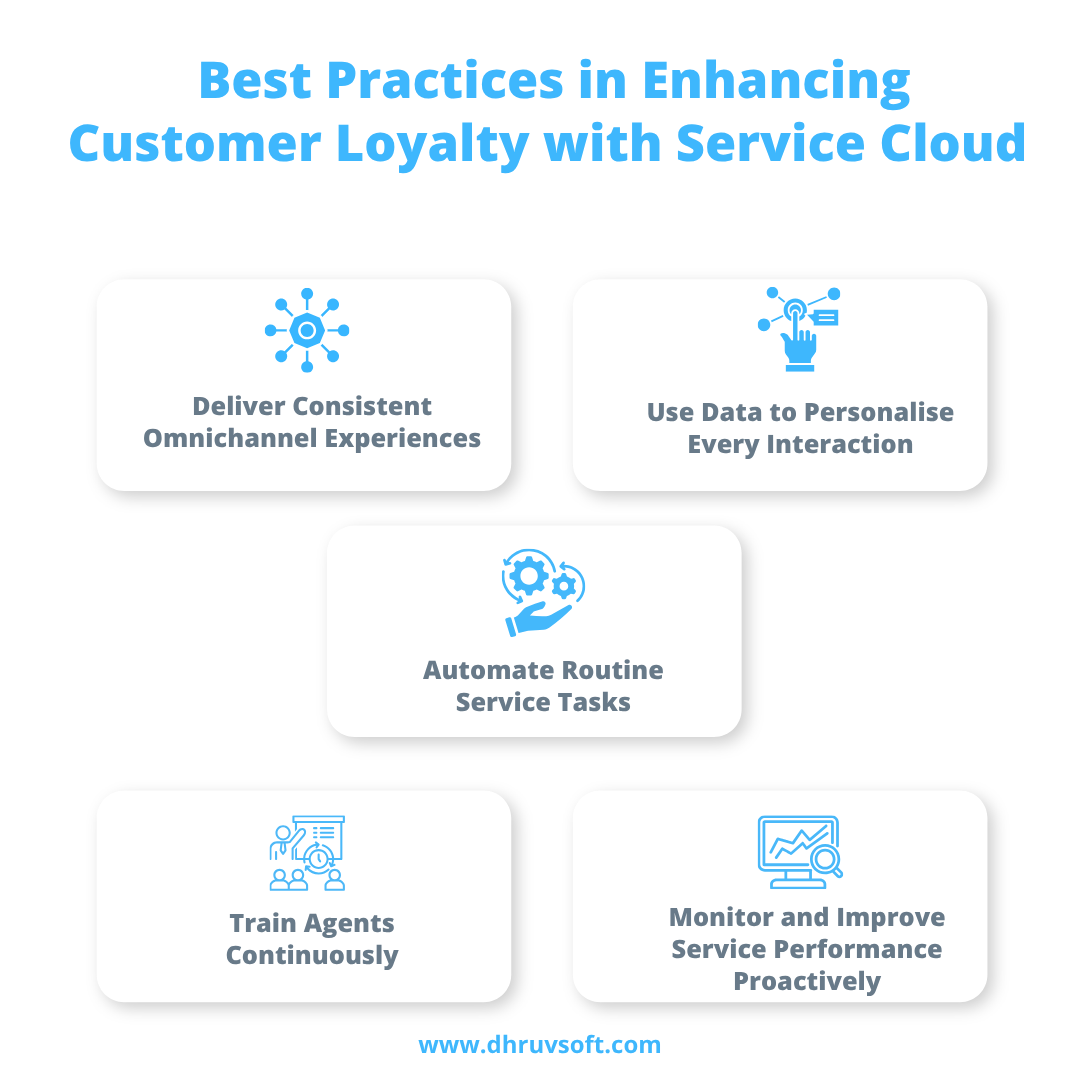
- Deliver consistent omnichannel experiences: Audit every channel your customers use and ensure that the quality, speed, and context of service are consistent across all of them. Inconsistency in service is one of the fastest ways to erode trust.
- Use data to personalise every interaction: Invest in data unification before optimising for AI or automation. Personalization is only possible when you have a complete, accurate, and accessible view of each customer.
- Automate routine service tasks—not customer relationships: Use automation to handle the administrative and repetitive elements of service delivery, freeing agents to focus on the human, empathetic dimensions of customer interaction that build genuine loyalty.
- Train agents continuously: Technology enables great service, but people deliver it. Regular training—on product knowledge, communication skills, and platform capabilities—is essential to sustaining service quality over time.
- Monitor and improve service performance proactively: Establish a cadence of performance review, using Service Cloud analytics to identify trends, flag issues, and prioritise improvements before they affect customer satisfaction.
Common Mistakes to Avoid
Even well-resourced organizations make avoidable mistakes in their pursuit of service-driven loyalty. The most common include:
- Ignoring customer feedback: Post-interaction feedback is one of the richest sources of improvement intelligence available. Organizations that collect it but do not act on it are leaving significant value on the table.
- Over-relying on automation without personalization: Automation that feels robotic or impersonal can damage the customer relationship as severely as slow service. Every automated interaction should be designed with the customer experience in mind, not just operational efficiency.
- Lack of data integration: Partial implementations—where Service Cloud is deployed but not connected to the full customer data ecosystem—limit the platform’s ability to deliver the unified, contextual service that loyalty requires.
- Inconsistent service experience: If service quality varies significantly between agents, shifts, or channels, customers lose confidence in the brand’s reliability. Standardization, training, and knowledge management are the antidotes.
Why Partnering with Dhruvsoft Matters
Implementing Salesforce Service Cloud is not simply a technology project—it is a transformation of how your organization relates to its customers. The configuration decisions made during implementation, the data integration choices, the workflow designs, and the change management approach all have a direct and lasting impact on the loyalty outcomes the platform enables.
Dhruvsoft brings deep expertise in Salesforce Service Cloud implementation, with a customer experience-driven approach that prioritises business outcomes over technical complexity. Our team works across industries—manufacturing, technology, financial services, and professional services—and understands the unique loyalty dynamics and service challenges each sector presents.
We design tailored solutions that reflect your specific customer base, service model, and operational constraints. And we stay engaged beyond go-live—providing ongoing optimization support, training, and strategic guidance as your service needs evolve. Our goal is not just a successful implementation; it is a measurable, sustained improvement in the loyalty your customers feel toward your brand.
Conclusion
Customer loyalty is not given—it is earned, interaction by interaction, through service experiences that are fast, consistent, personalized, and proactive. In a competitive landscape where product differentiation is increasingly difficult to sustain, the quality of your service experience is one of the most powerful and durable sources of competitive advantage available.
Salesforce Service Cloud provides the technology foundation to deliver on this promise at scale. By unifying customer data, enabling omnichannel service, embedding intelligent automation, and equipping agents with the tools and context they need to perform at their best, Service Cloud transforms service from a cost centre into a genuine driver of loyalty, retention, and long-term revenue.
Organizations that invest in service excellence—and that implement it with the strategic clarity and technical rigour it deserves—gain a compounding advantage that is genuinely difficult for competitors to replicate. Loyalty built through exceptional service is one of the most durable assets in business.
Ready to Build Stronger Customer Loyaltywith Salesforce?
Looking to improve Customer Loyalty with Salesforce Service Cloud? Dhruvsoft helps organizations design and implement service solutions that enhance customer relationships and drive long-term retention.
Whether you are starting from scratch or optimising an existing Salesforce environment, our team has the expertise to guide your journey from strategy to sustained results.
Connect with our experts today and take the first step toward a service experience your customers will remember—and return to.
 About Ashish Manuka


