Ask any healthcare administrator what slows down patient care, and the answer rarely points to clinical skill or staffing alone. It points to fragmentation. A patient’s demographic details sit in one system. Their appointment history sits in another. Care coordination happens over phone calls and email threads that no one else on the care team can see. Billing data lives in a finance system that has no visibility into clinical context. By the time a patient interacts with a provider, the information needed to serve them well is scattered across half a dozen disconnected tools.
This fragmentation is not just an operational inconvenience. It directly affects patient outcomes, care team efficiency, patient satisfaction, and financial performance. When a nurse cannot see a patient’s full care history at a glance, when a care coordinator has to call three departments to confirm a referral status, when a billing team has no context for a clinical encounter they are invoicing for — the cost is measured in delayed care, frustrated patients, and avoidable administrative overhead.
Salesforce Health Cloud was built specifically to solve this problem. It is a healthcare-specific platform that connects patient data, care teams, and operational and financial workflows into a single, unified system — giving healthcare organizations the connected foundation they need to deliver coordinated, efficient, and personalized care.This article explains what Salesforce Health Cloud is, how it connects patient data, care teams, and billing into one ecosystem, what a typical implementation looks like, and why healthcare organizations across hospitals, clinics, payers, and life sciences are adopting it as their patient engagement and care coordination platform.
What Is Salesforce Health Cloud?
Salesforce Health Cloud is an AI-first healthcare platform designed to connect clinical and operational data while supporting personalized, coordinated patient experiences. Built on the Salesforce platform, it extends far beyond what a traditional CRM can offer healthcare organizations — providing a comprehensive, real-time view of patients, care teams, and healthcare interactions in one place.
Rather than functioning as a stand-alone clinical system, Health Cloud is designed to sit alongside and enhance the systems healthcare organizations already use. It brings together information that would otherwise remain siloed, and makes that information actionable for every team member who needs it — from front-line care coordinators to billing specialists to executive leadership tracking operational performance.
At a functional level, Health Cloud supports:
- Connected, unified patient records across systems and departments
- Care team collaboration and coordinated care planning
- Personalized patient engagement across digital and traditional channels
- Clinical and operational workflow automation
- Healthcare analytics and reporting for operational visibility
- Secure healthcare data management aligned with industry compliance standards
For healthcare organizations evaluating digital transformation strategies, Health Cloud represents a shift away from managing patient relationships through disconnected point solutions and toward a single platform that supports the entire patient journey.
Why Healthcare Organizations Need a Connected Platform Like Health Cloud
The challenges that drive healthcare organizations toward Health Cloud are consistent across hospitals, clinics, specialty practices, and payer organizations. Most healthcare providers experience some combination of the following:
- Patient information is spread across multiple disconnected systems, with no single source of truth
- Limited visibility into a patient’s complete history at the point of care
- Poor communication and hand-offs between physicians, nurses, specialists, and care coordinators
- Manual, phone-and-email-driven care coordination that does not scale
- Inefficient, generic patient engagement that does not reflect each patient’s specific situation
- Operational inefficiencies caused by administrative processes that have not kept pace with patient volume
Each of these challenges compounds the others. Disconnected information leads to poor communication. Poor communication leads to manual workarounds. Manual workarounds consume staff time that should be spent on patient care. Salesforce Health Cloud addresses the root cause — fragmented data and disconnected systems — rather than treating each symptom individually.
Connecting Patient Data: The Foundation of Health Cloud
The single biggest advantage Salesforce Health Cloud offers is the creation of a unified patient view. Instead of care teams logging into multiple applications to piece together a patient’s situation, Health Cloud consolidates patient-related information into one centralized, accessible record.
Health Cloud is designed to connect a wide range of patient information, including:
- Clinical information relevant to ongoing care
- Patient demographics and contact details
- Care history across encounters, providers, and locations
- Appointments, scheduling, and visit history
- Patient interactions across calls, messages, and digital touchpoints
- Operational information relevant to the patient’s care journey
This unified patient profile is what makes everything else in Health Cloud possible. When a care coordinator, nurse, or front-desk staff member opens a patient record, they see the complete picture — not a fragment of it. This comprehensive view enables providers to understand the full patient journey, anticipate needs, and make better-informed care decisions at every touchpoint.
Improving Care Team Collaboration
Quality healthcare delivery depends on effective collaboration between physicians, nurses, specialists, care coordinators, and administrative staff. When these team members cannot easily share information or coordinate activities, patients experience delays, duplicated effort, and inconsistent communication.
Salesforce Health Cloud supports care team collaboration by enabling healthcare teams to:
- Securely share patient information across roles and departments
- Coordinate care activities and assign follow-up tasks within a connected system
- Track patient progress against care plans in real time
- Manage and update care plans collaboratively as a patient’s situation evolves
- Improve communication across departments that have traditionally operated in silos
With this connected care approach, every authorized member of a patient’s care team has access to relevant information exactly when they need it — without waiting on a phone call, an email reply, or a fax from another department. This is particularly valuable in care settings involving multiple specialists, transitions between inpatient and outpatient care, or chronic disease management programs that require ongoing coordination over months or years.
Supporting Personalized Patient Engagement
Patient expectations have shifted. People who use modern digital banking, retail, and service platforms in their everyday lives expect a similar level of responsiveness and personalization from their healthcare providers. A generic appointment reminder or a one-size-fits-all communication no longer meets the bar patients have come to expect.
Health Cloud enables healthcare organizations to deliver more personalized patient engagement through:
- Personalized communication based on a patient’s specific care context and history
- Streamlined patient service interactions across phone, digital, and in-person channels
- Digital engagement tools that meet patients where they already are
- Automated care reminders that reduce missed appointments and gaps in care
- Coordinated follow-up communication after visits, procedures, or care transitions
Connected, personalized patient experiences do more than improve satisfaction scores. They help healthcare organizations build and maintain long-term relationships with patients — improving adherence to care plans, reducing no-show rates, and supporting better health outcomes over time.
AI-Powered Healthcare Experiences
Salesforce positions Health Cloud as an AI-first healthcare platform, and that AI layer is increasingly where the platform delivers its sharpest value. Rather than requiring staff to dig through records to spot a high-risk patient or a stalled referral, Health Cloud’s AI surfaces those situations automatically — prioritizing work based on urgency and flagging gaps before they become missed care. The practical result is less time spent on manual case review and more time spent on the patients who need attention most. As these AI capabilities mature, their ability to recommend next-best actions and reduce administrative overhead becomes a real differentiator for organizations managing growing patient panels without growing headcount.
Connecting Clinical and Operational Data
Healthcare organizations generate vast amounts of information from a wide range of clinical and operational systems — scheduling platforms, clinical documentation systems, communication tools, and administrative software. When this data remains siloed within each individual system, the organization as a whole loses visibility into how clinical activity and operational performance connect.
Health Cloud helps unify:
- Clinical records relevant to patient care and treatment history
- Operational information spanning scheduling, staffing, and resource allocation
- Patient interactions across every channel and touchpoint
- Healthcare workflows that span clinical and administrative functions
This connected data foundation provides healthcare leadership with significantly better visibility across the organization, supporting more informed decision-making — whether that decision is about staffing a department, identifying a bottleneck in patient flow, or understanding which patient populations need additional outreach.
Healthcare Workflow Automation
Manual processes are one of the biggest hidden costs in healthcare administration — a referral tracked by hand, a form re-entered into a second system, a follow-up call that depends on someone remembering to make it. Each of these steps is a chance for delay or error. Health Cloud automates the repetitive parts of care coordination — task assignment, referral tracking, follow-up scheduling — so hand-offs happen automatically instead of depending on manual diligence. As patient volume grows, this automation compounds: the administrative burden that would normally scale with patient count instead stays flat, freeing care teams to spend that time on outcomes rather than paperwork.
Healthcare Data Security and Compliance
Healthcare organizations manage some of the most sensitive personal information that exists, and that data carries correspondingly strict security and regulatory requirements. Any platform handling patient data must be built with security and compliance as foundational design principles, not as features added after the fact.
Salesforce states that Health Cloud is designed with a security-first approach and supports compliance with major healthcare standards and regulations, including:
- HIPAA (Health Insurance Portability and Accountability Act)
- HL7 FHIR (Fast Healthcare Interoperability Resources)
- HITRUST
- GDPR (General Data Protection Regulation)
- NHS DCB 0129
- ASIP Santé
- FDA requirements relevant to healthcare data handling
These compliance capabilities give healthcare organizations the confidence to manage sensitive patient information on the platform while meeting the regulatory obligations that apply to their specific market and jurisdiction. For organizations operating across multiple regions or serving international patient populations, this breadth of compliance support is a significant advantage.
Extending Electronic Health Records (EHR), Not Replacing Them
A common point of confusion for healthcare organizations evaluating Health Cloud is whether it is meant to replace their existing Electronic Health Record (EHR) system. It is not. Health Cloud is designed to complement existing EHR systems rather than replace them.
According to Salesforce, Health Cloud functions as the engagement, data aggregation, and collaboration layer that sits alongside clinical systems of record. It does this by:
- Unifying clinical and non-clinical data from across the organization
- Creating a single, comprehensive patient view that spans multiple source systems
- Supporting connected care teams who need visibility beyond what any single EHR provides
- Enabling intelligent workflows that span clinical and administrative functions
This complementary approach allows healthcare organizations to maximize the value of the clinical systems they have already invested in, while adding the patient engagement, care coordination, and operational capabilities that traditional EHR systems were never designed to provide. Rather than a costly and disruptive rip-and-replace project, a Health Cloud implementation builds on top of your existing clinical infrastructure.
How Health Cloud Connects Patient Data, Care Teams, and Billing
Bringing patient data, care team collaboration, and billing into a connected system is the central value proposition of a Health Cloud implementation. A typical implementation follows a structured sequence designed to build this connected foundation step by step.
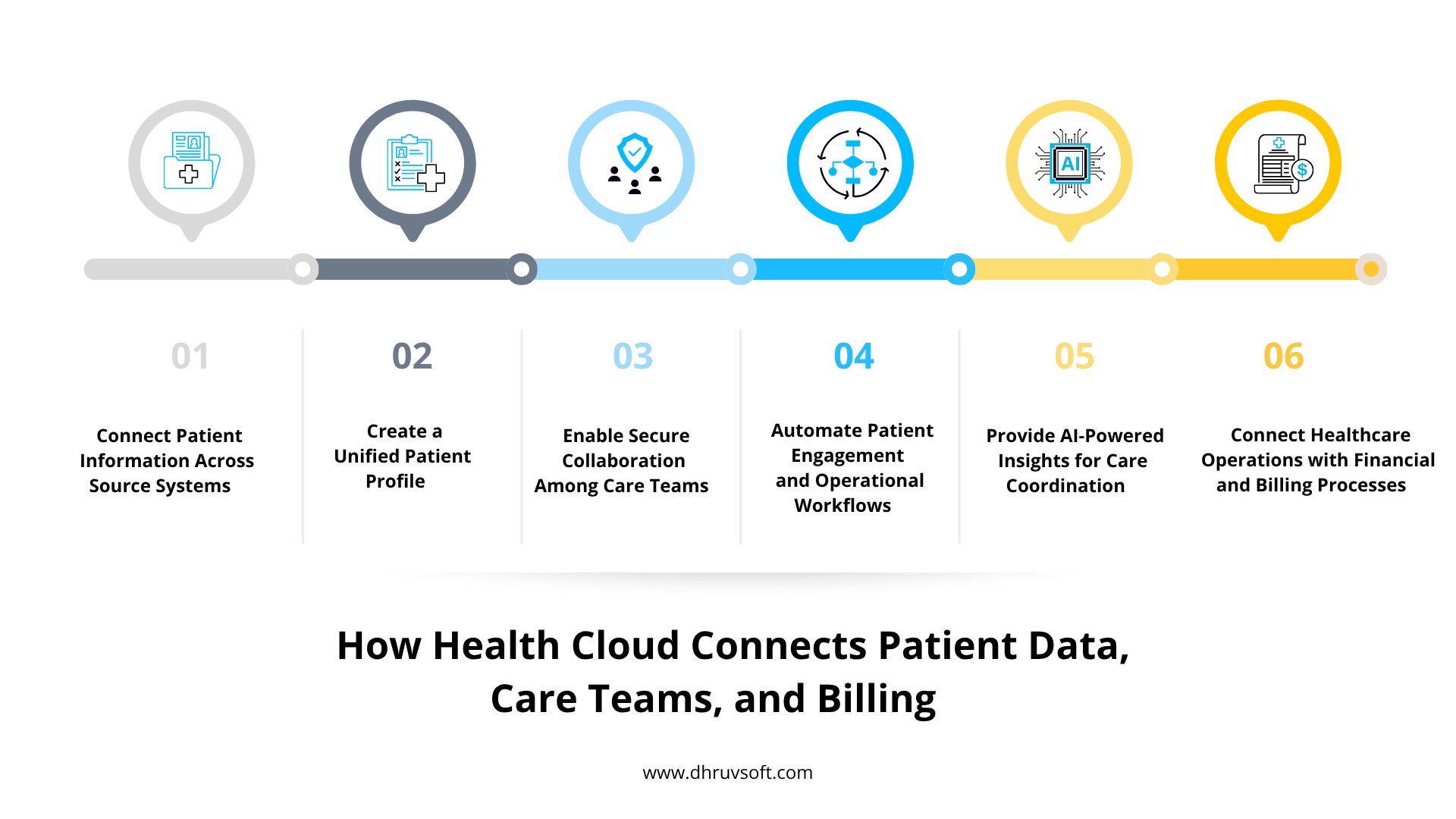
Step 1: Connect Patient Information Across Source Systems
The implementation begins by connecting patient information from the multiple healthcare systems an organization already relies on — scheduling platforms, EHR systems, communication tools, and administrative databases. This integration work establishes the data pipelines that feed the unified patient profile.
Step 2: Create a Unified Patient Profile
With data flowing in from connected systems, the implementation builds the unified patient profile that becomes the central reference point for every care team member. This profile consolidates demographics, care history, appointments, and interactions into a single, comprehensive record.
Step 3: Enable Secure Collaboration Among Care Teams
Role-based access and collaboration tools are configured so that physicians, nurses, care coordinators, and administrative staff can securely share information and coordinate care activities appropriate to their role, while maintaining the access controls that healthcare compliance requires.
Step 4: Automate Patient Engagement and Operational Workflows
Automated workflows are built for the recurring patient engagement and operational processes that previously required manual effort — appointment reminders, follow-up coordination, referral tracking, and task assignment across the care team.
Step 5: Provide AI-Powered Insights for Care Coordination
AI capabilities are configured to surface insights, flag priorities, and support care teams in making faster, better-informed decisions based on the connected data now available within the platform.
Step 6: Connect Healthcare Operations with Financial and Billing Processes
Finally, the implementation connects healthcare operations with financial and billing processes where appropriate within the organization’s broader ecosystem. This connection means billing teams gain clinical and operational context for the encounters they are processing, while care teams gain visibility into the financial dimension of patient care — closing the loop between clinical delivery and the revenue cycle that supports it.
This connected approach, implemented end-to-end, improves operational efficiency across the organization while directly supporting better patient experiences at every stage of the care journey.
Benefits of Salesforce Health Cloud Implementation
Organizations that implement Salesforce Health Cloud can expect a range of measurable benefits, including:
| Benefit Area | What It Means for Your Organization |
|---|---|
| Connected Patient Information | A single, reliable source of truth for every care team member. |
| Better Care Coordination | Fewer dropped hand-offs between providers and departments. |
| Improved Patient Engagement | Personalized, timely communication across every patient touchpoint. |
| Faster Healthcare Workflows | Reduced delays caused by manual, disconnected processes. |
| Reduced Administrative Burden | More staff time is directed toward patient care instead of paperwork. |
| AI-Assisted Healthcare Operations | Proactive insights that help teams anticipate issues instead of reacting to them. |
| Secure Healthcare Data Management | Compliance-aligned handling of sensitive patient information. |
| Better Operational Visibility | A clear, organization-wide view of performance, resources, and operational bottlenecks. |
Why Implementation Expertise Matters for Health Cloud Projects
Salesforce Health Cloud is a powerful platform, but its value is only fully realized through a thoughtful, well-executed implementation. Healthcare organizations have unique workflows, compliance obligations, and integration requirements that differ significantly from standard CRM deployments in other industries.
A successful Health Cloud implementation requires careful planning around data integration with existing EHR and operational systems, role-based access design that respects healthcare compliance boundaries, workflow automation that reflects how care teams actually operate day to day, and a rollout strategy that minimizes disruption to ongoing patient care during the transition.
Organizations that approach Health Cloud implementation without this level of planning often find that the platform is underutilized — deployed with basic functionality but without the deeper integration and automation that delivers its full value. Working with an experienced Salesforce implementation partner that understands both the platform and the realities of healthcare operations significantly improves the likelihood of a successful, high-impact deployment.
How Dhruvsoft Supports Salesforce Health Cloud Implementations
As a Salesforce Partner with over 15 years in business and 200+ Salesforce projects delivered across seven industries, Dhruvsoft brings both platform depth and cross-industry implementation experience to healthcare organizations adopting Health Cloud. Our team of 50+ certified Salesforce consultants has supported 100+ clients through complex, compliance-sensitive roll-outs — and we apply that same rigor to the unique demands of healthcare data, care coordination, and clinical-financial integration.
Our approach begins with understanding how your care teams currently work, where information gaps and manual processes are creating friction, and which integrations with existing EHR and operational systems are essential to a successful rollout.
From there, we configure the unified patient profile, set up secure, role-appropriate collaboration tools for your care teams, build the workflow automations that reduce administrative burden, and connect Health Cloud with your billing and financial processes so that clinical and financial data work together rather than in isolation.
We also support your team through training and change management, recognizing that the success of a Health Cloud implementation depends as much on adoption by your staff as it does on the technical configuration of the platform itself.
Frequently Asked Questions About Salesforce Health Cloud Implementation
Does Salesforce Health Cloud replace our existing EHR system?
No. Health Cloud is designed to complement your EHR, not replace it. It functions as an engagement, data-aggregation, and collaboration layer that sits alongside your clinical systems of record — unifying data from multiple sources into a single patient view without disrupting the clinical infrastructure you’ve already invested in.
Is Salesforce Health Cloud HIPAA compliant?
Salesforce designs Health Cloud with a security-first approach and supports compliance with major healthcare standards, including HIPAA, HL7 FHIR, and HITRUST, among others. Compliance configuration still depends on how the platform is implemented and used within your organization, so proper setup during implementation is essential.
How long does a typical Health Cloud implementation take?
Timelines vary based on the number of systems being integrated, the complexity of your care team workflows, and how much automation and AI configuration is in scope.
Can Health Cloud connect to our billing and financial systems?
Yes. A well-structured Health Cloud implementation can connect clinical and operational data with financial and billing processes, giving billing teams clinical context for encounters and giving care teams visibility into the financial side of patient care.
Can Salesforce Health Cloud integrate with third-party healthcare applications?
Yes. Salesforce Health Cloud can integrate with a wide range of third-party healthcare applications, including Electronic Health Record (EHR) systems, laboratory systems, telehealth platforms, patient portals, payment gateways, and ERP solutions. These integrations help create a unified patient view while reducing data silos and manual data entry.
Which healthcare organizations can benefit from Salesforce Health Cloud?
Salesforce Health Cloud is suitable for hospitals, multi-specialty clinics, diagnostic centers, healthcare providers, health insurance companies, life sciences organizations, pharmaceutical companies, and wellness providers. It can be tailored to meet the operational and patient engagement needs of organizations of all sizes.
Can Salesforce Health Cloud improve patient engagement and retention?
Absolutely. Health Cloud enables personalized communication, appointment reminders, follow-up notifications, wellness campaigns, and self-service experiences. These capabilities help healthcare organizations improve patient satisfaction, strengthen long-term relationships, and encourage better adherence to care plans.
What should organizations consider before implementing Salesforce Health Cloud?
Before implementation, organizations should assess their existing systems, integration requirements, data quality, compliance needs, workflow processes, and user adoption strategy. Partnering with an experienced Salesforce implementation provider ensures a smoother deployment, faster adoption, and better return on investment.
What are Salesforce Health Cloud implementation services?
Salesforce Health Cloud implementation services help healthcare organizations plan, configure, customize, integrate, test, and deploy Salesforce Health Cloud according to their business and healthcare requirements. These services can also include data migration, user training, post-implementation support, and ongoing optimization.
Conclusion: A Connected Platform for Connected Care
Healthcare organizations cannot deliver coordinated, efficient, patient-centered care from fragmented systems. When patient data, care team communication, and billing processes live in separate, disconnected tools, the result is delayed care, frustrated staff, and patients who feel like they are navigating a maze rather than receiving care.
Salesforce Health Cloud addresses this fragmentation directly — bringing patient data, care team collaboration, personalized engagement, AI-powered insights, and billing connectivity together on a single, secure, compliance-ready platform. It does this not by replacing the clinical systems healthcare organizations already rely on, but by connecting and extending them into a more complete, more actionable view of every patient and every care journey.
For healthcare organizations looking to improve care coordination, reduce administrative burden, and deliver more personalized patient experiences, a well-executed Salesforce Health Cloud implementation is one of the most impactful investments available today.
Ready to see how Health Cloud fits your organization? Contact Dhruvsoft for a free readiness assessment and a clear implementation roadmap tailored to your care teams and systems.
 About Ashish Manuka


