AI automation has moved beyond experimentation—it is now actively shaping how modern businesses operate, compete, and grow. Across industries, companies are using AI agents to handle routine tasks, respond to customers faster, and unlock efficiencies that were not possible just a few years ago. For business leaders, this shift is not just about adopting new technology; it is about rethinking how work gets done and how value is created across the organization.
This is where Salesforce Agentforce stands out. Unlike traditional tools that only assist with information, Agentforce introduces autonomous AI agents that can take real actions within your business—whether it’s updating records, managing customer interactions, or supporting sales and service teams at scale. It represents a fundamental change from AI as a helper to AI as an active contributor to business outcomes.
In this post, we break down what Agentforce really means for your bottom line—from how it works in practical terms to where it delivers measurable ROI, what it costs, and how to approach adoption without common mistakes. If you are evaluating AI for your organization, this guide is designed to give you a clear, honest, and business-focused perspective.
The Problem Every Business Leader Recognises
You must have heard this from your leadership team:
“My sales team spends more time entering data than selling.” – Sales Director
“My customer service agents answer the same 50 questions every single day.” – Service Head
“My marketing team sends generic emails and hopes something lands.” – Marketing Lead
Moreover, somewhere in the middle of all of this, valuable customers quietly walk out the door. This is not a people problem. This is a process problem. And Salesforce Agentforce is being positioned as the biggest solution to this problem that enterprise software has ever seen.
But before you sign a contract or book a demo, you need to understand exactly what Agentforce is, what it can actually do for your revenue, and where the real risks lie. This post gives you that honest picture — written for decision-makers, not developers.
What is Salesforce Agentforce?
Agentforce is Salesforce’s AI automation platform, launched in late 2024. It lets businesses build and deploy autonomous AI agents — digital workers that can take independent actions, not just answer questions.
Here is the important distinction – most AI tools you have seen before are like an intelligent search engine. You ask a question; they give you an answer. Agentforce is different. These agents can actually do things — they can update a customer record, send a follow-up email, process a refund, escalate a complaint, schedule a meeting, and complete a sales task — all without a human pressing a button each time.
Think of it this way: previous AI tools gave your team better information. Agentforce gives your team an extra set of hands that never sleeps, never gets tired, and never makes a typo.These agents work directly inside the Salesforce ecosystem — which means if you are already using Salesforce CRM, Sales Cloud, Service Cloud, or Marketing Cloud, Agentforce plugs in without needing a completely separate tech stack.
The Four Types of Agents You Can Deploy
If you classify the agents according to Salesforce Products, you have four key types of agents:
- Sales Agents: Qualify leads, personalize outreach, update pipeline records, and prepare reps for calls — automatically.
- Service Agents: Handle customer queries, process returns, escalate issues, and resolve tickets — around the clock.
- Marketing Agents: Segment audiences, personalize content, trigger campaigns, and analyze performance in real time.
- Custom agents: Agents that automate your custom processes.
How AI Agents Actually Work Inside Your Business
One of the most common questions from business leaders is this: “But how does it know what to do?” That is a fair question. Let us break it down simply.
The 1-2-3 of Agentforce Agents: Every Agentforce agent is built on three foundations:
- First, it has access to your company’s data — your CRM records, customer history, product catalogue, and business rules.
- Second, it has reasoning ability — powered by large language models (the same technology behind ChatGPT, but trained and grounded in your specific business context).
- Third, it can take actions — meaning it can interact with Salesforce and connected systems to do actual work.
When a customer sends a message asking where their order is, the agent does not just pull a generic answer. It checks the customer’s actual order, looks at your logistics system, sees there has been a delay, applies your customer policy on delays, and proactively offers the appropriate resolution — all in under five seconds.
“The shift from AI as an assistant to AI as an autonomous colleague is not a small upgrade. It is a fundamental change in how work gets done. It is not just a technological change – it also involves a change in process and culture.”
The critical thing to understand is that these agents are not rogue. You define the boundaries. You set what they can and cannot do. You decide when a human should take over. The agent works within those guardrails — consistently, at scale, without exceptions.
Seven Core Agentforce Features That Generate Business Value
Let’s explore the Agentforce capabilities that contribute most significantly to operational efficiency, customer engagement, and overall business performance.
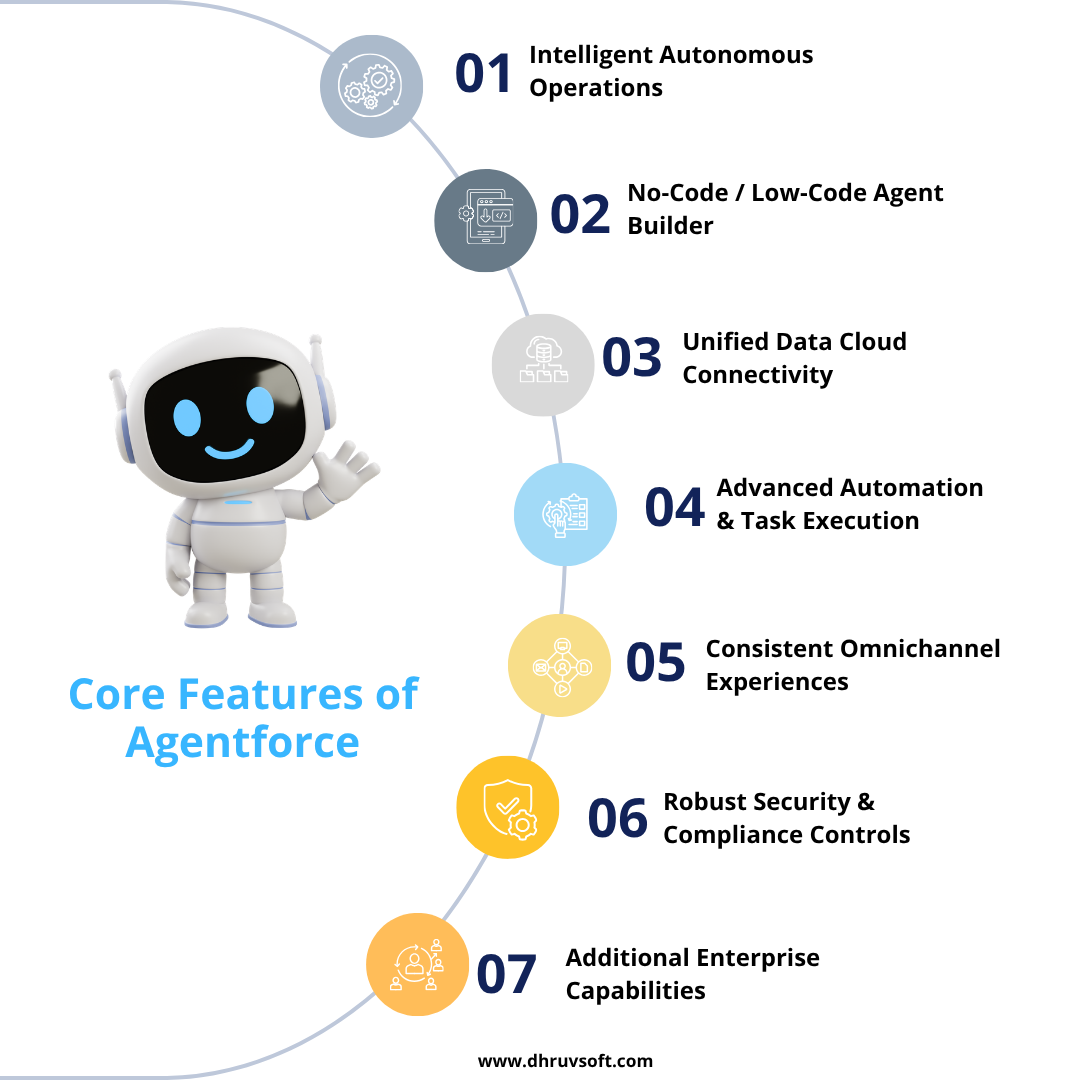
- Intelligent Autonomous Operations: Agentforce goes beyond traditional rule-based chatbots by leveraging advanced AI to analyze situations, make decisions, and perform actions independently across Salesforce solutions like Salesforce Service Cloud, Salesforce Sales Cloud, and Salesforce Marketing Cloud. This helps organizations reduce manual intervention and improve response times.
- No-Code / Low-Code Agent Builder: Organizations can rapidly design and deploy AI agents using simple natural language instructions. With minimal technical expertise, teams can configure workflows, define conversation topics, establish rules, and implement operational guardrails.
- Unified Data Cloud Connectivity: Through integration with Salesforce Data Cloud, Agentforce gains access to centralized, real-time customer and operational data. This enables AI agents to deliver more relevant, data-driven, and personalized interactions based on current business insights.
- Advanced Automation & Task Execution: Agentforce can automate a wide range of business processes, including updating Customer 360 data, initiating approval processes, triggering Flow automations, and integrating with external systems through APIs. These capabilities improve efficiency and streamline daily operations.
- Consistent Omnichannel Experiences: AI agents can engage users across multiple communication platforms such as email, SMS, Slack, web chat, and other digital channels while preserving conversation history and context for a seamless customer experience.
- Robust Security & Compliance Controls: The platform includes enterprise-grade governance mechanisms designed to minimize AI hallucinations, prevent unauthorized access, and support compliance requirements. Features like Agent-Assisted Identity ensure that agents only retrieve information users are authorized to access.
- Additional Enterprise Capabilities: Agentforce also offers external web grounding for more accurate responses, inline source citations for transparency, multilingual support for global users, and automatic model failover mechanisms to maintain system reliability and availability.
Industry-by-Industry Impact: Where is the ROI Highest?
Agentforce does not create equal value for every business. Some industries are seeing dramatically faster and more measurable returns. Here is an honest overview.
| Industry | Primary Use Case | Typical ROI Driver |
|---|---|---|
| Financial Services | Loan processing, client onboarding, compliance queries | Reduced processing time by 60%; lower compliance risk |
| Retail & E-commerce | Order management, returns, personalized upsell | 40–50% ticket deflection; higher average order value |
| Healthcare | Appointment scheduling, patient follow-ups, insurance queries | Staff hours freed; improved patient satisfaction scores |
| Manufacturing | Dealer support, order tracking, and service contracts | Faster quote-to-order cycles; reduced field service costs |
| Technology / SaaS | Customer onboarding, renewal risk detection, and tech support | Lower churn; faster time-to-value for new customers |
| Professional Services | Proposal generation, client communication, and billing queries | Consultant hours refocused on billable work |
The businesses seeing the fastest ROI are those with high volumes of repetitive, data-driven customer interactions. If your team is handling thousands of similar requests every week, Agentforce can transform your economics almost immediately.
What Does Agentforce Actually Cost Your Business?
This is where business leaders often get frustrated — and rightly so, because Salesforce pricing has historically been complex. Here is what you need to know.
Agentforce is priced primarily on a consumption model. Rather than a flat per-seat license, you pay based on the number of agent conversations or actions completed. Salesforce has publicly stated pricing starting around $2 per conversation for some agent types, though enterprise pricing varies based on volume and the specific products deployed.
For context: if your service team handles 50,000 tickets per month and an agent can resolve 60% of them autonomously at $2 per conversation, that is $60,000 per month in agent costs. But if a human agent costs an average of $15–25 per resolved ticket (fully loaded cost), you have just replaced $450,000–$750,000 of labor cost with $60,000 of AI cost. The unit economics can be extraordinary.
Important caveat: these numbers only work if your data is clean, your agents are well-configured, and your use case is genuinely repetitive and high-volume. Businesses that rush deployment without proper data governance often see disappointing results and higher-than-expected costs.
You will also need to factor in implementation costs — either internal Salesforce admin time or an external partner. For a mid-sized business, expect an implementation investment of anywhere from $30,000 to $300,000 depending on complexity, data integration requirements, and the number of use cases.
Common Mistakes Business Leaders Make with Agentforce
After speaking with dozens of businesses that have implemented AI automation platforms, certain patterns emerge in what goes wrong. Here are the most common errors — and how to avoid them.
- Trying to Automate Everything at Once: The businesses that succeed start with one specific, high-volume, well-defined use case. They prove ROI there, learn from it, and then expand. The businesses that fail try to deploy agents across sales, service, and marketing simultaneously — and end up with a complex, hard-to-manage system that does none of it particularly well. Our team of Agentforce consultants at Dhruvsoft uses an Agentforce Maturity Model while implementing this in your organization.
- Assuming the Data is Ready: AI agents are only as smart as the data they can access. If your Salesforce records are incomplete, inconsistent, or siloed across multiple systems, your agents will produce unreliable outputs. Before deploying Agentforce, invest time in data hygiene. This is not glamorous, but it is the difference between a successful deployment and a failed one.
- Forgetting the Human Side of Change: Your service team is going to feel nervous when they hear that AI agents are going to handle 50% of customer tickets. That anxiety is completely natural — and if it is not managed, it turns into resistance that slows down adoption. The most successful Agentforce deployments involve employees early, are transparent about what will change, and make clear that the goal is to free people from the worst parts of their job — not to eliminate them.
- Measuring the Wrong Things: Too many businesses measure Agentforce’s success by how many conversations the AI handles. That is a vanity metric. The metrics that actually matter are customer satisfaction scores, resolution rates on first contact, revenue influenced, and employee time recovered. Measure outcomes, not activity.
How to Get Started: A Practical Roadmap for Business Leaders
If you are convinced that Agentforce deserves serious evaluation, here is a grounded, step-by-step approach to beginning your journey without the common pitfalls.
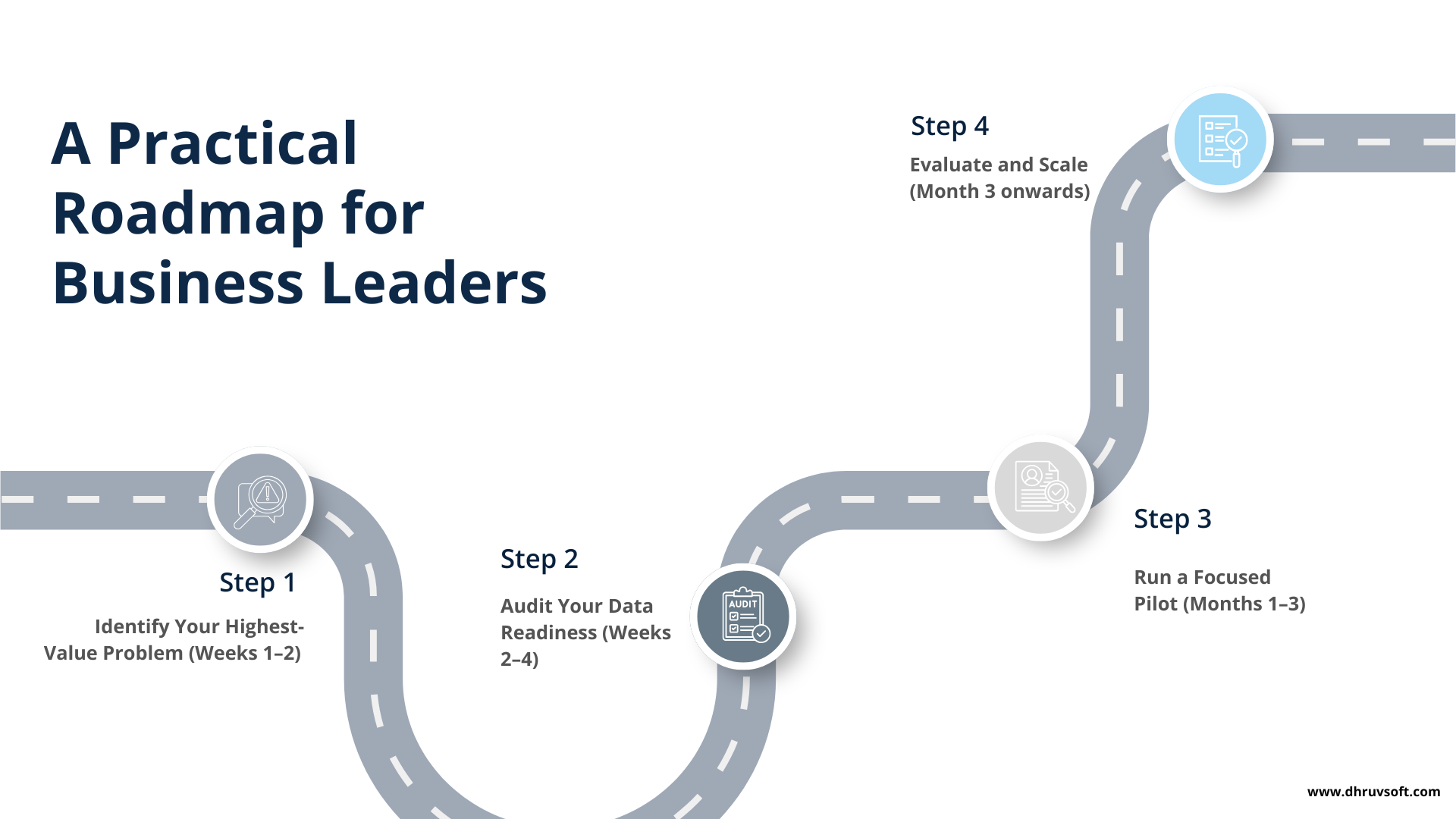
Step 1: Identify Your Highest-Value Problem (Weeks 1–2)
Do not start with technology. Start with business pain. What is the single most repetitive, high-volume, expensive problem in your customer operations right now? Write it down in one sentence. That is your first use case candidate.
Step 2: Audit Your Data Readiness (Weeks 2–4)
Pull a sample of 100 records related to your chosen use case. How complete are they? How consistent is the data format? How up-to-date is the information? This audit will tell you how much pre-work is needed before you can deploy an effective agent.
Step 3: Run a Focused Pilot (Months 1–3)
Work with Salesforce or a certified implementation partner like Dhruvsoft to build a single agent for your chosen use case. Set clear success metrics before you start. Run the pilot alongside your existing team — not instead of them. Measure what matters. Learn fast.
Step 4: Evaluate and Scale (Month 3 onwards)
After 90 days, you will have real data. If the ROI is there, expand to additional use cases. If the pilot struggled, you now know exactly why — and that knowledge is genuinely valuable before you commit to a full-scale deployment.
The businesses that get the most from Agentforce treat it as a product they are continuously improving — not a project with a launch date and a finish line. After the first three months, you can launch new agents every 2-4 sprints over a period of time.
The Competitive Landscape: What if You Do Nothing?
This is the question that should keep business leaders up at night more than any other. What happens if your competitors adopt AI automation and you do not?
The answer is not hypothetical. In competitive sectors, early AI adopters are already seeing measurable advantages. They are responding to customer enquiries faster. They are qualifying leads more accurately. They are personalizing customer experiences at a scale that simply was not economically possible two years ago.
The gap between AI-enabled businesses and those still running manual processes is going to widen significantly over the next two to three years. The businesses that wait for the technology to “mature” before trying it are, in many cases, waiting until it is already too late to catch up without a painful and expensive sprint.
This does not mean you should rush into a poorly planned deployment. It means you should start the evaluation process now, with urgency, so that your decision — whether to proceed, delay, or choose a different platform — is an informed one.
Agentforce vs. the Competition: A Honest Assessment
Salesforce is not the only player in the AI agent space. Microsoft Copilot for Dynamics 365, ServiceNow AI Agents, and various point solutions are all competing for the same budget. So why might Agentforce be the right choice — and when might it not be?
Agentforce makes the most sense for businesses that are already significantly invested in the Salesforce ecosystem. If your CRM, service desk, and marketing platform are all Salesforce products, the integration advantage is substantial. Your data is already in one place, your teams already know the interface, and deployment is meaningfully faster.
If your business runs primarily on Microsoft infrastructure — Office 365, Teams, Dynamics — then Microsoft’s Copilot stack deserves equal consideration. If you are a pure-play e-commerce business, there may be more specialized solutions that deliver faster ROI.
The honest answer is that platform selection should follow your existing infrastructure, your data architecture, and where your customer-facing operations are already managed — not brand loyalty or analyst hype.
The Bottom Line: What This Actually Means for Your Business
Salesforce Agentforce is a genuinely transformative technology — not in the breathless way that AI tools are usually marketed, but in a practical, measurable way. It can reduce operational costs in customer-facing functions. It can accelerate revenue cycles. It can allow your best people to spend their time on high-value work rather than administrative noise.
The ROI is real, but it is not automatic. It requires good data, a focused starting point, thoughtful change management, and a willingness to treat deployment as an ongoing product investment rather than a one-time project.
The businesses that will win with Agentforce are not the ones with the biggest budgets. They are the ones with the clearest problem to solve, the discipline to start small, and the leadership to champion the change internally.
If that describes your organization, then the question is not whether to explore Agentforce. The question is how quickly you can start your first pilot — before the business sitting next to you in your market does it first.
Ready to Evaluate Agentforce for Your Business?
Begin with a practical step—have an honest internal discussion about your highest-cost, most repetitive customer operations. These are often the areas where automation can deliver the most value.
If you need support in identifying the right starting point and building a clear roadmap, the Dhruvsoft team can help you move forward with confidence.
 About Sunil K


