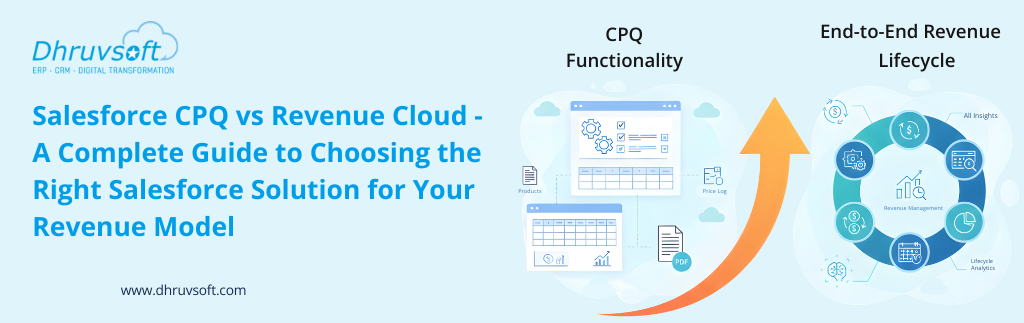
Are you looking for a comparison between Salesforce CPQ and Revenue cloud – here is a complete guide to choosing the right Salesforce.com solution for your revenue model. In this post, we drill down deep into the nuances of each solution and explain to you which solution to pick for your needs.
Why Revenue Operations Are Evolving
Revenue operations have changed dramatically over the last decade. Earlier, most organizations followed a simple deal-based selling model—a sales rep created an opportunity, closed the deal, and finance raised an invoice. That approach worked when products were simple and revenue models were predictable.
Today, revenue is far more complex.
Organizations now sell:
- Subscription-based products and SaaS offerings
- Usage-based or consumption pricing
- Bundled products and recurring services
- Contracts with upgrades, downgrades, renewals, and expansions
This shift has created growing pressure across pricing, quoting, billing, renewals, and revenue visibility. Sales, finance, and operations teams must work together far more closely than before.
Disconnected systems slow teams down. Manual processes introduce errors. Leadership struggles to forecast revenue accurately.
To address this, Salesforce has evolved its platform beyond traditional CRM into a complete revenue lifecycle ecosystem. Two solutions sit at the centre of this evolution: Salesforce CPQ and Salesforce Revenue Cloud.
The purpose of this article is to help organizations clearly understand the difference between Salesforce CPQ and Revenue Cloud, evaluate which solution fits their revenue model, and make a confident, future-ready decision.
Understanding the Revenue Lifecycle in Salesforce
What Is the Revenue Lifecycle?
The revenue lifecycle represents every stage a customer goes through—from first interaction to long-term value creation. In Salesforce, this lifecycle typically includes four major stages:
- Lead-to-Opportunity: Capturing leads, qualifying prospects, and converting them into sales opportunities.
- Quote-to-Contract: Configuring products, applying pricing and discounts, generating quotes, and formalising agreements.
- Order-to-Cash: Billing, invoicing, payments, revenue recognition, and financial reconciliation.
- Renewals and Expansions: Managing renewals, upgrades, cross-sell, and long-term customer growth.
A modern revenue platform must support all these stages seamlessly without forcing teams to rely on disconnected tools.
Why Traditional CRMs Fall Short
Traditional CRM systems were built primarily to track sales activities and pipeline stages. As revenue models grew more complex, several limitations became clear:
- Manual quoting and pricing errors due to spreadsheets and offline tools
- Billing handled outside the CRM, often in ERP or accounting systems
- Limited revenue forecasting and visibility, especially for subscriptions and renewals
As a result, sales teams lose speed, finance teams lose accuracy, and leadership loses confidence in revenue numbers.
Salesforce’s Evolution: From Sales Cloud to Revenue Cloud
Salesforce addressed these gaps through a phased evolution:
- Sales Cloud – Lead, Opportunity, and Deal pipeline management
- Salesforce CPQ – Structured product configuration, pricing, and quoting
- Salesforce Revenue Cloud – Fully featured revenue lifecycle management
Salesforce is now investing heavily in Revenue Cloud because it aligns with how modern businesses generate, manage, and scale revenue.
Salesforce CPQ: Overview and Capabilities
What Is Salesforce CPQ?
Salesforce CPQ stands for Configure, Price, Quote.
It is designed to help sales teams create accurate, consistent quotes for complex products and pricing models.
CPQ focuses primarily on accelerating the quoting process while reducing errors and manual effort.
Configure, Price, Quote Explained
- Configure – Ensures products, bundles, and options are selected correctly
- Price – Applies pricing rules, discounts, and approvals based on selected bundles or product configuration
- Quote – Generates professional, customer-ready quotes
This structure removes guesswork and ensures deals follow company pricing policies.
Role of CPQ in Accelerating Sales Cycles
Salesforce CPQ helps sales teams:
- Reduce back-and-forth with finance or quoting teams
- Eliminate pricing inconsistencies
- Generate quotes faster
- Close deals with confidence
For sales-driven organizations, CPQ directly improves productivity and win rates.
Core Features of Salesforce CPQ
- Product configuration and bundling rules
- Pricing models and discount approval workflows
- Quote templates and automated document generation
- Guided selling tools for sales representatives
Strengths of Salesforce CPQ
Salesforce CPQ delivers strong value when:
- Pricing rules must be enforced consistently
- Quotes need to be generated quickly
- Sales teams need structured guidance
Key benefits include:
- Reduced manual quote errors
- Improved deal consistency
- Faster quote turnaround
Limitations of Salesforce CPQ
Despite its strengths, CPQ is not a complete revenue solution.
Common limitations include:
- Limited native billing functionality
- Subscription management constraints
- Heavy dependency on ERP or finance systems
- Limited support for renewals and amendments
CPQ works best when billing complexity is low and finance processes are managed outside Salesforce.
Salesforce Revenue Cloud: Overview and Capabilities
What Is Salesforce Revenue Cloud?
Salesforce Revenue Cloud is a comprehensive – end-to-end quote-to-cash platform built natively on Salesforce.
It goes far beyond quoting to manage:
- Contracts
- Billing and invoicing
- Renewals and amendments
- Revenue forecasting and analytics
Revenue Cloud brings departments like sales, finance, and operations on a single software platform.
What are Core Features of Salesforce Revenue Cloud
- Advanced CPQ capabilities
- Subscription and usage-based billing
- Contract lifecycle management
- Amendments, renewals, and upgrades
- Revenue forecasting and analytics
These features enable organizations to manage revenue as a continuous lifecycle—not isolated transactions.
Strengths of Salesforce Revenue Cloud
Revenue Cloud is designed for complex and scalable revenue models.
Key strengths include:
- Unified quote-to-cash visibility
- Better alignment between sales and finance
- Reduced integration complexity
- Support for SaaS and recurring revenue
Why Salesforce Is Pushing Revenue Cloud
Salesforce is prioritising Revenue Cloud because it:
- Supports modern SaaS and consumption-based pricing
- Reduces reliance on multiple third-party tools
- Enables AI-driven revenue insights
- Future-proofs revenue operations
Revenue Cloud represents Salesforce’s long-term vision for revenue management.
Salesforce CPQ vs Revenue Cloud: Detailed Comparison
| Feature / Capability | Salesforce CPQ | Salesforce Revenue Cloud |
|---|---|---|
| Core Purpose | A quoting tool that helps sales teams configure products, apply pricing rules, and generate quotes quickly and accurately. It focuses on selling and quoting. | A unified quote-to-cash and revenue lifecycle platform, managing quoting, billing, subscriptions, contracts, fulfilment, and revenue. |
| Product Configuration | Supports configurable product bundles and rules for accurate sales quotes. | Includes CPQ capabilities plus broader product catalogue management across the revenue lifecycle. |
| Pricing & Discounts | Handles pricing and discount logic for sales quotes. | Handles advanced pricing strategies, dynamic models, and complex pricing across multiple revenue streams. |
| Quoting | Primary focus — creating accurate, approved quotes for sales deals. | Includes quoting as part of an end-to-end revenue process. |
| Billing & Invoicing | Requires external billing or integration with finance/ERP systems. | Built-in billing, invoicing, and revenue collection functionality. |
| Subscription & Usage Models | Limited support; often needs add-ons or separate tools. | Native support for subscriptions, usage-based billing, renewals, and consumption billing. |
| Contract Lifecycle Management (CLM) | Basic contract support tied to quoting workflow. | Advanced CLM — automation for contract terms, renewals, amendments. |
| Order Management & Fulfilment | Not included; typically handled externally. | Native order management with automated fulfilment workflows. |
| Revenue Recognition | Not natively supported; requires external system or extensions. | Built-in revenue recognition and compliance support (ASC 606/IFRS 15). |
| Platform Architecture | Salesforce CPQ is a Managed package built on top of Sales Cloud. Extending a Managed package can be complex. | Native Salesforce platform (Einstein 1 / Agentforce 360) — unified data model and integrated ecosystem. Extending native applications is relatively less complex. |
| Target Users | Sales teams focused on accurate quotation and pricing. | Sales, finance, revenue operations, services, and customer success teams. |
| Best For | Organizations needing robust quoting and pricing but simpler revenue models. | Businesses with complex revenue models — subscriptions, billing, renewals, usage pricing, and full revenue automation. |
Summary of Key Differences
- Salesforce CPQ is ideal for structured quoting and pricing workflows within sales.
- Salesforce Revenue Cloud (also known as Agentforce Revenue Management) builds on CPQ and adds billing, subscription, and full revenue lifecycle automation, making it suitable for modern revenue operations.
Choosing the Right Solution Based on Business Scenarios
When Salesforce CPQ Is the Right Choice
Salesforce CPQ is a strong fit if your organization:
- Sells primarily deal-based products
- Has limited billing complexity
- Is sales-driven rather than finance-led
- Needs to fix short-term quoting challenges
CPQ is often the right starting point for organizations early in their revenue maturity journey.
When Salesforce Revenue Cloud Is the Better Choice
Salesforce Revenue Cloud is the better choice if you:
- Run a subscription or SaaS business
- Manage complex billing, renewals, and amendments
- Require strong finance governance
- Are scaling rapidly
Revenue Cloud supports long-term growth without rework.
CPQ Today, Revenue Cloud Tomorrow
Many organizations follow a phased revenue transformation approach:
- Start with CPQ to standardise quoting
- Move to Revenue Cloud as revenue complexity increases
This approach allows organizations to evolve without creating technical debt.
Implementation Considerations
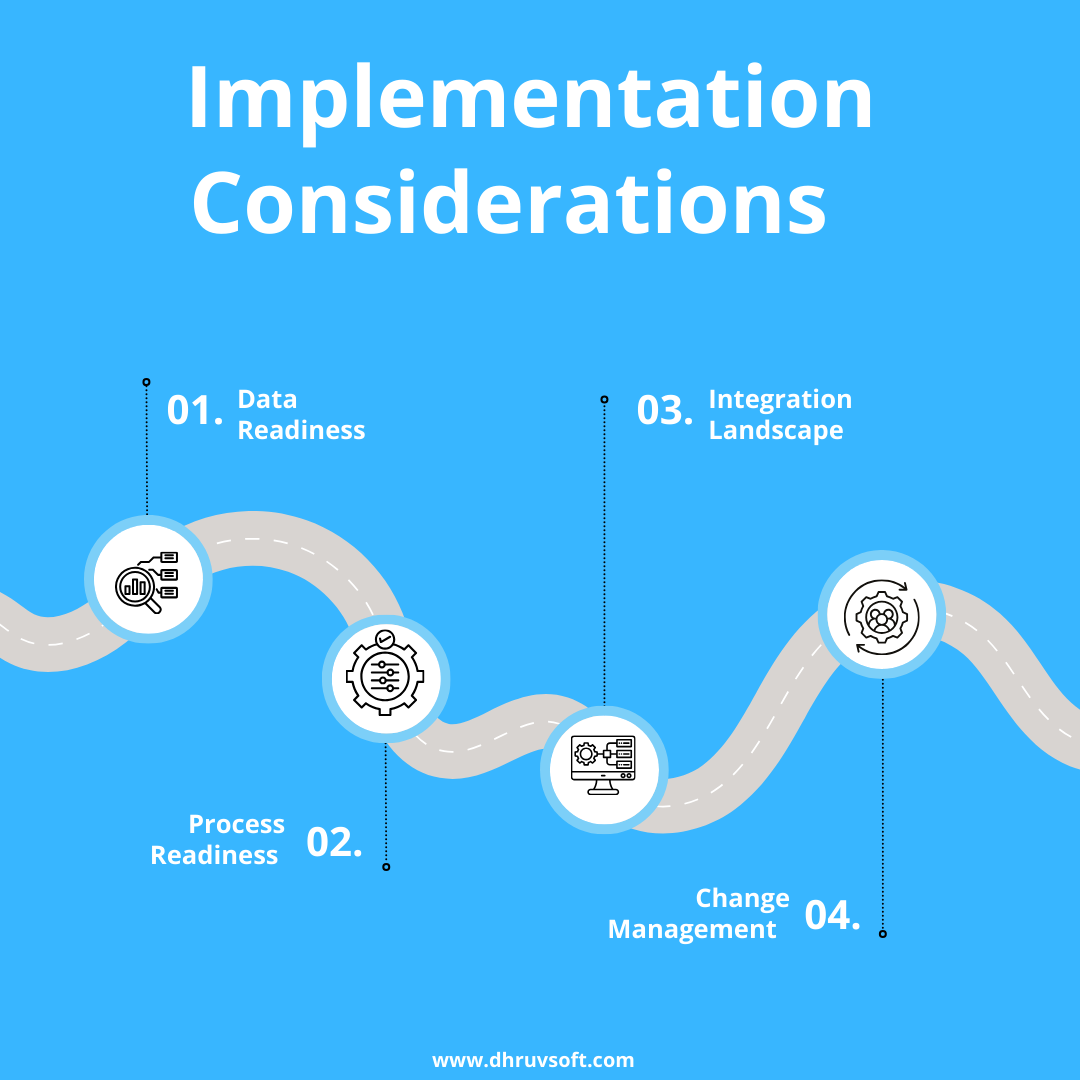
Data Readiness
Successful implementation requires:
- A clean product catalogue
- Clear pricing and discount structures
- Accurate contract and billing data
Poor data quality undermines both CPQ and Revenue Cloud.
Process Readiness
Revenue solutions demand alignment between:
- Sales
- Finance
- Operations
Standardized workflows must be defined before implementation begins.
Integration Landscape
Organizations must evaluate:
- ERP and accounting systems
- Reporting and analytics tools
- Data synchronisation requirements
Integration planning reduces downstream complexity.
Change Management
Revenue transformation is not just a system change.
It requires:
- Sales and finance adoption planning
- Role-based training
- Governance and ownership models
Without adoption, even the best platform fails.
Common Mistakes Organizations Make
- Choosing CPQ when Revenue Cloud is required
- Over-customizing CPQ
- Ignoring future revenue complexity
- Treating revenue transformation as only a sales project
Avoiding these mistakes protects ROI and scalability.
Dhruvsoft’s Perspective on CPQ vs Revenue Cloud
Dhruvsoft follows a business-model-first approach to revenue transformation.
Our focus includes:
- Revenue maturity assessment
- Selecting the right solution—not the most complex or fancy one
- Avoiding technical debt
- Designing scalable Salesforce revenue architectures
We align Salesforce solutions with real business outcomes.
Key Questions to Ask Before Deciding
Before choosing CPQ or Revenue Cloud, ask:
- What revenue models do we support today and tomorrow?
- How complex is our billing and renewal process?
- Do sales and finance work from the same data today?
- Are we scaling fast?
Clear answers lead to confident decisions.
Conclusion & Next Steps
Salesforce CPQ and Revenue Cloud serve different stages of revenue maturity.
- CPQ improves quoting efficiency
- Revenue Cloud transforms revenue operations
The right choice depends on complexity, scale, and growth vision. A strategic evaluation ensures long-term ROI and future readiness. As a next step, you can contact our team to see a demo of these products.
Not sure whether Salesforce CPQ or Revenue Cloud is right for your business?
Dhruvsoft helps organizations assess, implement, and scale Salesforce revenue solutions with confidence. Talk to our Salesforce CPQ and Revenue Cloud experts today.
 About Firoz Basha


