How to Configure Salesforce to Enhance Campaign Management and Lead Generation
Why Marketing Needs a Customized CRM
Marketing has evolved from being a support function to becoming a core driver of revenue growth. Today’s organizations rely on marketing teams not only to generate leads but also to influence the pipeline, improve conversion rates, and contribute directly to business outcomes. However, achieving this level of impact requires more than creativity and campaigns—it requires the right technology foundation.
Many organizations struggle because their marketing tools are disconnected. Data is scattered across multiple systems, campaign performance is difficult to measure, and attribution remains unclear. As a result, marketing teams often operate without a clear understanding of what is working and what is not.
This is where Salesforce becomes powerful—but only when you customize Salesforce for Marketing Campaigns.
Out-of-the-box CRM configurations are primarily designed for sales processes. While Salesforce Sales Cloud offers strong capabilities, it does not automatically align with marketing workflows unless it is tailored to do so. Without customization, marketing teams may face challenges such as incomplete campaign tracking, lack of segmentation, and limited visibility into performance metrics.
At Dhruvsoft, the approach is simple: a CRM should be designed around how marketing actually works. When Salesforce is configured to support campaign management, lead nurturing, and performance tracking, it becomes a central system that drives measurable marketing success.
The Role of Salesforce CRM in Modern Marketing Operations
Salesforce as a Marketing Data Hub
In modern marketing environments, data is everything. Every interaction—whether it is an email click, website visit, webinar registration, or social media engagement — generates valuable insights. However, without a centralised system, this data becomes fragmented and difficult to use.
Salesforce acts as a single source of truth by bringing together customer, lead, and campaign data into one platform. This centralization allows marketing teams to:
- Understand customer behaviour across channels
- Track engagement history in one place
- Build unified customer profiles
- Enable better targeting and personalization
When properly configured, Salesforce eliminates data silos and ensures that both marketing and sales teams are working with consistent, accurate information.
Aligning Marketing with Revenue Goals
One of the biggest challenges organizations face is aligning marketing activities with revenue outcomes. Marketing teams often focus on metrics like impressions and clicks, while leadership expects pipeline contribution and revenue impact.
Salesforce bridges this gap by enabling:
- Campaign influence tracking
- Pipeline contribution measurement
- Revenue attribution to marketing efforts
With the right configuration, organizations can clearly see how campaigns contribute to opportunities and closed deals. This shifts marketing from a cost centre to a revenue-generating function.
Importance of End-to-End Visibility
Modern customer journeys are complex. A single prospect may interact with multiple campaigns across different channels before making a purchase decision.
Salesforce provides end-to-end visibility by tracking:
- Lead generation sources
- Campaign interactions
- Conversion stages
- Opportunity progression
This visibility helps marketing teams understand the full customer journey and optimize campaigns accordingly.
How to Design a Strong Campaign Management Framework with Salesforce
Campaign Hierarchy and Structure
A well-defined campaign structure is the foundation of effective campaign management in Salesforce. Without it, reporting becomes inconsistent and difficult to interpret.
Salesforce allows organizations to create parent-child campaign hierarchies. For example:
- Parent Campaign: Annual Marketing Strategy
- Child Campaigns:
- Email Campaigns
- Paid Ads
- Events
- Webinars
This structure helps in organizing campaigns by region, product line, or channel, making it easier to analyse performance at both granular and aggregated levels.
Multi-Channel Campaign Tracking
Marketing today is multi-channel by nature. Organizations run campaigns across:
- Email marketing
- Social media
- Paid advertising
- Events and webinars
Salesforce enables unified tracking of all these channels within a single platform. This ensures that performance data is consolidated and accessible, allowing teams to compare channel effectiveness and optimize budget allocation.
Campaign Member Status Configuration
Campaign Member Status is a critical yet often overlooked feature in Salesforce. It allows organizations to track how individuals interact with campaigns.
Statuses can include:
- Sent
- Opened
- Clicked
- Registered
- Attended
By defining these stages clearly, marketing teams can measure engagement levels and identify which campaigns are driving meaningful interactions.
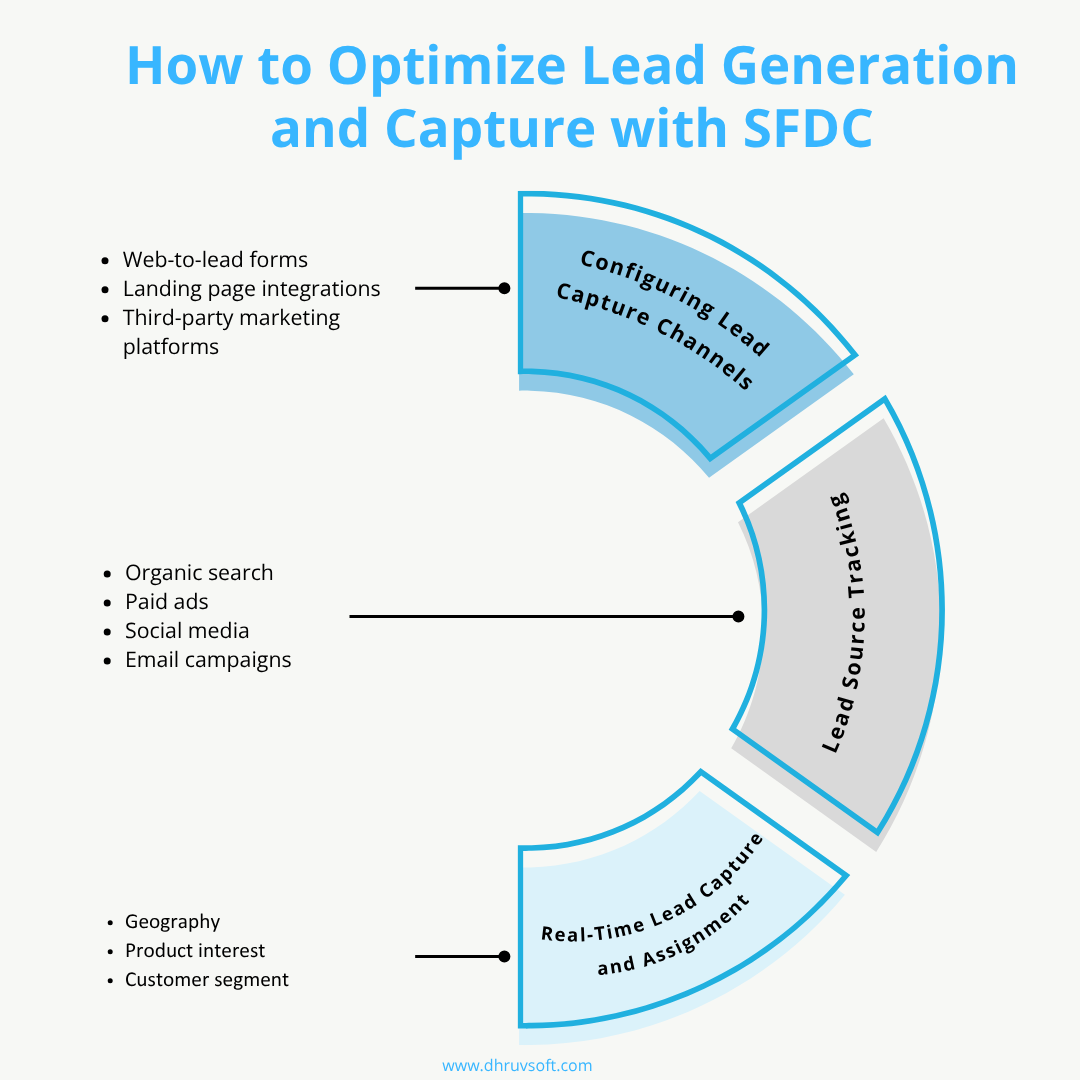
How to Optimize Lead Generation and Capture with SFDC
Configuring Lead Capture Channels
Effective lead generation starts with capturing data accurately. Salesforce.com supports multiple lead capture methods, including:
- Web-to-lead forms
- Landing page integrations
- Third-party marketing platforms
By integrating these channels with Salesforce, organizations ensure that all leads are captured in real time and stored in a centralised system.
Lead Source Tracking
Understanding where leads come from is essential for optimising marketing investments. Salesforce allows organizations to track lead sources such as:
- Organic search
- Paid ads
- Social media
- Email campaigns
This data helps marketing teams identify high-performing channels and allocate resources more effectively.
Real-Time Lead Capture and Assignment
Speed is critical in lead management. The faster a lead is followed up, the higher the chances of conversion.
Salesforce enables automated lead assignment based on:
- Geography
- Product interest
- Customer segment
This ensures that leads are routed to the right sales representatives instantly, improving response times and conversion rates.
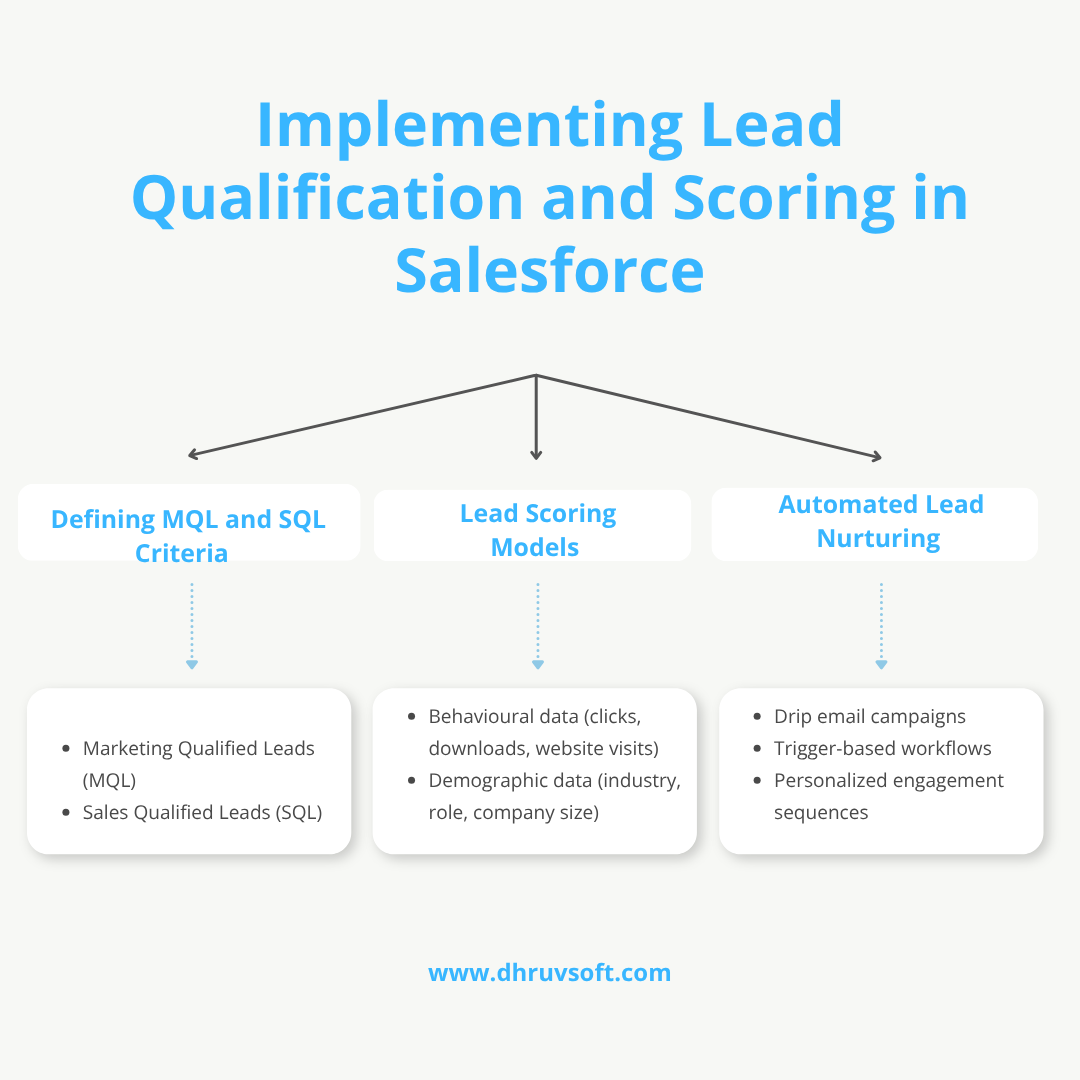
Implementing Lead Qualification and Scoring in Salesforce.com
Defining MQL and SQL Criteria
A common challenge in organizations is the lack of alignment between marketing and sales when it comes to lead quality.
Salesforce helps define clear criteria for:
- Marketing Qualified Leads (MQL)
- Sales Qualified Leads (SQL)
This alignment ensures that only high-quality leads are passed to sales, improving efficiency and conversion rates.
Lead Scoring Models
Lead scoring is essential for prioritising prospects. Salesforce can be configured to assign scores based on:
- Behavioural data (clicks, downloads, website visits)
- Demographic data (industry, role, company size)
This allows marketing and sales teams to focus on leads with the highest potential.
Automated Lead Nurturing
Not all leads are ready to convert immediately. Salesforce supports automated nurturing through:
- Drip email campaigns
- Trigger-based workflows
- Personalized engagement sequences
These capabilities help maintain engagement and move leads through the funnel over time.
Integrating Marketing Automation with Salesforce
Email Marketing Integration
Salesforce can be integrated with email marketing tools to:
- Execute campaigns
- Track performance
- Analyse engagement
This integration ensures that email data is directly linked to leads and opportunities.
Marketing Automation Platforms
Advanced marketing strategies require automation tools that support:
- Lead nurturing
- Journey-based campaigns
- Behavioural tracking
You can use Salesforce Marketing Cloud for implementing these advanced marketing strategies. Integrating these platforms with Salesforce enhances its capabilities and provides deeper insights.
Multi-Channel Integration
Salesforce can also integrate with:
- Social media platforms
- Advertising tools
- Event and webinar systems
- eCommerce systems like Salesforce Commerce Cloud
- Organization based third party system including back office systems or ERPs
This creates a connected ecosystem where all marketing activities are tracked and analysed in one place. One such platform to unify customer data is Salesforce Data Cloud which is designed to collect, aggregate, and analyse customer data in real time from multiple sources.
Design Salesforce Data Model for Marketing Insights
Custom Fields for Segmentation
Segmentation is key to personalized marketing. Salesforce allows organizations to create custom fields, such as:
- Industry
- Campaign source
- Engagement level
These fields enable targeted campaigns and better customer experiences.
Data Governance and Quality
Poor data quality can undermine even the best marketing strategies. Salesforce supports:
- Deduplication rules
- Validation processes
- Data enrichment
Maintaining clean and accurate data ensures reliable reporting and decision-making.
Consent and Compliance Management
With increasing data privacy regulations, managing customer consent is critical. Salesforce enables:
- Opt-in tracking
- Communication preferences
- Compliance with regulations like GDPR and DPDP
This ensures that marketing activities remain compliant and trustworthy.
Automation to Improve Salesforce Marketing Efficiency
Workflow Automation
Automation reduces manual effort and improves efficiency. Salesforce workflows can automate:
- Lead follow-ups
- Campaign triggers
- Task assignments
Alerts and Notifications
Real-time alerts help teams act quickly. Examples include:
- Notifications for hot leads
- Campaign performance alerts
Reducing Manual Effort
By automating repetitive tasks, marketing teams can focus on strategy and creativity instead of administrative work.
Reporting and Analytics for Marketing Campaign Success
Campaign Performance Dashboards
Salesforce provides dashboards that track:
- ROI
- Cost analysis
- Channel performance
Lead Funnel and Conversion Tracking
Organizations can track the entire funnel:
- Lead → Opportunity → Customer
This helps identify bottlenecks and improve conversion rates.
Advanced Attribution Models
Salesforce supports multiple attribution models:
- First-touch
- Last-touch
- Multi-touch
These models provide a deeper understanding of campaign impact.
Align Sales and Marketing Through Salesforce
Defining SLAs Between Teams
Clear service-level agreements ensure accountability. These include:
- Lead response times
- Ownership rules
Feedback Loops
Sales feedback helps marketing refine strategies and improve lead quality. Create a closed feedback loop for effective alignment between Sales and Marketing.
Shared Metrics and Dashboards
Both teams can track:
- Pipeline contribution
- Revenue impact
This alignment improves collaboration and results.
Case Study: Marketing Transformation with Salesforce
Challenge
A professional services organization based in North America relied on multiple disconnected marketing tools, leading to fragmented data and inconsistent campaign execution. Visibility into campaign performance was limited, making it difficult to measure impact. As a result, lead conversion rates remained low, and sales teams lacked confidence in marketing-generated leads.
Solution
A customized campaign structure was implemented within Salesforce to align marketing activities with business goals. The platform was integrated with marketing automation tools to ensure seamless data flow and tracking. Automated lead capture, scoring, and nurturing workflows were introduced to improve efficiency and lead quality.
Results
The organization achieved a significant improvement in lead-to-opportunity conversion, significantly enhancing pipeline quality. Campaign ROI doubled within six months due to better targeting and tracking. Faster lead response times and improved alignment between sales and marketing teams led to stronger overall performance.
Common Mistakes to Avoid when implementing Salesforce for Marketing
- Over-customizing without clear processes: Customizing systems without defined marketing workflows leads to confusion and inefficiency. The platform may become complex and difficult to manage. Clear processes should always come before customization.
- Ignoring data quality: Poor data quality results in inaccurate targeting, reporting, and campaign performance. Incomplete or duplicate records reduce trust in the system. Regular data cleaning and governance are essential.
- Lack of alignment between marketing and sales: When marketing and sales are not aligned, lead hand-offs and follow-ups suffer. This creates gaps in the customer journey and lowers conversion rates. Strong collaboration ensures better pipeline outcomes.
- Poor campaign structure: Unstructured campaigns make it difficult to track performance and measure ROI. Without a clear hierarchy, reporting becomes inconsistent and confusing. A well-defined campaign structure improves visibility and control.
- Not leveraging automation: Failing to use automation leads to manual effort and slower processes. Opportunities for lead nurturing, scoring, and follow-ups are missed. Automation improves efficiency and enhances overall marketing performance.
Avoiding these mistakes helps build a more effective, scalable, and results-driven marketing strategy.
Five Best Practices for Salesforce Marketing Customization
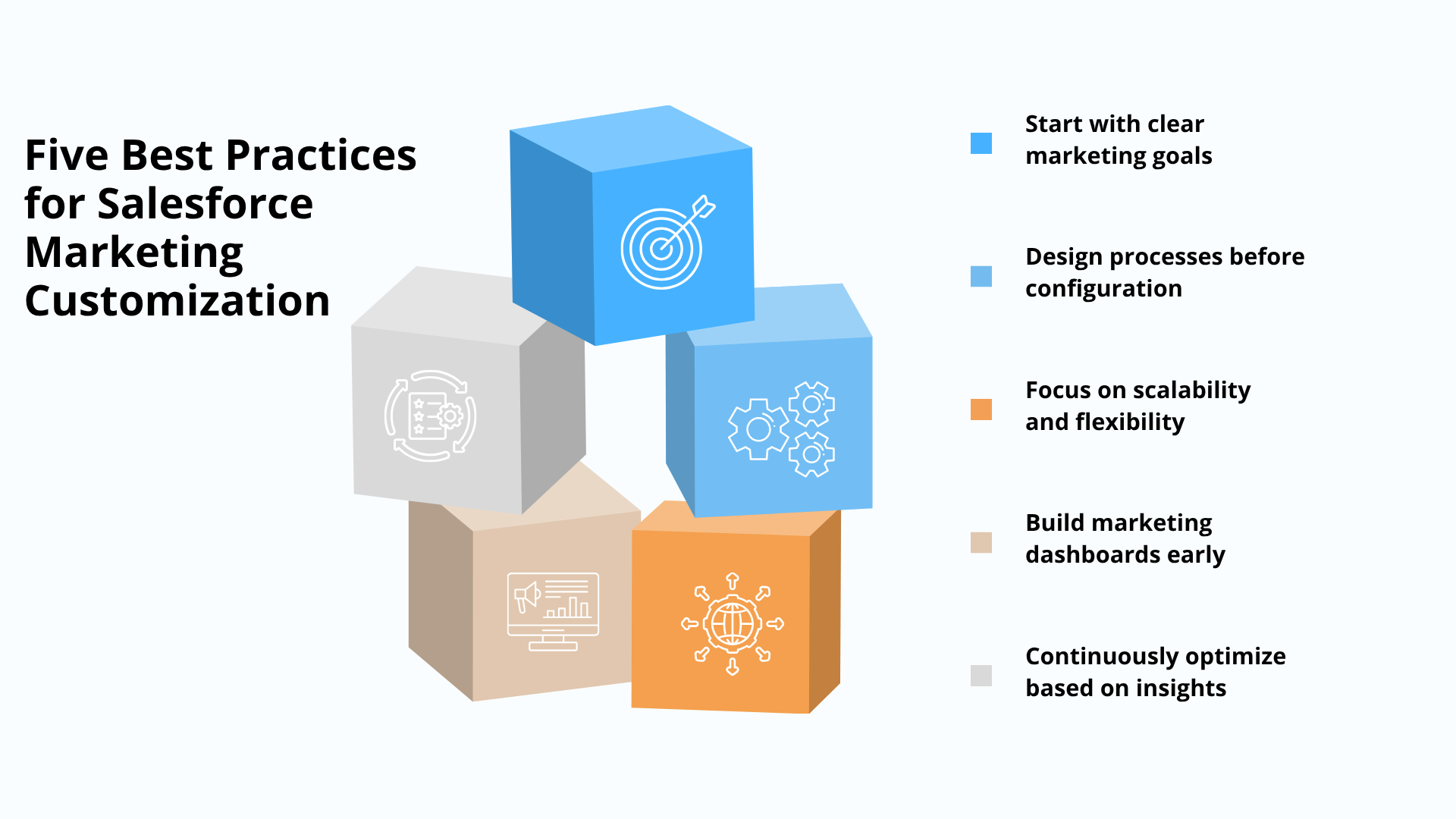
- Start with clear marketing goals: Before customising Salesforce, define what you want to achieve—such as lead generation, campaign ROI, or customer engagement. Clear goals ensure the system is built with purpose. This helps measure success and avoid unnecessary complexity.
- Design processes before configuration: Marketing workflows and customer journeys should be clearly mapped before system setup. This ensures the CRM reflects real business processes rather than forcing changes later. A well-designed process reduces rework and improves efficiency.
- Focus on scalability and flexibility: Customization should support future growth and evolving marketing strategies. Flexible configurations allow you to adapt campaigns, channels, and data models easily. This ensures Salesforce continues to meet business needs over time.
- Build marketing dashboards early: Dashboards provide visibility into campaign performance and pipeline impact from the start. Early setup helps marketing teams track KPIs and make data-driven decisions. This improves accountability and performance monitoring.
- Continuously optimize based on insights: Marketing strategies should evolve based on real-time data and performance insights. Regularly refine campaigns, workflows, and lead scoring models. Continuous optimization ensures better ROI and long-term success.
Why Partnering with Dhruvsoft Matters?
Dhruvsoft brings deep expertise in Salesforce implementation and customization. The team focuses on:
- Designing marketing-centric CRM systems
- Building scalable campaign frameworks
- Integrating marketing automation tools
- Providing ongoing optimization and support
This ensures that organizations not only implement Salesforce but also maximize its value.
Conclusion
Customizing Salesforce for marketing is no longer optional—it is essential. Organizations that invest in a well-configured CRM gain:
- Better campaign performance
- Higher lead conversion rates
- Improved ROI
- Stronger alignment between marketing and sales
Salesforce becomes more than just a CRM—it becomes a growth engine.
Looking to transform your marketing operations with Salesforce?
Dhruvsoft helps organizations design and customize Salesforce to improve campaign performance, accelerate lead generation, and deliver measurable revenue impact. Review our Salesforce Services and Marketing Cloud Implementation Services for more information.
Connect with Dhruvsoft experts today and build a marketing system that drives real business results.
 About Ravi Achana


