
Many organizations believe that choosing the right CRM platform is the most important step in a CRM initiative. In reality, technology is only a small part of the success equation. The real success of a CRM program depends on how ready the organization is to adopt new ways of working.
Salesforce is one of the most powerful and flexible CRM platforms in the world. It can support complex sales processes, multi-channel service operations, advanced marketing automation, and deep analytics. However, Salesforce is not a plug-and-play tool. It does not automatically fix broken processes, poor data quality, or organizational silos.
CRM success depends more on readiness than on technology
Across industries, we see a consistent pattern: organizations invest heavily in Salesforce licenses and implementation projects, but the business results fall short of expectations. User adoption is low, data quality is poor, and leadership does not trust the reports coming out of the system. In most of these cases, the problem is not Salesforce. The real issue is that the organization was not ready for CRM transformation.
CRM success requires:
- Clear business processes
- Strong leadership sponsorship
- Disciplined data practices
- Willingness to change how teams work
Without these foundations, even the best CRM platform will struggle to deliver value.
Salesforce as a powerful platform—but not a plug-and-play solution
Salesforce is designed to be configured around your business. This flexibility is a major strength, but it also means that Salesforce reflects the maturity of your organization. If your processes are unclear, Salesforce will become confusing. If your governance is weak, Salesforce will become chaotic. If your culture resists transparency, Salesforce will face adoption challenges.
Why organizations fail when readiness is overlooked
Organizations typically fail in CRM initiatives when they:
- Automate broken or undefined processes
- Migrate poor-quality and ungoverned data
- Underestimate the impact of change on users
- Over-customize Salesforce too early
- Treat Salesforce as an IT project instead of a business transformation
Salesforce implementations as business transformation initiatives
A Salesforce implementation is not just about deploying software. It is about:
- Redesigning how sales teams sell
- Redefining how service teams support customers
- Aligning marketing with revenue outcomes
- Creating a single, trusted view of the customer
In short, it is a business transformation program, and like any transformation, it requires preparation.
Dhruvsoft’s Salesforce-first approach to readiness assessment At Dhruvsoft, we start every Salesforce journey with one fundamental principle: get the foundation right before building the system.
Our Salesforce readiness assessment helps organizations evaluate their current state across people, processes, data, and technology, so the implementation starts with clarity, not assumptions.
What Organizational Readiness Means in a Salesforce Context
Organizational readiness is about how prepared a company is to use Salesforce effectively, not just install it. Salesforce is powerful, but it only delivers results when the organization is clear on goals, processes, and ownership.
Salesforce Is Highly Configurable—Readiness Is Critical
Salesforce is designed to adapt to your business processes. It does not force you to work in a fixed way. This flexibility is a strength—but it also creates risk if readiness is low.
Salesforce adapts to processes, not the other way around.
If processes are unclear or broken, Salesforce will only automate confusion.
That is why clarity before configuration is critical:
- Teams must agree on how sales, service, and marketing should work
- Roles and responsibilities must be clearly defined
- Success metrics must be decided in advance
Without this clarity, Salesforce becomes over-customized, hard to use, and poorly adopted.
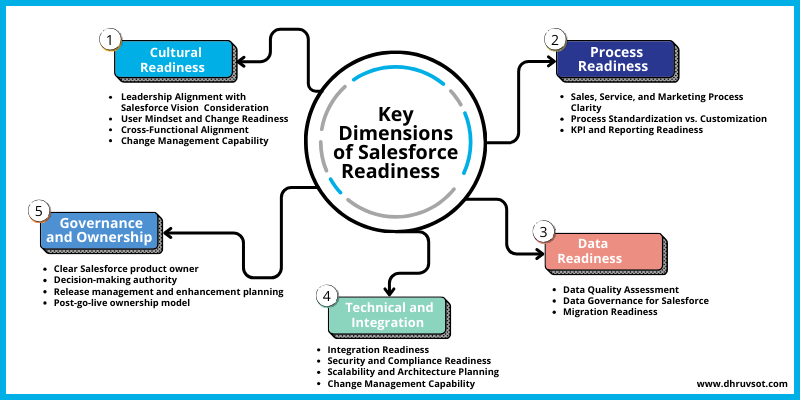
Key Dimensions of Salesforce Readiness
Salesforce readiness is not just technical. It has multiple dimensions that must work together.
Cultural Readiness
Teams must be open to change. Salesforce introduces transparency, tracking, and accountability. If teams resist visibility or process discipline, adoption will suffer. Leadership support and communication are essential.
Process Readiness
Processes must be clearly defined before Salesforce is configured. This includes lead management, opportunity stages, approvals, and follow-ups. Salesforce works best when processes are simple, standard, and agreed upon.
Data Readiness
Good decisions need good data. Organizations must define:
- What data is required
- Who owns data quality
- How duplicates and errors will be handled
Poor data leads to poor trust in Salesforce.
Technical and Integration Readiness
Salesforce rarely works alone. It often integrates with ERP, marketing tools, support systems, and reporting tools. Organizations must be ready with:
- Clear integration requirements
- Data flow definitions
- Security and access controls
This avoids delays and rework later.
Governance and Ownership
Someone must own Salesforce success. This includes:
- Decision-making authority
- Change control
- Ongoing improvements
Without governance, Salesforce becomes inconsistent and difficult to scale.
Cultural Readiness: Preparing People for Salesforce Adoption
Salesforce success depends as much on people as on technology. Even the best Salesforce setup will fail if teams are not ready to change how they work. Cultural readiness ensures that employees understand why Salesforce is being implemented and are willing to use it in their daily work.
Leadership Alignment with Salesforce Vision
Strong leadership alignment is the foundation of Salesforce adoption. When leaders are clear and committed, teams follow.
This includes:
- Executive sponsorship for Salesforce programs – Senior leaders must actively support Salesforce, not just approve budgets.
- Clear business outcomes expected from Salesforce – Leaders should clearly communicate what Salesforce is expected to improve, such as pipeline visibility, customer experience, or productivity.
- Leadership role in driving adoption – When leaders use Salesforce dashboards and reports themselves, it sends a strong message that the system matters.
Without leadership alignment, Salesforce is often seen as just another IT tool.
User Mindset and Change Readiness
Users must be mentally prepared to change how they work. Salesforce introduces structure, visibility, and accountability, which can feel uncomfortable at first.
Cultural readiness includes:
- Openness to transparency and data visibility – Teams must accept that work and performance will be visible in Salesforce.
- Willingness to move away from spreadsheets and manual tracking – Old habits slow down adoption and reduce data quality.
- Readiness for standardised Salesforce workflows – Users must be willing to follow defined processes instead of personal methods.
When users understand the benefits, resistance to change reduces.
Cross-Functional Alignment
Salesforce works best when teams work together on one platform. Cultural readiness requires strong alignment across departments.
This means:
- Sales, service, and marketing collaboration in Salesforce – Teams should use the same system to manage customer interactions.
- Shared ownership of customer data – Data quality becomes a shared responsibility, not just one team’s job.
- Breaking silos using a single Salesforce platform – Information should flow freely instead of being locked in separate tools.
This creates a unified view of the customer and improves decision-making.
Change Management Capability
Change does not happen automatically. Organizations must be ready to manage it properly.
This includes:
- Clear communication plans for Salesforce rollout – Teams should know what is changing, when it is changing, and why.
- Role-based Salesforce training readiness – Different users need different training based on how they use Salesforce.
- Identifying Salesforce champions within teams – Internal champions help drive adoption, answer questions, and support peers.
Strong change management turns Salesforce from a new system into a daily habit.
Process Readiness for Salesforce Implementation
Before Salesforce is configured, organizations must be clear on how work should flow across sales, service, and marketing. Salesforce works best when processes are defined first and automated later.
Sales, Service, and Marketing Process Clarity
Process clarity is the starting point of Salesforce success. If processes are unclear, Salesforce will only automate confusion.
This includes:
- Defined sales stages before Salesforce configuration – Sales teams must agree on clear stages, entry rules, and exit criteria before building pipelines.
- Clear service case lifecycle – Service teams should define how cases are created, worked on, escalated, and closed.
- Lead management and handoff processes – Marketing and sales must agree on how leads are captured, qualified, and handed over.
When processes are clear, Salesforce becomes easier to configure and easier to use.
Process Standardization vs. Customization
Salesforce is flexible, but flexibility must be used carefully. Too much customization creates complexity and slows adoption.
Good process readiness means:
- Avoiding over-customization in Salesforce – Custom fields and workflows should only be added when truly required.
- Leveraging Salesforce best-practice frameworks – Using proven Salesforce models reduces risk and speeds up implementation.
- Designing scalable, future-ready processes – Processes should support growth without needing frequent redesign.
Standard where possible. Customize only where it adds real value.
KPI and Reporting Readiness
Reporting should not be an afterthought. KPIs must be defined before dashboards are built.
This includes:
- Defining KPIs before building Salesforce dashboards – Teams must agree on what success looks like before measuring it.
- Aligning Salesforce reports with leadership goals – Dashboards should answer leadership questions, not just show activity.
When KPIs are clear, Salesforce reporting becomes meaningful and trusted.
Data Readiness: The Foundation of Salesforce Success
Data is the backbone of Salesforce. If data is poor, users will not trust the system, and adoption will fail. Strong data readiness ensures Salesforce delivers accurate insights and real business value.
Data Quality Assessment
Before Salesforce implementation, organizations must review the current state of their data.
This includes:
- Duplicate, outdated, or incomplete records – Old systems often contain repeated or incorrect data that must be cleaned.
- Ownership of customer data – Clear ownership is needed to decide who is responsible for keeping data accurate.
Clean data builds trust and improves reporting from day one.
Data Governance for Salesforce
Data quality must be maintained after go-live, not just during migration.
This requires:
- Data standards and validation rules – Clear rules for mandatory fields, formats, and naming conventions.
- Ongoing data hygiene processes – Regular reviews to remove duplicates and correct errors.
Good governance ensures Salesforce remains reliable as usage grows.
Migration Readiness
Not all data should move into Salesforce. Migration must be planned carefully.
This includes:
- Deciding what data moves into Salesforce – Only relevant and useful data should be migrated.
- Preparing clean, structured data for migration – Data must be cleaned and formatted before loading.
Well-planned migration avoids clutter and improves system performance.
Technical Readiness in a Salesforce Ecosystem
Salesforce does not work in isolation. It connects with many other systems. Technical readiness ensures smooth integrations, strong security, and long-term scalability.
Integration Readiness
Organizations must understand how Salesforce will connect with other systems.
This includes:
- ERP, finance, marketing automation, and support systems – Identifying systems that need to share data with Salesforce.
- Understanding Salesforce integration touchpoints – Knowing what data flows in and out of Salesforce.
- API, security, and data flow planning – Ensuring integrations are secure, reliable, and scalable.
Clear integration planning prevents data gaps and rework later.
Security and Compliance Readiness
Security and compliance must be planned from the beginning.
This includes:
- Role-based access models – Users should only see data relevant to their role.
- Compliance requirements (GDPR, DPDP, HIPAA, etc.) – Salesforce must support legal and regulatory needs.
- Salesforce security features planning – Using profiles, permission sets, and audit controls effectively.
Strong security builds trust and reduces risk.
Scalability and Architecture Planning
Salesforce should support today’s needs and tomorrow’s growth.
This includes:
- Future user growth – Planning for more users, teams, and regions.
- Multi-cloud Salesforce adoption – Preparing for Sales Cloud, Service Cloud, and Marketing Cloud usage over time.
A scalable architecture avoids costly redesigns later.
Governance and Ownership in Salesforce Programs
Salesforce success does not end at go-live. Strong governance ensures long-term value and control.
This includes:
- Clear Salesforce product owner – One person or team must own Salesforce success.
- Decision-making authority – Clear rules for approving changes and enhancements.
- Release management and enhancement planning – Structured updates without disrupting users.
- Post-go-live ownership model – Ongoing support, improvement, and accountability.
With the right governance, Salesforce becomes a long-term growth platform, not just a one-time project.
Salesforce Readiness Assessment Framework by Dhruvsoft
At Dhruvsoft, we believe Salesforce success starts before implementation begins. Our readiness framework helps organizations prepare the right foundation for long-term CRM success using Salesforce.
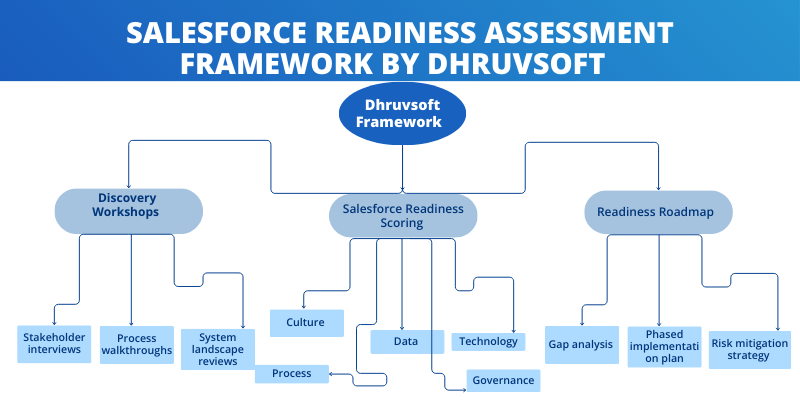
Discovery Workshops
We begin with focused discovery workshops to understand the organization clearly before any design or configuration.
We conduct:
- Stakeholder interviews – To understand business goals, expectations, and challenges
- Process walkthroughs – To review how sales, service, and marketing actually work today
- System landscape reviews – To understand existing tools, data sources, and integrations
This step ensures Salesforce is aligned with real business needs, not assumptions.
Salesforce Readiness Scoring
Next, we assess readiness across critical dimensions and provide a clear scorecard.
We assess and score:
- Culture – Openness to change, transparency, and system-driven work
- Process – Clarity, standardisation, and scalability of workflows
- Data – Quality, ownership, and governance readiness
- Technology – Integration, security, and architecture readiness
- Governance – Ownership, decision-making, and change control
This scoring helps leadership clearly see strengths, gaps, and risks.
Readiness Roadmap
Based on the assessment, we deliver a clear and practical roadmap.
We deliver:
- Gap analysis – What is missing or unclear today
- Phased implementation plan – What to fix now vs. later
- Risk mitigation strategy – How to reduce cost, delay, and adoption risks
This roadmap ensures Salesforce is implemented in the right order and at the right pace.
Key Indicators That an Organization Is Ready for Salesforce
Organizations are truly ready for Salesforce when the following are in place:
- Strong executive sponsorship – Leadership actively supports and uses Salesforce
- Clear processes – Sales, service, and marketing workflows are well-defined
- Governed data – Data standards, ownership, and quality controls exist
- Integration strategy – Clear understanding of how Salesforce connects with other systems
- Change management plan – Training, communication, and user adoption are planned
When these indicators are present, Salesforce adoption becomes smoother and more successful.
Conclusion
Salesforce success does not start at go-live. It starts with readiness.
A strong readiness approach reduces risk, controls cost, and ensures long-term ROI. It helps organizations avoid rework, low adoption, and over-customization.
Planning a Salesforce implementation?
Dhruvsoft helps organizations assess Salesforce readiness and build a strong foundation for successful CRM transformation.→ Connect with our Salesforce experts today.
 About Sunil K


