
How Salesforce Improves Case Tracking, Faster Resolution, and Higher Customer Satisfaction
Customer expectations have changed dramatically in recent years. Today’s customers expect businesses to respond quickly, resolve issues efficiently, and provide consistent support across multiple channels. When customer service teams struggle with scattered information, manual processes, or disconnected systems, service quality declines and customer satisfaction suffers.
Effective case management has therefore become a critical part of modern customer service strategies. Companies need systems that allow support teams to track customer issues, prioritise requests, collaborate internally, and resolve problems quickly.
Salesforce provides a powerful platform for modern case management through its Service Cloud capabilities. By centralising customer interactions, automating service processes, and providing real-time insights, Salesforce enables organizations to deliver faster resolutions and more personalized support experiences.
This article explores how Salesforce helps organizations optimize case management, improve service performance, and enhance overall customer satisfaction.
The Importance of Effective Case Management
Customer service is no longer just a support function. It plays a major role in shaping customer experience and loyalty. A single unresolved issue or delayed response can impact customer trust and damage a brand’s reputation.
In contrast, businesses that respond quickly and resolve problems efficiently often strengthen customer relationships and build long-term loyalty.
However, many organizations still struggle with traditional case management systems. Support requests may arrive through different channels, such as email, phone calls, web forms, and social media. Without a centralised system, service teams often find it difficult to track requests, assign responsibilities, and monitor progress.
Customers today also expect faster and more personalized support. They want quick responses, consistent information, and the ability to interact with companies through their preferred communication channels.
Salesforce helps organizations address these challenges by providing a modern, unified case management platform. With Salesforce, service teams gain complete visibility into customer interactions, automate repetitive tasks, and ensure that every case is handled efficiently from start to resolution.
Understanding Case Management in Modern Customer Service
What Is Case Management?
Case management (aka ticket management) refers to the process of tracking, managing, and resolving customer issues or service requests. Each customer problem or inquiry is recorded as a “case” within the system.
Service agents then work through the case lifecycle, which typically includes:
- Logging the issue
- Assigning it to the appropriate agent
- Investigating and resolving the problem
- Communicating updates to the customer
- Closing the case once the issue is resolved
In modern customer service environments, case management must also handle requests from multiple channels, including phone, email, chat, web portals, and social media platforms.
Why Efficient Case Management Matters?
Efficient case management directly impacts customer satisfaction and retention. Customers appreciate quick responses, transparent communication, and timely resolution of their problems.
Organizations that manage cases efficiently benefit from:
- Faster response times
- Improved resolution rates
- Increased customer satisfaction
- Higher customer loyalty
Quick and accurate issue resolution not only improves the customer experience but also enhances operational efficiency within service teams.
Common Challenges Without a Centralized System
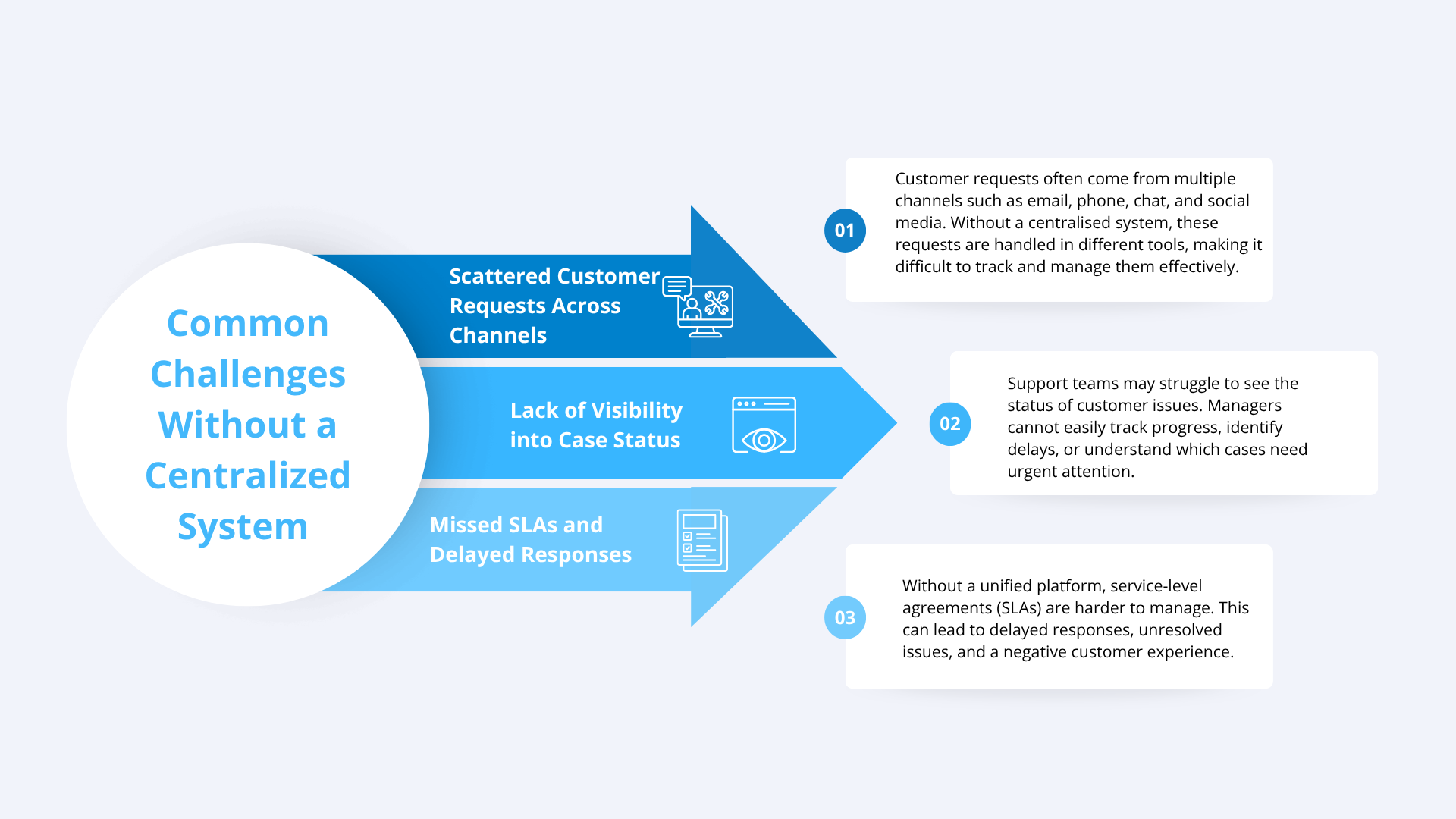
- Scattered Customer Requests Across Channels: Customer requests often come from multiple channels such as email, phone, chat, and social media. Without a centralised system, these requests are handled in different tools, making it difficult to track and manage them effectively.
- Lack of Visibility into Case Status: Support teams may struggle to see the status of customer issues. Managers cannot easily track progress, identify delays, or understand which cases need urgent attention.
- Missed SLAs and Delayed Responses: Without a unified platform, service-level agreements (SLAs) are harder to manage. This can lead to delayed responses, unresolved issues, and a negative customer experience.
Centralizing Case Tracking with Salesforce
One of the most powerful advantages of Salesforce is its ability to centralise all customer service activities into a single platform.
Unified Customer View
- Salesforce provides service agents with a complete view of customer interactions and case history. Every email, phone call, chat conversation, and previous support request can be accessed from a single interface.
- This unified customer view allows agents to understand the context of each issue quickly and provide more personalized support.
- Instead of asking customers to repeat information, agents can immediately see past interactions and address issues more effectively.
Multi-Channel Case Capture
Modern customers interact with businesses through multiple communication channels. Salesforce Omni Channel features enable organizations to capture cases from various sources, including:
- Email inquiries
- Phone calls
- Web forms
- Live chat
- Social media messages
All these interactions automatically create cases in Salesforce, ensuring that no customer request is missed or overlooked.
Real-Time Case Visibility
- Salesforce provides real-time visibility into case status, ownership, and priority. Agents can track which cases are assigned to them and monitor progress toward resolution.
- Managers also gain full visibility into service operations, allowing them to identify bottlenecks, monitor workloads, and ensure that cases are handled efficiently.
Automating Case Assignment and Workflows
Automation is one of the most valuable features of Salesforce case management.
Intelligent Case Routing
- Salesforce can automatically assign cases to the most appropriate service agents based on predefined rules such as agent expertise, workload, or location.
- This intelligent routing ensures that cases reach the right person quickly, reducing delays and improving resolution times.
Workflow Automation
- Salesforce also enables organizations to automate various service workflows. For example, the system can automatically send follow-up notifications, escalate unresolved cases, or trigger alerts when service deadlines approach.
- Escalation rules ensure that critical cases receive immediate attention and that service level agreements are not violated.
Reduced Manual Work
- By automating repetitive tasks, Salesforce allows service agents to focus more on resolving customer issues rather than performing administrative work.
- This improves productivity and enables service teams to handle higher volumes of support requests without compromising quality.
Improving Case Resolution with Knowledge and AI
Salesforce enhances case resolution by providing service agents with access to knowledge resources and artificial intelligence capabilities.
Knowledge Base Integration
- Salesforce allows organizations to create a centralised knowledge base containing frequently asked questions, troubleshooting guides, and support documentation.
- Service agents can quickly search these knowledge articles to find solutions to common problems.
- This ensures consistent responses across service teams and reduces the time required to resolve issues.
AI-Powered Recommendations
- Salesforce’s AI capabilities analyse past cases and customer interactions to suggest potential solutions for new cases.
- These recommendations help agents resolve issues faster and reduce the need for extensive investigation.
- AI-driven insights can also identify patterns in support requests, helping organizations address recurring problems more effectively.
Self-Service Capabilities
- Salesforce also enables customer self-service options through online portals and knowledge articles.
- Customers can search for solutions on their own without contacting support agents, which reduces support workload and improves response times for more complex issues.
Enhancing Agent Productivity
Salesforce provides tools designed specifically to improve service agent efficiency and productivity.
Unified Service Console
- The Salesforce Service Console provides agents with a centralised workspace where they can manage cases, review customer history, and communicate with customers.
- Having all relevant information in one place allows agents to respond quickly and work more efficiently.
Macros and Quick Actions
- Salesforce enables agents to create macros and quick actions that automate repetitive tasks such as sending standard responses or updating case fields.
- These tools significantly reduce response times and allow agents to handle cases more efficiently.
Collaboration Across Teams
- Some customer issues require collaboration between multiple teams such as technical support, billing, or product specialists.
- Salesforce provides internal communication tools that allow service agents to collaborate with colleagues, share information, and resolve complex issues faster.
Monitoring Service Performance with Analytics
Effective case management requires continuous monitoring and improvement. Salesforce provides powerful analytics tools that help organizations track service performance.
Real-Time Case Dashboards
Salesforce dashboards provide real-time insights into key service metrics, including:
- Number of open and closed cases
- Average case resolution time
- Case volume by category
- Agent performance
These dashboards allow managers to monitor operations and make data-driven decisions.
SLA Monitoring
- Service level agreements define expected response and resolution times for customer requests. Salesforce automatically tracks SLA compliance and alerts managers when deadlines are at risk.
- This helps organizations maintain service standards and improve accountability.
Customer Satisfaction Metrics
- Salesforce also enables organizations to collect customer feedback through surveys and satisfaction ratings.
- Analysing these metrics helps service leaders identify areas for improvement and enhance the overall customer experience.
Delivering Better Customer Experience
Optimizing case management ultimately leads to a better customer experience.
- Faster Response and Resolution : Automated acknowledgements, case routing, and workflow automation allow organizations to respond to customer requests quickly and resolve issues faster.
- Consistent Omnichannel Support : Salesforce enables seamless support across multiple communication channels, ensuring that customers receive consistent service regardless of how they contact the organization.
- Personalized Customer Interactions : With access to complete customer histories, service agents can provide personalized responses and tailored solutions, strengthening customer relationships.
Case Study: Optimizing Case Management with Salesforce
Business Challenge
- A growing organization experienced a rapid increase in customer support requests. Without a centralised case management system, service teams struggled to track issues and maintain visibility into case status.
- Managers also lacked insights into service performance and SLA compliance.
Salesforce Implementation Approach
- To address these challenges, Salesforce was implemented as the organization’s centralised case management platform.
- The solution included automated case routing, escalation workflows, and service dashboards for leadership.
Business Outcomes
After implementing Salesforce, the organization achieved significant improvements:
- Reduced case resolution times
- Improved SLA compliance
- Greater visibility into service performance
- Higher customer satisfaction levels
Best Practices for Salesforce Case Management
Organizations can maximize the benefits of Salesforce by following several best practices.
- Define clear case categories and priorities
- Automate workflows and escalation rules
- Maintain an updated knowledge base
- Monitor service performance metrics regularly
- Provide continuous training for service teams
These practices ensure that the system remains effective as service operations evolve.
The Future of AI-Driven Case Management
- Artificial intelligence is playing an increasingly important role in customer service operations.
- AI-powered tools can analyse customer behaviour, predict potential issues, and recommend solutions before problems escalate.
- In the future, organizations will increasingly rely on predictive support models where potential issues are identified and resolved proactively.
- Salesforce continues to invest in AI-driven capabilities that help service teams deliver faster and smarter support experiences.
Why Partnering with Dhruvsoft Matters
- Expertise in Salesforce Service Cloud implementation: Dhruvsoft brings deep expertise in implementing Salesforce Service Cloud for organizations across industries. Their consultants understand service processes, automation, and platform capabilities. This ensures a well-designed system that supports efficient customer service operations.
- Customized case management solutions: Every organization has unique service workflows and escalation processes. Dhruvsoft designs tailored case management solutions that align with your support model and business goals. This improves case handling efficiency and customer satisfaction.
- Ongoing optimization and support: Successful CRM adoption goes beyond initial implementation. Dhruvsoft provides continuous optimization, platform enhancements, and expert support. This helps organizations maximize the long-term value of their Salesforce investment.
Conclusion
Effective case management is essential for delivering exceptional customer service and maintaining strong customer relationships.
Salesforce enables organizations to modernise their service operations by centralizing case management, automating workflows, and providing powerful analytics.
By optimising case management processes, organizations can improve operational efficiency, resolve customer issues faster, and enhance overall customer satisfaction.
Companies that invest in modern service platforms like Salesforce gain a significant competitive advantage in today’s customer-driven marketplace.
Looking to improve your customer service operations with Salesforce?
Dhruvsoft helps organizations implement and optimize Salesforce solutions to deliver faster, smarter, and more efficient customer support.
Connect with our experts today to transform your customer service experience.
 About Surender Patel


