Steps to Create a CRM Plan that Prioritizes Marketing Needs and Seamless Tool Integration
Salesforce CRM implementations have traditionally been driven by sales teams. While this approach may help manage opportunities and forecasts, it often leaves marketing teams struggling with poor visibility, disconnected tools, and limited attribution.
Today, marketing is no longer just a support function for sales. It is a revenue-driving engine responsible for demand generation, pipeline contribution, and customer engagement across the entire lifecycle. To support this shift, Salesforce must be implemented with marketing at the center—not as an afterthought.This article explains why Salesforce CRM must be built for marketing, where most implementations fail, and provides a step-by-step plan to design a truly marketing-centric Salesforce CRM that delivers measurable ROI.
Why CRM Must Be Built for Marketing, Not Just Sales
Why Many Salesforce CRM Implementations Fail Marketing Teams
Many Salesforce projects start with a narrow focus on sales pipelines, opportunity tracking, and forecasting. Marketing requirements are added later—often through workarounds, spreadsheets, or disconnected tools.
Common reasons for failure include:
- Salesforce configured without understanding marketing workflows
- Limited campaign and attribution capabilities
- Poor integration with marketing automation platforms
- No well defined ownership of customer journey data
- Lack of reporting for marketing performance and ROI
As a result, marketing teams struggle to prove impact, sales teams lose trust in lead quality, and leadership lacks visibility into true revenue drivers.
CRM Is Evolving from a Sales Tool to a Revenue and Customer Intelligence Platform
Modern CRM systems are no longer just sales databases. They are central customer intelligence platforms that connect:
- Marketing engagement data
- Sales interactions
- Customer behavior
- Revenue outcomes
Salesforce, when implemented correctly, can act as the single source of truth for the entire go-to-market engine.
The Need to Design Salesforce with Marketing at the Center
A marketing-centric Salesforce implementation ensures:
- Every lead is tracked from first touch to revenue
- Campaigns are measurable and optimized
- Marketing and sales operate from the same data
- Attribution is accurate and defensible
- Customer journeys are visible end-to-end
Dhruvsoft’s Perspective
At Dhruvsoft, we believe marketing-driven Salesforce implementations lead to better pipeline quality, stronger sales alignment, and higher ROI. When marketing needs are designed into Salesforce from day one, organizations unlock faster growth and smarter decision-making.
Why Marketing-Centric Salesforce CRM Implementation Matters
Marketing’s Expanding Role in Revenue Growth – Marketing today owns far more than awareness. Its responsibilities include:
- Building Pipeline and Generating Demand : Marketing is no longer limited to brand awareness—it is directly accountable for revenue impact. Teams are responsible for generating qualified demand and consistently contributing to the sales pipeline. CRM systems must clearly connect marketing activities to pipeline creation and revenue outcomes.
- Lead Nurturing and Buyer Education : Modern buyers complete a large part of their decision journey before engaging with sales. CRM must support long-term lead nurturing through personalized content and engagement tracking. This ensures prospects are educated, sales-ready, and aligned with buying intent.
- Ownership of the Customer Journey : Marketing plays a critical role in shaping the customer experience from the first interaction onward. From initial awareness to onboarding and expansion, every touchpoint matters. A CRM like Salesforce helps manage and optimize this journey across channels.
- Attribution and Revenue Accountability: CMOs are expected to demonstrate clear ROI from marketing investments. Accurate attribution models are essential to measure pipeline influence and revenue contribution. CRM-driven insights ensure marketing performance is transparent, measurable, and defensible.
What Happens When Salesforce Is Implemented with a Sales-First Mindset
When marketing is not prioritized, organizations face:
- Poor lead quality and low sales trust
- Limited campaign and attribution visibility
- Disconnected marketing tools and data silos
- Weak alignment between sales and marketing teams
This leads to friction, inefficiency, and missed growth opportunities.
A Step-by-Step Framework for Building a Marketing-Centric Salesforce CRM
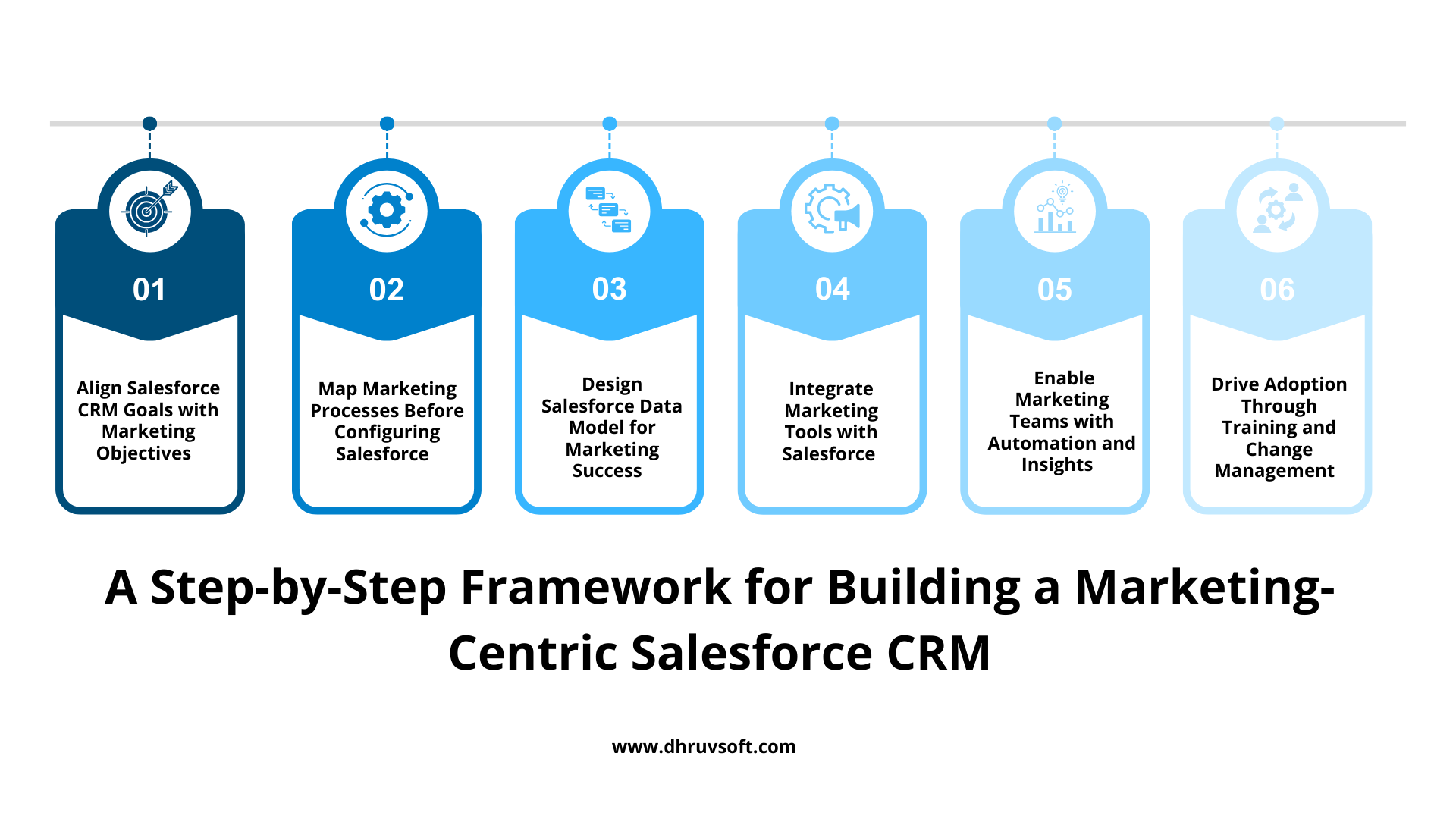
Step 1 — Align Salesforce CRM Goals with Marketing Objectives
Define Clear Marketing Outcomes
Before configuration begins, marketing goals must be clearly defined.
Key outcomes include:
- Targets for volume and quality of Leads
- Pipeline contribution and revenue influence
- Campaign performance and ROI metrics
- Engagement metrics across the buyer journey
These outcomes guide every Salesforce design decision.
Identify Core Marketing Use Cases in Salesforce
Salesforce should support essential marketing activities such as:
- Lead capture and source tracking
- Lead scoring and qualification logic
- Audience segmentation and personalization
- Campaign tracking and attribution reporting
Step 2 — Map Marketing Processes Before Configuring Salesforce
Lead Management and Nurturing Workflows
Document how leads flow through the organization:
- Lead sources and capture points
- MQL and SQL definitions
- Rules for assigning and routing leads
- Nurture, recycle, and re-engagement journeys
Campaign Planning and Execution Model
Salesforce campaigns should reflect how marketing actually works:
- Clear parent-child campaign hierarchy
- Multi-channel tracking (email, ads, events, webinars)
- Budget allocation and ROI measurement
Framework for Sales and Marketing Harmonization
Define how teams collaborate:
- Lead hand-off rules
- SLAs between marketing and sales
- Lead quality feedback closed loops
- Lead recycling processes
Step 3 — Design Salesforce Data Model for Marketing Success
Marketing-Ready Salesforce Data Structure
Core objects must be designed for marketing use:
- Leads, Contacts, Accounts, Deals or Opportunities
- Campaigns and Campaign Members
- Campaign Influence models
- Custom fields for segmentation and targeting
Data Quality and Governance
Strong data governance ensures trust:
- Duplicate management rules
- Mandatory and validated fields
- Well defined data ownership and stewardship
Consent and Compliance Readiness
Salesforce must support compliance requirements:
- Email consent and preference management
- GDPR / DPDP compliance
- Communication tracking and audit trails
Step 4 — Integrate Marketing Tools with Salesforce
Salesforce Marketing Cloud or Account Engagement (Pardot)
Key capabilities include:
- Email marketing and journey orchestration
- Lead scoring and nurturing
- Behavioral tracking and engagement history
Website and Digital Channel Integrations
Integrate Salesforce with:
- Forms and landing pages
- Website behavior tracking
- Analytics and tracking tools
Advertising, Events, and Third-Party Tools
Connect platforms such as:
- Digital advertisement platforms like Google Ads and LinkedIn Ads
- Webinar and event platforms
- Social media and partner tools
Step 5 — Enable Marketing Teams with Automation and Insights
Automation for Marketing Efficiency
Salesforce automation reduces manual effort:
- Automated lead assignment
- Campaign response workflows
- Alerts and follow-up triggers
Salesforce Marketing Dashboards and Reporting
Build visibility early:
- Campaign performance dashboards
- Funnel and conversion reports
- Pipeline and revenue attribution dashboards
Step 6 — Drive Adoption Through Training and Change Management
Successful CRM adoption requires:
- Role-based Salesforce training for marketers
- Hands-on campaign and reporting workshops
- Clear documentation, play-books, and SOPs
- Ongoing enablement and optimization
Practical Example:
Dhruvsoft’s Marketing-Centric Salesforce Implementation in Action – Case Study
The Business Challenge
When Dhruvsoft engaged with the organization, marketing and sales were operating on disconnected systems. Marketing relied on multiple tools for campaigns, lead capture, and analytics, while Salesforce was primarily configured for sales tracking.
This disconnect created several challenges:
- Marketing data lived outside Salesforce, limiting end-to-end visibility
- Lead quality was inconsistent, causing low sales confidence in marketing leads
- Campaign performance and ROI were difficult to measure accurately
- Leadership lacked a unified view of pipeline contribution from marketing
As a result, marketing efforts were active—but their impact on revenue was unclear.
Dhruvsoft’s Implementation Approach
Dhruvsoft adopted a marketing-first Salesforce implementation strategy, starting with business goals rather than system configuration.
Marketing process discovery
The team conducted detailed workshops with marketing and sales stakeholders to understand demand generation goals, buyer journeys, lead qualification criteria, and attribution requirements.
Salesforce is designed around marketing outcomes
Instead of retrofitting marketing into an existing sales-centric CRM, Dhruvsoft redesigned Salesforce to support:
- Structured campaign hierarchies
- End-to-end lead lifecycle tracking
- Clear MQL and SQL definitions aligned with sales expectations
Full marketing stack integration
All marketing tools were integrated directly with Salesforce to ensure a clean, real-time data flow. This eliminated manual imports and reduced data inconsistencies across platforms.
Automation and governance
Automated lead capture, scoring, routing, and campaign workflows were implemented to ensure:
- Faster response times
- Consistent lead qualification
- Better synchronization between marketing and sales teams
Dashboards and reports were configured to give leadership clear visibility into campaign performance, pipeline contribution, and ROI.
Business Impact
The marketing-centric Salesforce implementation delivered measurable improvements across teams.
- Improved lead quality and sales trust: Sales teams gained confidence in marketing-generated leads due to clear scoring, routing, and visibility into lead history.
- Faster, data-driven marketing execution: Marketing teams could launch, monitor, and optimize campaigns faster using real-time insights within Salesforce.
- Clear attribution and ROI visibility: Leadership gained a single source of truth for understanding how marketing influenced pipeline, conversions, and revenue.
- Stronger alignment between teams: With shared data and definitions, marketing and sales operated as a unified revenue team rather than separate functions.
This engagement reinforced Dhruvsoft’s belief that Salesforce delivers maximum value only when marketing is designed into the foundation—not added as an afterthought. By aligning technology with real marketing workflows and revenue goals, organizations gain clarity, accountability, and measurable growth.
Best Practices for a Marketing-Centric Salesforce CRM Strategy
- Involve marketing from day one: Marketing should be part of the CRM strategy from the initial planning stage. This ensures campaign needs, lead journeys, and attribution models are built correctly. Early involvement avoids rework and misalignment later.
- Prioritize integrations before heavy customization: Connect marketing automation, websites, and analytics tools with Salesforce first. Strong integrations ensure clean data flow and complete customer visibility. Customization should only follow once the foundation is stable.
- Maintain clean, well-governed data: Define clear data standards, ownership, and validation rules. Clean data improves lead quality, reporting accuracy, and campaign insights. Ongoing governance prevents data decay over time.
- Build dashboards early: Dashboards help teams track performance from the start. Marketing and sales leaders gain visibility into leads, campaigns, and pipeline impact. Early insights guide better decisions and faster optimization.
- Continuously optimize based on insights: Use real-time data to refine campaigns, lead scoring, and workflows. Regular optimization keeps marketing aligned with business goals. This ensures Salesforce continues to deliver the measurable ROI that business is expecting.
Conclusion: Salesforce Should Power Your Entire Growth Engine
A marketing-centric Salesforce implementation transforms CRM into a true growth platform. When marketing is empowered with the right data, tools, and visibility, organizations achieve stronger engagement, higher-quality pipelines, and measurable revenue impact.
CRM should enable marketing—not slow it down. A structured, marketing-first implementation approach ensures long-term success and ROI.
Build Your Marketing-Centric Salesforce with Dhruvsoft
Dhruvsoft helps organizations design and deliver marketing-first Salesforce CRM solutions that drive real business outcomes.
Our services include:
- Salesforce CRM strategy and planning
- Marketing-centric implementation
- Tool integration and data architecture
- Optimization, reporting, and enablement
Talk to our Salesforce experts and build a CRM that truly supports your growth engine.
 About Ashish Manuka


