
Sales culture is no longer a soft concept driven only by motivation, experience, or individual talent. In today’s competitive markets, sales performance is shaped by structure, data, visibility, and execution discipline. Organizations that consistently hit revenue targets are not relying on intuition or hero sellers — they operate with a high-performance sales culture supported by the right systems and processes.
As businesses scale, sales teams often struggle with inconsistent execution, unclear accountability, poor pipeline visibility, and unreliable forecasts. These challenges directly impact revenue predictability and growth.
This is where Salesforce plays a critical role. More than a CRM, Salesforce acts as a sales execution engine, enabling organizations to build, enforce, and sustain a disciplined, results-driven sales culture.At Dhruvsoft, we view Salesforce not as a tracking tool, but as the foundation for sales consistency, accountability, and continuous improvement. This article explains how Salesforce helps organizations build and maintain a high-performance sales culture — and how the right implementation approach makes all the difference.
Why Sales Culture Directly Impacts Revenue Performance
Revenue outcomes are a direct reflection of sales behaviour. When sales teams operate without structure or clarity, results become unpredictable.
A weak sales culture typically shows up as:
- Missed targets despite high activity
- Inaccurate forecasts and last-minute surprises
- Deals stuck in the pipeline with no clear ownership
- Managers chasing updates instead of coaching
In contrast, a strong sales culture delivers:
- Predictable revenue
- Repeatable selling motions
- Clear accountability at every stage
- Data-backed decision-making
Sales culture defines how deals move, how decisions are made, and how performance is measured. Technology alone cannot fix cultural issues — but the right CRM platform can enable and reinforce the right behaviours.
The Shift from Intuition-Led Selling to Data-Driven Selling
Traditional sales relied heavily on gut feeling, personal relationships, and anecdotal updates. While experience still matters, modern sales organizations operate in far more complex environments with longer buying cycles, multiple stakeholders, and intense competition.
Salesforce enables the shift from:
- “I feel this deal will close”
- to “This deal has a 70% probability based on data”
Data-driven selling allows leaders to:
- Assess pipeline health objectively
- Identify risks early
- Coach reps using facts, not assumptions
- Forecast revenue with confidence
This shift is essential for building a scalable, high-performance sales culture.
Common Sales Challenges Salesforce Helps Solve
Before Salesforce, many organizations faced recurring challenges:
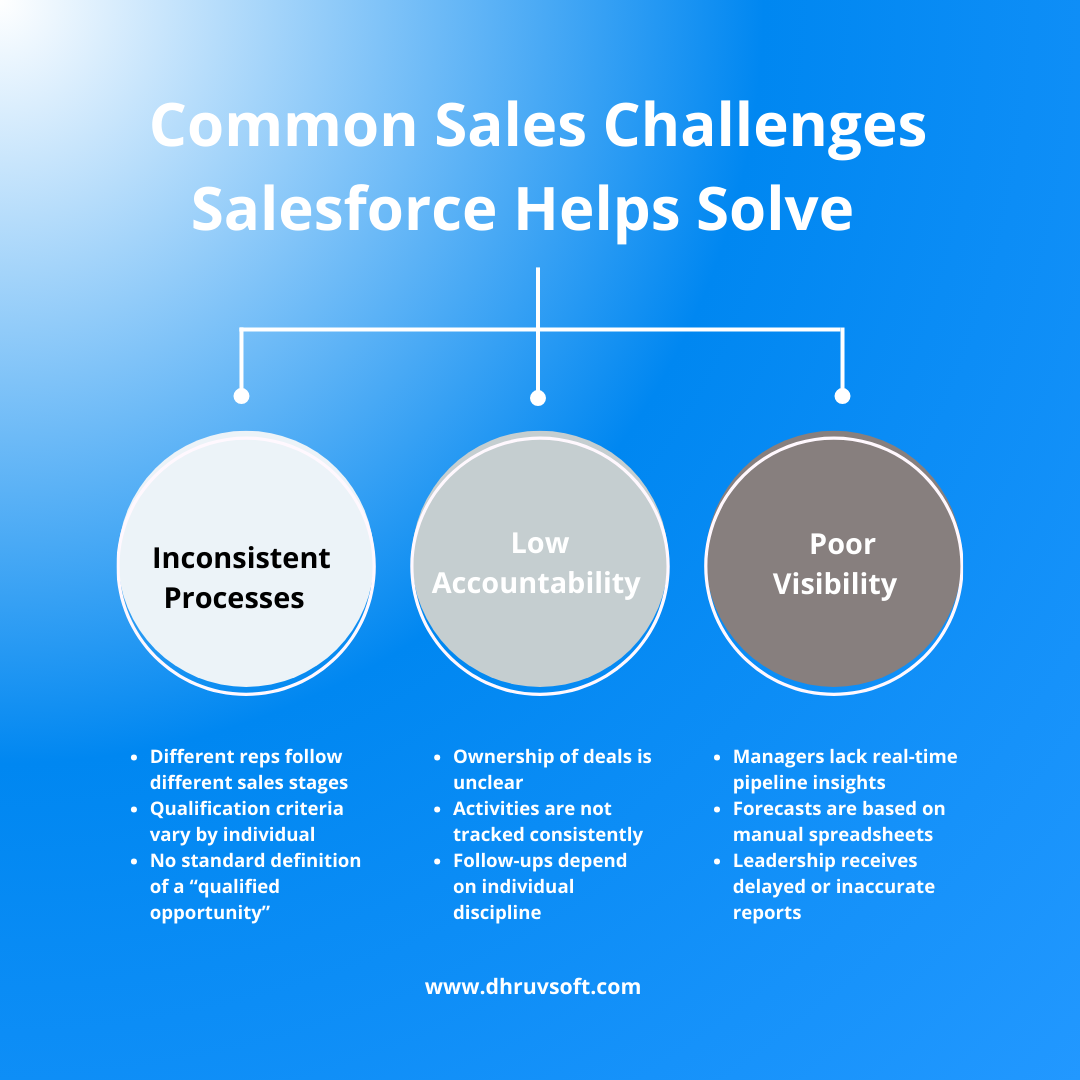
Inconsistent Processes
- Different reps follow different sales stages
- Qualification criteria vary by individual
- No standard definition of a “qualified opportunity”
Low Accountability
- Ownership of deals is unclear
- Activities are not tracked consistently
- Follow-ups depend on individual discipline
Poor Visibility
- Managers lack real-time pipeline insights
- Forecasts are based on manual spreadsheets
- Leadership receives delayed or inaccurate reports
Salesforce addresses these issues by embedding structure, transparency, and discipline directly into daily sales workflows.
Salesforce as the Foundation for a High-Performance Sales Culture
Salesforce becomes the single source of truth for all sales work, opportunities, and performance data. When Salesforce is implemented in the right way, it standardises how sales teams work while still giving them enough flexibility to sell in their own style.
Key Cultural Benefits Include:
- Clear expectations for every role
Every person in the sales team knows exactly what is expected from them. Their responsibilities, targets, and daily activities are clearly defined inside Salesforce. - Shared visibility across teams
Sales leaders, managers, and reps can all see the same data. Everyone knows what is happening in the pipeline, which deals are moving, and which ones need attention. - Objective performance measurement
Performance is measured using real data, not opinions. This makes reviews fair, transparent, and focused on improvement. - Consistent execution regardless of team size
Whether the team is small or large, everyone follows the same sales process. This keeps quality and discipline high as the company grows.
At Dhruvsoft, we design Salesforce environments that match how your sales teams actually sell. At the same time, we make sure best practices are followed so your sales culture becomes strong, consistent, and high-performing.
What Defines a High-Performance Sales Culture
Clear Goals and Accountability
High-performing sales teams operate with absolute clarity on:
- Individual targets – Every salesperson knows exactly what number they must achieve. There is no confusion about expectations.
- Team goals – Each team knows its shared target and works together to reach it.
- Ownership of each opportunity – Every deal has one clear owner who is responsible for moving it forward.
Salesforce enables this through:
- Clearly assigned leads and opportunities – Every lead and deal is owned by the right salesperson. Nothing is left unassigned.
- Defined quotas at rep, team, and regional levels – Targets are set clearly at all levels, so performance can be tracked easily.
- Visibility into who owns what — at every stage – Managers and teams can see who is responsible for each deal and where it stands.
No deal moves without accountability. This creates discipline and focus in the sales team.
Consistent Sales Processes
Consistency is the backbone of scalability. Salesforce allows organizations to define:
- Standard sales stages aligned with buyer journeys – The sales process follows how customers actually buy.
- Qualification criteria at each stage – Clear rules decide whether a deal is ready to move forward.
- Exit requirements before deals move forward – A deal cannot move to the next stage until key steps are completed.
This ensures:
- Every opportunity is evaluated equally – All deals are reviewed in the same way.
- Managers can compare performance accurately – Results across reps and teams can be measured fairly.
- New reps ramp faster using proven processes – New team members learn quickly by following a clear and tested process.
Data-Driven Decision Making
In a high-performance sales culture, decisions are based on data — not instinct. Salesforce provides insights into:
- Pipeline coverage – Leaders can see if there are enough deals to reach targets.
- Stage-wise conversion rates – Teams can see where deals move fast and where they get stuck.
- Win/loss trends – Leaders can understand why deals are won or lost.
- Forecast accuracy – Teams can see how reliable their predictions really are.
This reduces dependency on gut feeling and increases predictability.
Continuous Performance Improvement
Sales excellence is not static. High-performing teams focus on:
- Regular coaching – Managers help reps improve through frequent guidance.
- Skill development – Teams keep improving their selling skills.
- Outcome-based improvement – The focus stays on real results, not just activity.
Salesforce supports this by capturing performance data that enables:
- Targeted coaching – Managers can coach based on real gaps, not guesses.
- Identification of skill gaps – Weak areas become visible and can be fixed.
- Continuous optimization of sales strategies – Sales methods keep improving over time.
Using Salesforce to Drive Sales Discipline and Consistency
Standardized Sales Processes in Salesforce
Salesforce allows organizations to design sales stages aligned with real buyer journeys rather than internal assumptions.
This includes:
- Custom opportunity stages reflecting how customers buy
- Mandatory fields to capture critical deal information
- Validation rules to prevent poor-quality pipeline entries
Guided selling through Salesforce Flows ensures reps follow best practices without slowing them down.
Opportunity and Pipeline Management
Effective pipeline management is central to sales performance.
Salesforce provides:
- Clear visibility into deal progress
- Stage-wise probability and weighted forecasting
- Early identification of stalled or at-risk opportunities
Managers can intervene early, improving win rates and reducing surprises.
Activity Tracking and Follow-Ups
Consistency in follow-up separates average teams from high performers.
Salesforce enables:
- Automatic logging of calls, emails, and meetings
- Task management to ensure timely follow-ups
- Activity-to-opportunity correlation analysis
This ensures momentum is maintained across every deal.
Creating Transparency and Accountability with Salesforce Analytics
Sales Dashboards for Reps and Managers
Salesforce dashboards provide real-time visibility at every level.
For sales reps:
- Individual performance tracking
- Pipeline health visibility
- Activity and target alignment
For managers:
- Team-level pipeline and revenue views
- Conversion trends across stages
- Performance comparison across reps
Transparency drives ownership and self-correction.
Forecasting and Predictability
Reliable forecasting is a hallmark of high-performance sales organizations.
Salesforce enables:
- Real-time pipeline forecasts
- Commit, best-case, and upside tracking
- Historical forecast accuracy analysis
This improves confidence in revenue planning and leadership decision-making.
Performance Reviews Based on Data
Salesforce transforms performance reviews from subjective discussions into fact-based conversations.
Benefits include:
- Objective coaching based on metrics
- Clear identification of top performers
- Early detection of performance gaps
This builds trust and fairness across the sales organization.
Motivating and Engaging Sales Teams Using Salesforce
Gamification and Leader-boards
Healthy competition drives performance when managed correctly.
Salesforce supports:
- Leader-boards for key metrics
- Visibility into top performers
- Recognition that reinforces positive behaviour
Gamification motivates without creating unhealthy pressure.
Incentives and Performance Tracking
When effort and reward are clearly connected, engagement increases.
Salesforce enables:
- Commission and incentive tracking
- Target vs achievement visibility
- Alignment between activity and outcomes
Reps clearly see how performance translates into rewards.
Sales Coaching and Enablement
Effective coaching is personalized, not generic.
Salesforce provides:
- Data-backed coaching insights
- Role-based performance views
- Skill gap identification by stage or activity
Managers coach smarter, not harder.
Embedding a Results-Driven Mindset with Salesforce Automation
Automation to Reduce Admin Work
High-performance sales cultures protect selling time. Salespeople should spend more time talking to customers and less time doing system work. Salesforce automation helps make this possible.
Salesforce automation includes:
- Automated lead assignment – Leads are sent to the right sales reps automatically. No one needs to do this by hand.
- Workflow-driven follow-ups – Follow-up tasks and reminders are created automatically. Nothing is forgotten or delayed.
- Reduced manual data entry – Many updates happen automatically, so reps do not need to enter the same data again and again.
Because of this, reps focus on conversations, not clicks.
Focus on Selling, Not Reporting
With the right automation and dashboards in Salesforce, work becomes simpler and faster.
With automation and dashboards:
- Reps spend more time engaging prospects – Less time is wasted on updates and reports.
- Managers focus on strategy and coaching – Instead of chasing reports, they focus on helping teams win more deals.
- Reporting becomes real-time and effortless – Dashboards show live data without manual work.
This shift directly improves productivity and team morale.
Practical Example: Building a High-Performance Sales Team with Salesforce
The Challenge
The organization was facing several serious sales problems:
- Inconsistent sales execution – Every salesperson was working in a different way. There was no common process.
- Poor forecast accuracy – Leadership could not trust the numbers. Forecasts were often wrong.
- Limited visibility into rep performance – Managers could not clearly see who was performing well and who needed help.
Because of this, sales results were unpredictable, and leadership had low confidence in the pipeline.
Dhruvsoft’s Salesforce Approach
Dhruvsoft redesigned Salesforce to support daily sales work, not just reporting.
Dhruvsoft implemented:
- Sales process redesign aligned with buyer journeys – The sales stages were rebuilt to match how customers actually buy.
- Custom dashboards and forecasting models – Leaders and managers got clear, real-time views of performance and pipeline.
- Automation for lead-to-opportunity flow – Leads moved smoothly from marketing to sales with less manual work.
- Performance metrics aligned with business goals – Teams were measured on what really mattered to the business.
The CRM was repositioned as a daily execution tool, not just a reporting system.
Business Impact
After the Salesforce transformation, the company saw clear improvements:
- Improved forecast accuracy – Leadership could trust the numbers.
- Higher win rates – More deals were closed successfully.
- Faster sales cycles – Deals moved faster through the pipeline.
- Stronger accountability across teams – Ownership and discipline improved at every level.
The sales culture shifted from reactive to disciplined and predictable.
Best Practices for Sustaining High Sales Performance
To maintain momentum, organizations should:
- Clearly define sales stages and exit criteria
- Track activities consistently
- Review dashboards weekly
- Use data for coaching, not policing
- Recognize top performers publicly
- Continuously refine processes based on insights
Salesforce supports all these practices when implemented with intent.
Conclusion
A high-performance sales culture does not happen by accident. It requires structure, visibility, accountability, and continuous improvement.
Salesforce provides the tools needed to:
- Enforce consistency
- Improve transparency
- Enable data-driven execution
When culture and CRM execution align, organizations achieve sustainable revenue growth. Dhruvsoft helps organizations design and implement Salesforce environments that drive sales excellence and measurable results, not just system adoption.
Looking to build a high-performance sales culture?
Connect with our Salesforce experts and turn your CRM into a true sales execution engine.
 About Surender Patel


