Organizations across industries are embracing CRM platforms like Salesforce to strengthen customer relationships, streamline processes, and improve business performance. But despite the undeniable benefits of CRM systems, a surprisingly large percentage of CRM implementations fail to deliver their intended value. The core reason behind this pattern is not technological—it is organizational. Many companies underestimate the human and operational transformation required when adopting a CRM system.
Change management is the discipline that ensures people, processes, and systems evolve together. Without it, even the best CRM platform becomes just another unused IT tool. When organizations fail to prepare their teams, communicate the rationale behind the transformation, or align internal processes with the new system, adoption suffers. As adoption drops, data quality weakens, leadership loses confidence in reports, and the CRM gradually becomes irrelevant.
A successful Salesforce implementation, therefore, is fundamentally dependent on change management. It is not only about deploying technology; it is about transforming how people think, work, collaborate, and make decisions. For this reason, CRM implementation should be seen not as a software project but as a strategic business transformation initiative.
At Dhruvsoft, we have worked with organizations across industries and have seen this pattern repeat: companies that invest in change management achieve significantly higher CRM ROI, better user adoption, improved data governance, and faster value realisation compared to those that focus solely on technical setup.In this Blog article we explores the critical role of change management in ensuring a successful Salesforce implementation and outlines Dhruvsoft’s proven approach to guiding organizations through this transformation.
What Is Change Management in CRM Implementation?
Change management refers to a structured approach used to prepare individuals, teams, and the organization for adopting new systems, processes, and behaviours. Within the context of Salesforce CRM implementation, change management ensures that users understand the need for the CRM, embrace new workflows, and actively engage with the system in their day-to-day operations.
Understanding Change Beyond Technology
CRM implementation changes how people work. It reorganises daily tasks, introduces new responsibilities, redefines how data is captured, and alters the decision-making process across sales, service, marketing, and leadership. Change management helps teams transition from old practices to new CRM-driven workflows.
Without change management, employees often:
- Revert to spreadsheets
- Avoid logging into Salesforce
- Enter incomplete data
- Ignore automation workflows
- Create parallel processes that break system integrity
People, Process, and Technology Alignment
For Salesforce to succeed, three pillars must work together:
- People: The users must be willing and prepared to adopt changes in their daily routine. They must understand the value of Salesforce and feel confident using it.
- Process: Legacy processes must be re-evaluated, optimised, and standardised before being implemented in the CRM.
- Technology: Salesforce must be configured according to well-defined business processes and user needs.
Without this alignment, CRM becomes complicated, adoption slows, and ROI declines.
Salesforce Success Depends More on People Than Technology
Salesforce is one of the most advanced CRM platforms available. It includes automation, AI, analytics, and workflows that can transform business performance. But these capabilities only deliver value when users:
- Log in consistently
- Enter complete and accurate data
- Follow standardised processes
- Trust the system
- Use dashboards and reports for decision-making
Salesforce success is 30% technology and 70% people readiness. Change management is the bridge between technical implementation and organizational transformation.
Why Change Management Is Critical for Salesforce CRM Projects
Change management is not optional—it is the single most important determinant of CRM success. A Salesforce implementation without change management is like building a modern office without training people how to work in it. Technology alone cannot transform business outcomes.
Ensures Smooth Transition from Legacy Workflows to Salesforce
Most organizations use a mixture of tools—emails, spreadsheets, outdated CRMs, and manual documentation. Transitioning to Salesforce requires unlearning old habits and adopting new ones. Change management creates a guided roadmap for users, reducing confusion and frustration during the transition.
Reduces Resistance and Boosts User Adoption
Resistance to change is natural. People fear:
- Losing control
- Learning new systems
- Changing their workflow
- Being monitored
- Extra workload
Through structured communication, workshops, and early engagement, change management helps users understand the necessity and benefits of Salesforce. When people understand the “why,” resistance decreases significantly.
Minimizes Delays, Rework, and Cost Overruns
Most CRM failures occur due to misalignment between business expectations and user behaviour. Without change management, technical teams end up reworking configurations because users rejected or misunderstood the changes. This leads to:
- Higher project costs
- Delayed go-live
- Poor user satisfaction
- Loss of trust in the system
Change management ensures alignment from day one.
Supports Long-Term CRM ROI
Salesforce ROI depends on adoption. If users do not trust dashboards, do not enter accurate data, or do not use automation, the CRM fails to deliver value. Change management builds and sustains adoption, ensuring the organization realises long-term return on its investment.
Enhances Productivity, Data Quality, and Collaboration
With effective change management:
- Sales teams manage pipelines better
- Service teams close cases faster
- Managers rely on real-time dashboards
- Leadership makes data-driven decisions
- Collaboration across departments increases
High adoption equals high productivity.
Common Challenges Organizations Face Without Change Management
Organizations that skip or underinvest in change management frequently encounter predictable obstacles:
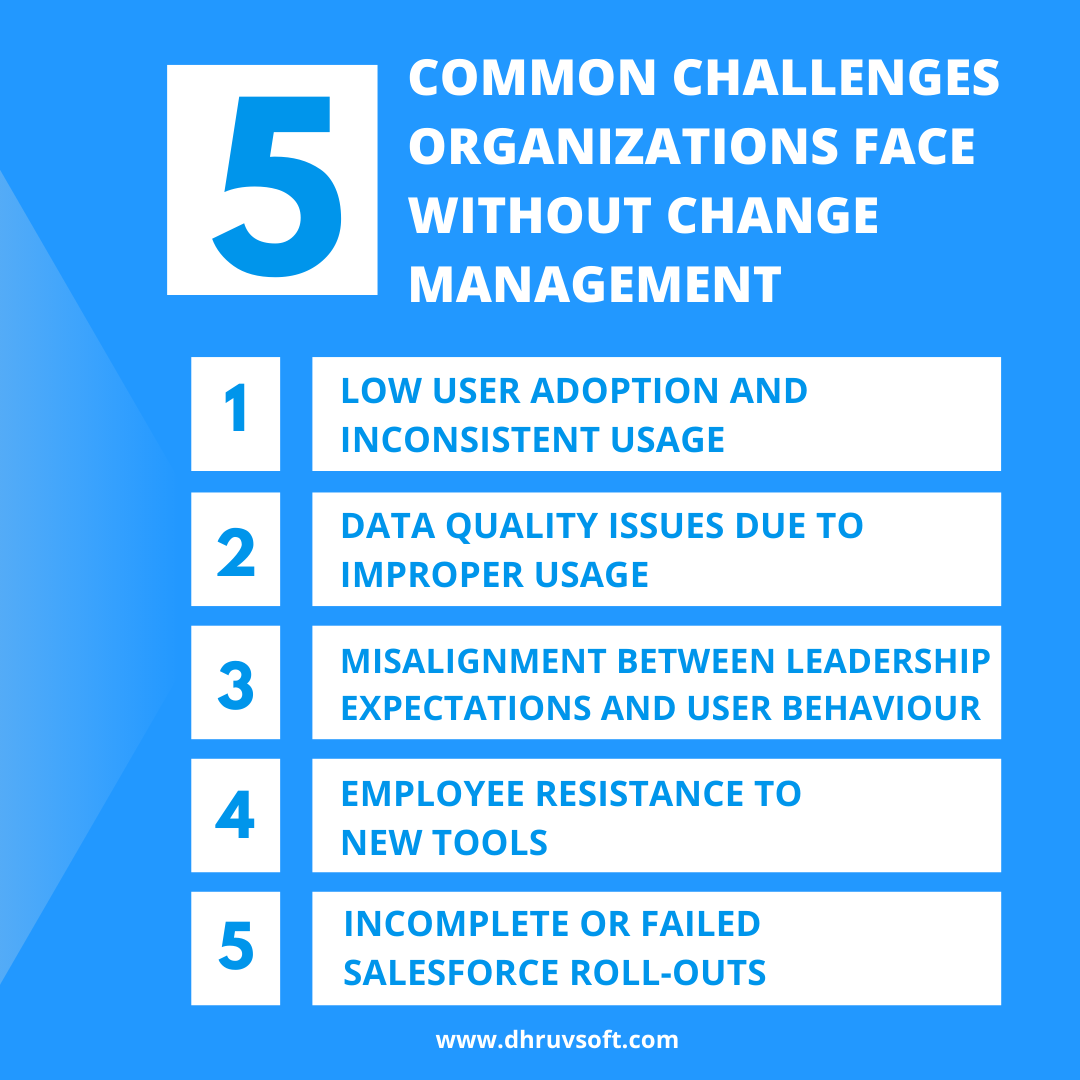
- Low user adoption and inconsistent usage: Users stick to old habits—spreadsheets, personal notes, disconnected tools—leaving Salesforce underutilised and data fragmented.
- Data quality issues due to improper usage: When users don’t understand field definitions, required inputs, or the importance of data hygiene, the system quickly fills with incomplete or inaccurate information, undermining reporting and decision-making.
- Misalignment between leadership expectations and user behaviour: Executives expect dashboards populated with real-time insights, but if frontline users aren’t consistently logging activities, those dashboards remain empty or misleading.
- Employee resistance to new tools: Without proper communication about benefits and adequate training, employees view Salesforce as extra work rather than a productivity enabler, leading to frustration and pushback.
- Incomplete or failed Salesforce roll-outs: Projects stall, timelines extend, and budgets balloon when user feedback reveals fundamental misalignments late in the process—or worse, after launch.
These challenges aren’t technical failures; they’re change management failures. The good news? They’re also preventable.
Key Components of an Effective Change Management Strategy
A successful change management strategy for Salesforce implementation addresses multiple dimensions simultaneously. Here are the essential components:
Stakeholder Analysis & Alignment
Not everyone experiences change the same way. Effective change management starts with understanding your stakeholder landscape.
- Identify champions, influencers, and potential resistors: Map out who will drive adoption (champions), who holds informal influence (influencers), and who might resist the change. Tailor your approach to each group.
- Leadership sponsorship and support Executive buy-in isn’t optional—it’s foundational. Leaders must visibly support the initiative, allocate resources, and hold their teams accountable for adoption. When leadership treats Salesforce as a priority, so does everyone else.
Communication Strategy
People fear what they don’t understand. A robust communication plan demystifies the change.
- Clear messaging about the “why” behind the CRM: Users need to understand how Salesforce makes their jobs easier, improves customer experiences, or contributes to company goals. Connect the change to personal and organizational benefits.
- Regular updates during Salesforce implementation: Keep stakeholders informed about project milestones, upcoming changes, and what’s expected of them. Transparency builds trust and reduces anxiety.
Training & Enablement
Training is where theory meets practice. Poorly trained users become frustrated users.
- Role-based Salesforce training: A sales representative needs different skills than a service agent or marketing coordinator. Customize training content to reflect actual job responsibilities and use cases.
- Hands-on workshops and learning paths: Passive presentations don’t stick. Interactive workshops, sandbox practice, and scenario-based exercises help users build confidence and muscle memory.
- Continuous post-go-live support: Learning doesn’t end at launch. Offer office hours, refresher sessions, quick reference guides, and a support channel where users can ask questions and get help.
Process Standardization
Salesforce works best when it reflects how your organization actually operates—or how it should operate.
- Mapping old vs new processes: Document current workflows, identify pain points, and design improved processes in Salesforce. Help users see the before-and-after to appreciate the improvements.
- Ensuring users understand Salesforce workflows and automations: If users don’t understand why certain fields auto-populate or how approval processes work, they’ll work around the system instead of with it. Make the logic transparent.
Feedback Loops
Change management isn’t a one-way broadcast—it’s a conversation.
- Collect user feedback regularly: Use surveys, focus groups, and direct conversations to understand what’s working and what isn’t. Early feedback prevents small issues from becoming major problems.
- Adjust configurations to enhance usability: Be willing to iterate. If users consistently struggle with a particular feature or workflow, refine it. Flexibility demonstrates that their input matters and improves overall adoption.
Best Practices for Successful Salesforce Change Management
Industry experience shows that some best practices greatly increase adoption and success.
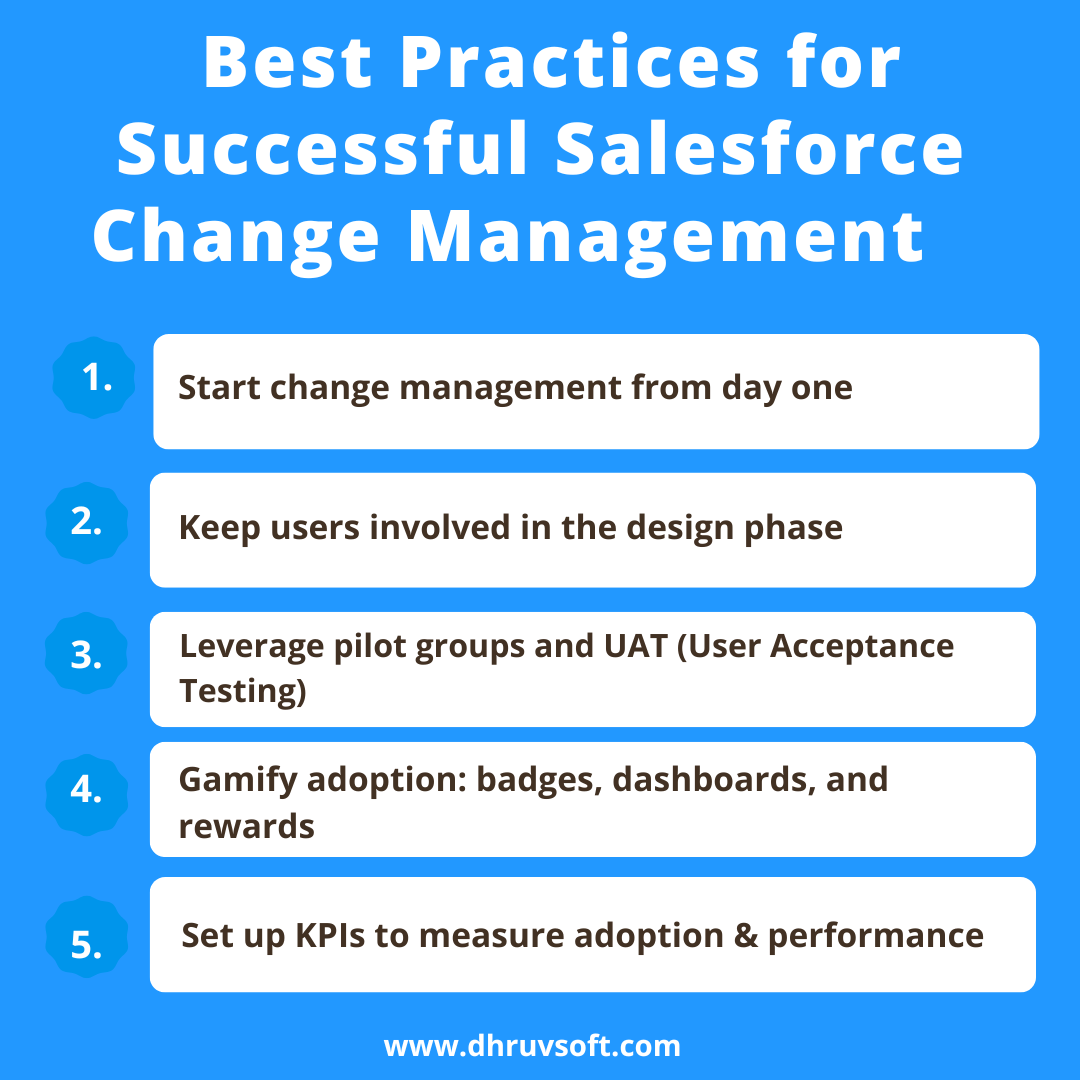
- Start change management from day one: Don’t wait until the system is built to think about adoption. Change management should run parallel to technical implementation, beginning with stakeholder analysis and communication planning.
- Keep users involved in the design phase: Invite representatives from key user groups to participate in requirements gathering, design workshops, and user acceptance testing. People support what they help create.
- Leverage pilot groups and UAT (User Acceptance Testing): Test Salesforce with a small, representative group before full rollout. Gather feedback, make adjustments, and use pilot participants as champions during broader deployment.
- Gamify adoption: badges, dashboards, and rewards: Make adoption engaging. Create leader-boards for data entry completion, recognize power users publicly, or offer incentives for achieving adoption milestones. A little friendly competition goes a long way.
- Set up KPIs to measure adoption & performance: Define clear metrics: login frequency, opportunity conversion rates, case resolution times, dashboard usage. What gets measured gets managed.
- Provide ongoing user support and retraining: Salesforce evolves—and so should your users’ skills. Schedule regular check-ins, advanced training sessions, and update communications when new features are released.
Dhruvsoft’s Approach to Change Management in Salesforce Implementations
Dhruvsoft integrates change management into every project phase.
- How Dhruvsoft embeds change management in every CRM project: From initial discovery through post-go-live support, our methodology integrates people readiness activities alongside technical milestones. We assess organizational change readiness early, identify risks, and build mitigation strategies into the project plan.
- Our methods: stakeholder workshops, tailored training, hyper-care support: We conduct interactive workshops to align stakeholders on vision and requirements. Our training programs are customized by role and learning style—combining instructor-led sessions, self-paced modules, and hands-on practice. Post-launch, our hyper-care teams provide intensive support during the critical first weeks.
- Tools & accelerators we use for better adoption: We leverage proven play-books, training templates, quick reference guides, and adoption dashboards that track usage patterns in real time. These accelerators shorten time-to-value and reduce adoption risk.
- Success stories from previous Salesforce clients: We’ve helped organizations across industries achieve adoption rates exceeding 90% within the first quarter post-launch. In one recent engagement, a manufacturing client saw sales productivity increase by 35% within six months—not because we built a better system, but because we ensured their people were ready to use it effectively.
Our approach is pragmatic, empathetic, and results-driven. We meet users where they are and guide them to where they need to be.
Measuring the Success of Change Management
How do you know if your change management efforts are working? Measurement turns intuition into insight.
- User adoption metrics (login rates, feature usage, data entry compliance): Track how frequently users log in, which features they’re leveraging, and whether required fields are being populated consistently. Low engagement in critical areas signals the need for additional support or training.
- Productivity improvements: Monitor KPIs like sales cycle length, lead response time, case resolution speed, or campaign execution efficiency. Effective Salesforce adoption should translate into measurable productivity gains.
- Customer experience enhancements: Are customers receiving faster responses? More personalized interactions? Better service? Customer satisfaction scores and Net Promoter Scores (NPS) often improve when CRM adoption is strong.
- ROI and business impact achieved through Salesforce: Ultimately, success is measured in business outcomes: increased revenue, reduced costs, improved win rates, higher retention. Connect CRM adoption metrics to bottom-line results to demonstrate value to leadership.
Regular measurement creates accountability, celebrates progress, and identifies areas for continuous improvement.
Conclusion
Salesforce is a transformative platform—but only when your people are ready to transform with it. Change management is the bridge between technical implementation and business value, turning a powerful tool into a competitive advantage.
Organizations that invest in change management experience higher adoption rates, better data quality, stronger ROI, and more satisfied users. Conversely, those that skip this critical step waste time, money, and opportunity on underutilised technology.
The equation is simple: strong user adoption equals long-term Salesforce ROI. Every dollar and hour invested in change management multiplies the returns on your CRM investment.
At Dhruvsoft, we’ve built our reputation on delivering Salesforce implementations that stick—not just technically sound solutions, but change-ready transformations that empower your teams and drive lasting results.
Ready to implement Salesforce with a high-adoption strategy? Dhruvsoft’s experts can guide you through a smooth, change-ready CRM transformation. Let’s build not just a system, but a culture of CRM excellence.Contact us today to get started.
 About Surender Patel


